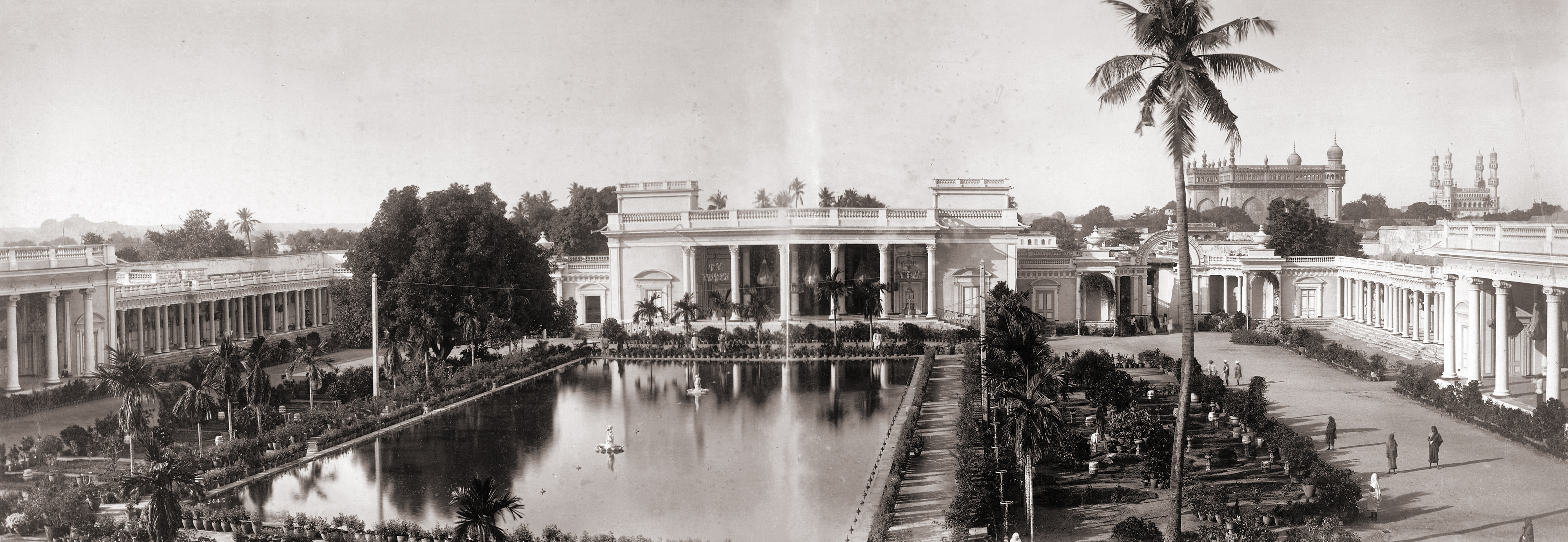
Chowmahalla Palace
The name tells you the ambition: Chowmahalla, from the Persian chow mahal -- four palaces. When the Nizams of Hyderabad wanted a seat of power, they did not build a palace. They built four of them, arranged symmetrically around a courtyard, and then kept building for over a century until the complex sprawled across 45 acres of central Hyderabad. From 1720 to 1948, the Asaf Jahi dynasty ruled one of the wealthiest princely states in India from these grounds, receiving dignitaries in a Darbar Hall lit by 19 Belgian crystal chandeliers, its walls echoing with decisions that shaped millions of lives. Today, only 12 acres remain, but what survives is enough to understand why William Dalrymple called it a lost world.
Built in Layers, Over Generations
Chowmahalla Palace was not built in a single campaign. Salabat Jung initiated construction in 1750 on the site of an earlier Qutb Shahi palace, and the complex was not completed until the reign of Afzal ad-Dawlah, Asaf Jah V, between 1857 and 1869 -- more than a century of intermittent building. The result is a palace that reads like a geological cross-section of architectural taste. The southern courtyard, the oldest section, holds the four original palaces: Afzal Mahal, Mahtab Mahal, Tahniyat Mahal, and Aftab Mahal, built opposite each other in Neoclassical style with a garden and pond between them. The grand Khilwat, or Darbar Hall, dominates the northern section -- the ceremonial heart of the complex, where the Nizams held official audiences. Walk from one end of the palace grounds to the other and you pass through decades of evolving style: Mughal formality giving way to European Neoclassicism, Persian garden design merging with Indian courtyard planning.
The Wealth of the Nizams
The Nizams of Hyderabad were, at their peak, among the wealthiest rulers on Earth. The palace reflects that wealth without restraint. The council hall housed rare manuscripts and priceless books. The Khilwat's 19 chandeliers, imported from Belgium, were spectacular enough to become the palace's signature detail -- massive assemblies of cut crystal that threw light across the Darbar Hall during state occasions. The palace collection also includes vintage automobiles, among them Rolls-Royces that the Nizams drove through Hyderabad's streets. The Sixth Nizam, Mir Mahbub Ali Khan, reportedly owned a wardrobe so vast that he never wore the same garment twice. His residence within the complex, the Roshan Bangla, was named for his mother Roshan Begum. Each detail -- the granite arches, the elaborate lime plaster work, the terracotta balusters -- speaks to a court that understood ostentation as a form of governance, projecting power through beauty.
Decline and the Long Silence
When India's princely states were absorbed into the new republic after 1948, the Nizams' reign ended and Chowmahalla began its slow fade. The palace fell into disuse. Without the daily maintenance that such a complex demands -- the garden watering, the roof repairs, the dusting of chandeliers -- decades of monsoon rains, tropical humidity, and simple neglect took their toll. Walls crumbled. Plasterwork peeled. Gardens became overgrown. Of the original 45 acres, development consumed the majority, leaving just 12 acres of the historic core intact. For years, the palace existed in a kind of suspended decay -- too significant to demolish, too expensive to restore, owned by a family whose princely privileges had been stripped away.
Restoration and a Second Life
In 2005, the former Nizam, Barkat Ali Khan Mukarram Jah, and his family opened the restored palace to the public. The initiative, led by Princess Esra Birgen, had taken more than five years of painstaking documentation and conservation work. The restoration unfolded in three stages: first, thorough mapping and conservation planning; second, emergency stabilization of structures in danger of collapse, including waterproofing and structural propping; and finally, the full physical restoration using traditional craftsmen and techniques wherever possible. Granite arches were repaired to their original design. Lime plaster was reapplied by hand. Terracotta balusters were recreated to match the surviving originals. The palace reopened as a museum, and in its galleries visitors can now see the collection that was nearly lost -- manuscripts, clothing, photographs, and the vintage cars that once rolled through Hyderabad's streets. Chowmahalla earned a UNESCO Asia-Pacific Award for Cultural Heritage Conservation, confirming what the restoration team already knew: that what they had saved was irreplaceable.
From the Air
Located at 17.358N, 78.472E in the heart of Hyderabad's Old City, Telangana, India. The palace complex is visible from the air as a cluster of Neoclassical and Indo-Islamic structures with courtyards and gardens, situated near the Charminar and Makkah Masjid. Best viewed at 2,000-4,000 feet AGL. The Charminar and Makkah Masjid are visible to the northeast. Nearest airport: Rajiv Gandhi International Airport (VOHS), approximately 22 km to the south. The Musi River runs east-west to the north, separating the Old City from newer Hyderabad.