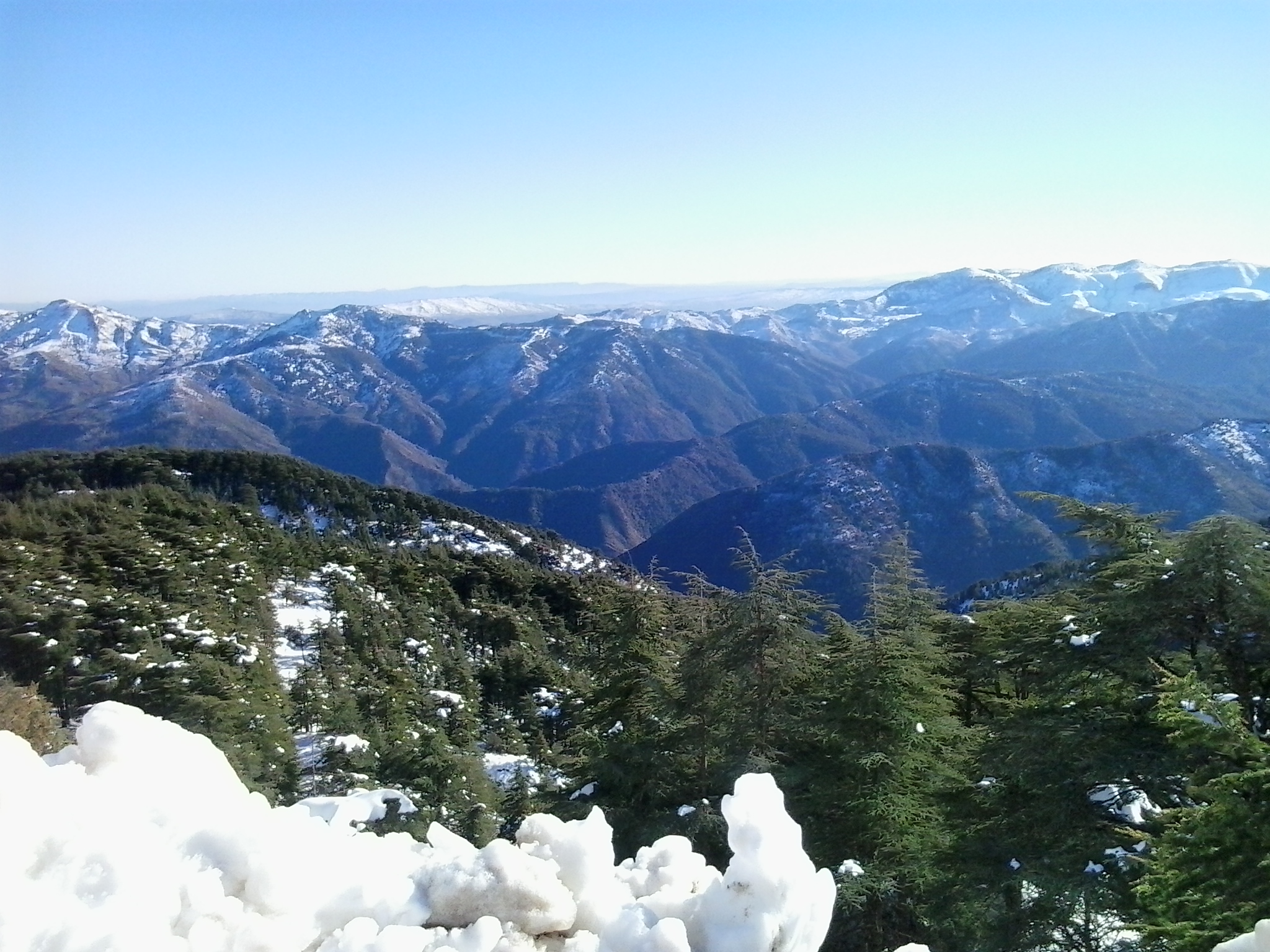
Chrea National Park
You can ski in Algeria. That fact surprises most people, but at the Chrea ski station in the Blidean Atlas mountains, snow falls on natural slopes every winter. Chrea National Park contains one of the few places on the African continent where skiing on natural snow is possible -- not on machine-made powder in a resort complex, but on actual winter precipitation in an actual mountain forest. The park sits in the Tell Atlas range, barely 50 kilometers south of Algiers, spanning 36,985 hectares of cedar forest, gorges, and limestone caves. It is home to over 1,240 plant and animal species, including a population of the endangered Barbary macaque.
The Mountain Above the City
The Blidean Atlas is the section of the Tell Atlas that rises directly behind the city of Blida, creating a dramatic mountain wall visible from much of the Mitidja plain. Chrea National Park occupies its upper reaches, where the terrain climbs steeply through mixed forest into cedar-dominated highlands. The proximity to Algiers -- Algeria's capital and largest city -- gives the park an unusual dual identity. It functions both as a nationally significant protected area and as the nearest mountain escape for millions of urban residents. Weekend hikers, winter skiers, and summer picnickers share the park with its wild inhabitants, though the macaques tend to claim priority on the trails.
The Macaques of the Cedars
The Barbary macaque is the only primate, aside from humans, native to North Africa. Once distributed across a vast range from Morocco to Libya, the species has contracted to scattered mountain populations, and Chrea is one of the few remaining habitat areas in Algeria that supports a viable group. The macaques live in the ancient Atlas cedar forests that form the park's ecological core. These forests of Cedrus atlantica, with their dense canopies and cooler microclimate, provide the food and shelter the macaques need. Sharing this habitat are wild boar, striped hyenas, red foxes, golden jackals, North African hedgehogs, common genets, Egyptian mongooses, European badgers, least weasels, African wildcats, and crested porcupines -- a census that reads like a guidebook to Mediterranean-North African biodiversity.
Caves and Gorges
Beyond the forest and ski station, Chrea contains the Grotto of Chiffa, a cave system set within the deep gorge of the Chiffa River. The gorge cuts through the limestone bedrock of the Tell Atlas, creating sheer walls and narrow passages that contrast sharply with the forested mountain slopes above. The geological drama of the park -- from karst caves to exposed rock faces to the smooth slopes of the ski station -- reflects the tectonic complexity of the Tell Atlas, a range built by the collision of the African and European plates. Founded as a national park in 1997, Chrea also holds UNESCO Biosphere Reserve status, recognizing its importance not just to Algeria but to the broader Mediterranean ecological network.
Africa's Unlikely Winter Sport
The Chrea ski station occupies the upper slopes where winter temperatures drop below freezing and snowfall accumulates enough for downhill runs. It is a modest operation compared to Alpine resorts -- no high-speed chairlifts, no apres-ski champagne bars -- but its existence is remarkable in its own right. Africa has ski resorts in Morocco's Atlas Mountains and South Africa's Drakensberg, but natural-snow skiing on the continent remains rare enough to qualify as exotic. At Chrea, the juxtaposition is everything: stand on the slopes and look north, and on a clear day you can see the Mediterranean coast. Behind you, the cedars and the macaques. Beneath your feet, African snow.
From the Air
Located at 36.40N, 2.87E in the Blidean Atlas mountains, approximately 50 km south of Algiers, within Blida Province. The park occupies the forested mountain slopes visible from the Mitidja plain. Best viewed at 4,000-6,000 feet AGL. Nearest airports: DAAG (Houari Boumediene Airport, Algiers) approximately 50 km north; DAAB (Blida) approximately 15 km north. The ski station and cedar forests are identifiable on the upper ridgeline.