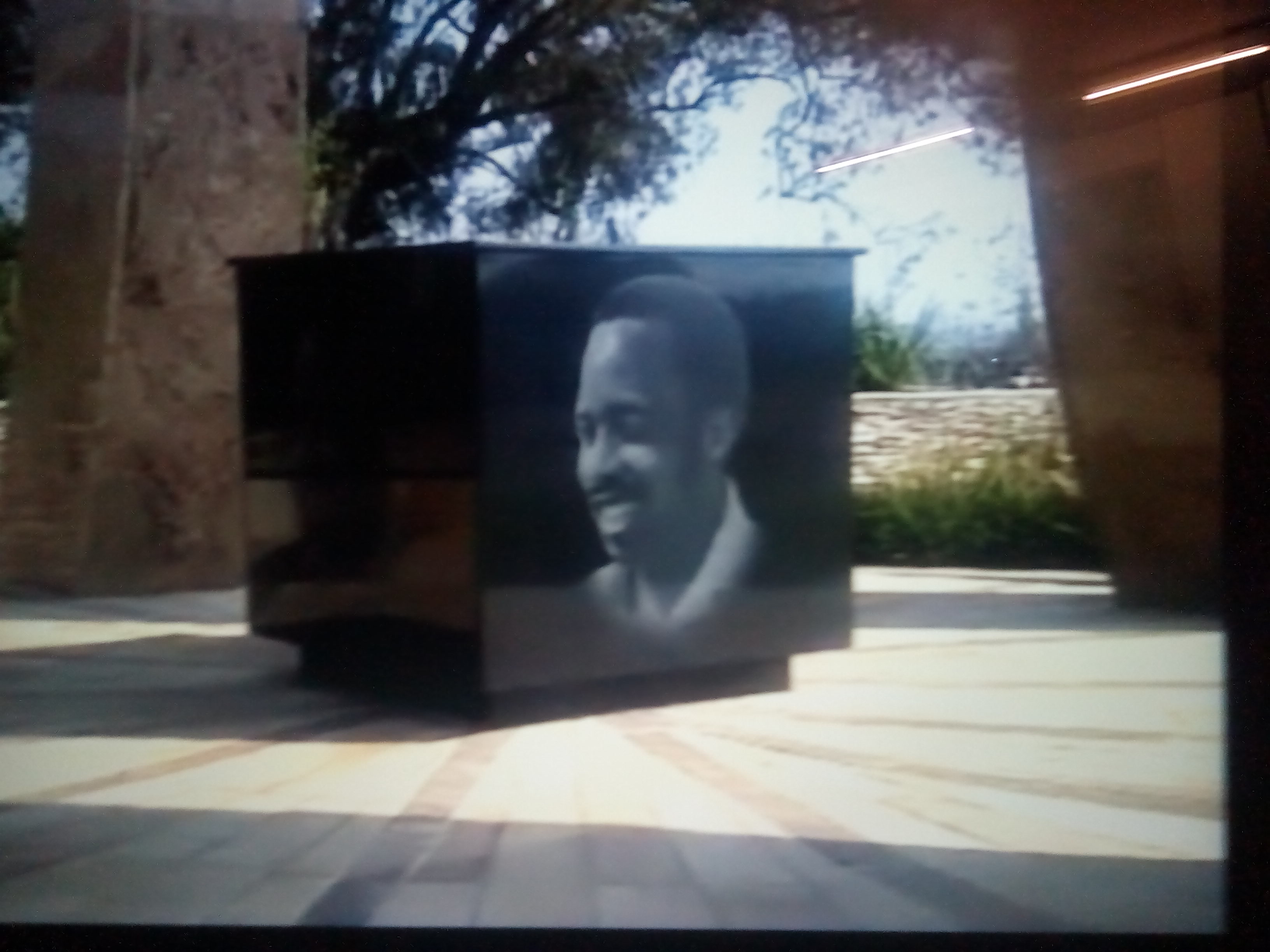
Chris Hani Memorial
On the morning of April 10, 1993, Janusz Walus pulled a pistol from his waistband and shot Chris Hani in the driveway of his Dawn Park home, just a few kilometres from here. Hani was 50 years old, the general secretary of the South African Communist Party, and one of the most popular leaders in the anti-apartheid movement. His assassination nearly derailed the negotiations that would lead to South Africa's first democratic elections. Instead, it accelerated them. Nelson Mandela went on national television that night to calm a country teetering on the edge, and within weeks both sides agreed to set a date for the vote: April 27, 1994. The memorial that now stands at the Thomas Nkobi Memorial Garden in Boksburg does not merely remember Hani. It attempts to translate his life into stone and steel.
The Gladiator from Cofimvaba
Martin Thembisile Hani was born on June 28, 1942, in the village of Sabalele near Cofimvaba in the Transkei, the fifth of six children. Three of his siblings died in infancy. He adopted the name Chris as a nom de guerre -- it was actually his brother's name. Hani joined the South African Communist Party at 15 and rose through the ranks of Umkhonto we Sizwe, the armed wing of the ANC. He was charismatic in a way that South African politics rarely produced: a firebrand who quoted Marx but also wrote poetry, a guerrilla commander who could speak to workers in the townships as easily as to intellectuals in exile. By the early 1990s, polls showed him as the most popular leader in the country after Mandela himself. His murder, carried out on the instructions of right-wing Conservative Party member Clive Derby-Lewis, triggered an estimated six million workers to strike in his memory.
Geometry of Remembrance
The memorial takes the form of a circle -- unity, equality, inclusion -- with five concentric rings representing the five decades of Hani's life. Nothing about the design is arbitrary. The entire structure sits at an angle of 32 degrees to Hani's existing grave, one degree for each of the 32 years he was a member of the SACP. From a shaded granite bench, that angle creates a clear sightline to the gravesite. A granite cube at the top of the podium bears Hani's sand-blasted profile on each side. Five concrete columns support a cantilevered roof, each column standing for a quality the designers saw in him: selflessness, vision, wisdom, dedication, compassion. Strong lines radiate outward from the podium's centre, tracing the ripple effect of a life that touched millions. The materials are deliberately modest -- granite, concrete, sandstone -- reflecting the SACP slogan that guided Hani's career: "for the workers and the poor."
Swords Disguised as Flowers
Four granite pillars around the memorial are shaped to echo the wild gladiolus, a flower endemic to the Transkei where Hani was born. The connection is more than botanical. Gladiolus takes its name from the Latin for "little sword," and the plant's long, narrow leaves do resemble blades. The designers called this a true reflection of Hani: the gladiator with the heart of a poet. Indigenous trees line the Walk of Remembrance, a curving path that connects the Hani memorial to the Wall of Remembrance on the opposite side of the garden. The walk is meant as a contemplative meander through the Highveld landscape, shaded by a canopy with benches set at intervals for reflection. Lighting along the path symbolizes the hope that burned in the hearts of the struggle's heroes -- a flame, the designers wrote, that could not be extinguished.
Glass Walls and Fallen Names
The Wall of Remembrance, directly opposite the Hani memorial, honours the broader community of South Africa's liberation martyrs. An elevated concrete podium anchored by solid granite holds three glass boxes -- democracy, transparency, inclusivity made visible. The names of fallen heroes are sand-blasted into the glass walls, and visitors walk around the boxes, reading them one by one. President Jacob Zuma unveiled the memorial on April 10, 2015, the 22nd anniversary of Hani's death. In the same ceremony, the gravesite was declared a national heritage site by the South African Heritage Resources Agency. Today the entire complex -- the memorial, the walk, the wall -- functions as a single interconnected tribute. Local students from Zimisele Secondary School have documented the site, ensuring the story reaches a generation born after the struggle ended.
From the Air
Located at 26.28S, 28.22E in Boksburg, within the Ekurhuleni Metropolitan Municipality east of Johannesburg. From altitude, the Thomas Nkobi Memorial Garden is in a residential area south of the R21 highway. The circular memorial structure and Walk of Remembrance are visible among the garden's tree canopy. Nearest major airport is OR Tambo International (FAOR), approximately 10 km to the northeast. Rand Airport (FAGM) is also nearby to the west. The Highveld terrain is flat at approximately 1,640 metres elevation.