Chris Jorgensen
A fourteen-year-old boy is sketching near a house in San Francisco. It is early 1874, and the boy - Christian August Jorgensen, four years removed from Norway, four years since his mother brought him and his siblings across the Atlantic to reunite with an uncle - is drawing with an intensity that catches the attention of Virgil Williams, who happens to live nearby. Williams is not just any neighbor. He is the founding director of the San Francisco School of Design, which is about to open its doors in February. He watches the boy work, walks over, and invites him to become the school's first free student. It is the kind of origin story that sounds invented, but Chris Jorgensen's entire life would follow this pattern: talent placed in the path of opportunity, again and again, until a Norwegian immigrant orphan became one of California's most prolific landscape painters and built the first museum in Yosemite Valley.
From Oslo to the Sierra
Jorgensen was born in Oslo on October 7, 1860. His father, Ole, died of tuberculosis in 1864, leaving Sophie Jorgensen to raise five children alone. The family immigrated to San Francisco in 1870, where Chris's talent emerged quickly and forcefully. Under Williams's mentorship at the School of Design, Jorgensen absorbed French and Italian painting techniques secondhand - Williams had studied abroad and emphasized regular exhibition, classical composition, and disciplined observation. A second mentor proved equally formative. Thomas Hill, one of the most commercially successful California landscape painters of the late nineteenth century, taught Jorgensen to intensify color through heavy glazing and to embrace a more impressionistic looseness. From Williams, Jorgensen learned structure. From Hill, he learned drama. The combination would define his mature work: carefully composed foregrounds dissolving into atmospheric washes at the horizon, a style that worked beautifully in the medium that became his signature.
The Watercolorist in the Valley
Jorgensen was unusual among his contemporaries for his commitment to watercolor. In the late nineteenth century, watercolor was widely considered inferior to oil painting - a medium for sketches and studies, not finished work. Jorgensen reversed that hierarchy in his own practice. His watercolors possessed a luminous transparency that his oils, by his own and critics' admission, could not match. The careful delineation he learned from Williams shone in the foreground of his watercolors, while the distant peaks and valleys dissolved into the kind of foggy washes that only a transparent medium could produce. Oil made the same technique look primitive. Watercolor also suited his habit of painting en plein air - outdoors, in the landscape itself, working fast before the light changed. He painted Yosemite's icons obsessively: Half Dome, Yosemite Falls, Mariposa Grove, the Minarets. He also spent years documenting California's twenty-one Spanish missions in watercolor, a body of work that now resides in collections across the state.
Chocolate Money and a Studio on the Merced
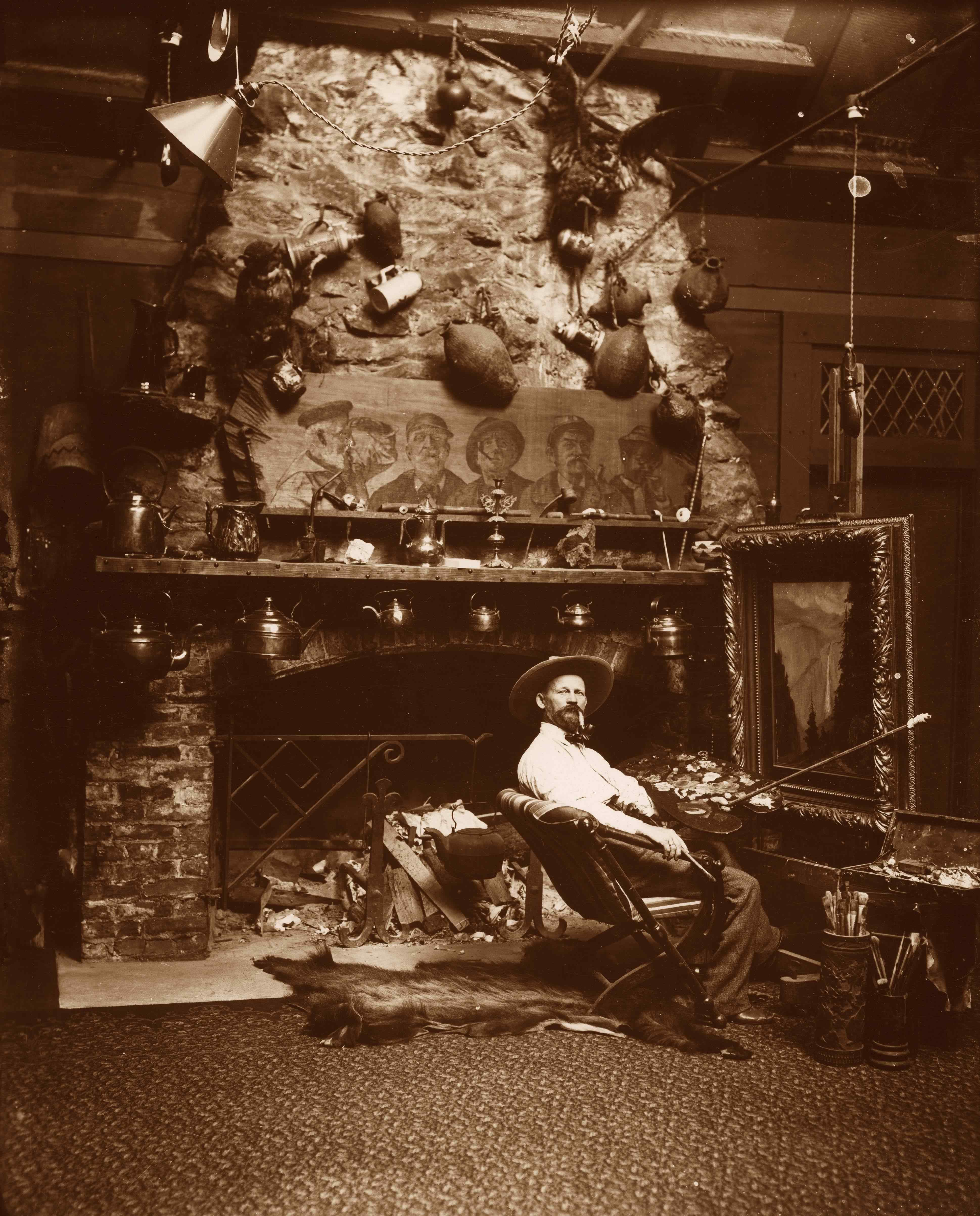
In 1888, Jorgensen married Angela Ghirardelli, a fellow student at the School of Design and the daughter of Domingo Ghirardelli, founder of the famous San Francisco chocolate company. The marriage connected a struggling artist to one of the city's wealthiest families. The couple studied painting in Italy for two years in the early 1890s, then returned to California. After visiting Yosemite for the first time in 1898, Jorgensen was granted permission to build a home and studio on the banks of the Merced River near what is today Sentinel Bridge. He constructed the house for five thousand dollars and lived there during summers and some winters from 1900 to 1917. The San Francisco Chronicle, visiting in February 1901, described the living room as one of the "most unique and artistic studios on the coast," filled with animal skins, Native American baskets, beer steins, and water buffalo horns. It was part gallery, part curiosity cabinet, part declaration that an artist could live in the wilderness on his own terms.
The First Museum and a Quiet Departure
When the Jorgensens left Yosemite in 1917 to live permanently in Piedmont, California - closer to the Ghirardelli family - the studio remained. In 1922 it was repurposed as the first museum in Yosemite Valley, a modest but significant step in the park's cultural life. The one-room log building was eventually moved to the Pioneer Yosemite History Center in Wawona, where it stands today, a cabin among cabins. Jorgensen died on June 24, 1935, of a heart attack. Angela survived him by only a few months. She donated many of his works to museums after his death, ensuring that the watercolors he had spent a lifetime making would outlast them both. Jorgensen never achieved the national fame of Albert Bierstadt or Thomas Moran, but his paintings captured something those artists' grand canvases sometimes missed: the intimacy of Yosemite. Not the thundering sublime, but the quiet meadow at dawn, the single sequoia trunk, the mist drifting through the pines. He painted the valley as someone who lived there, not someone passing through.
From the Air
Located at 37.7486°N, 119.588°W in Yosemite Valley, near the site of his former studio by the Merced River close to Sentinel Bridge. The Jorgensen Studio was relocated to the Pioneer Yosemite History Center in Wawona, approximately 25 miles south of Yosemite Valley. Nearest airports: Fresno Yosemite International (FAT), 65 miles south; Mariposa-Yosemite Airport (MPI), approximately 30 miles west. Best viewed at 3,000-5,000 ft AGL. The Merced River is clearly visible from the air, with Sentinel Bridge and the meadows where Jorgensen painted visible on the valley floor.