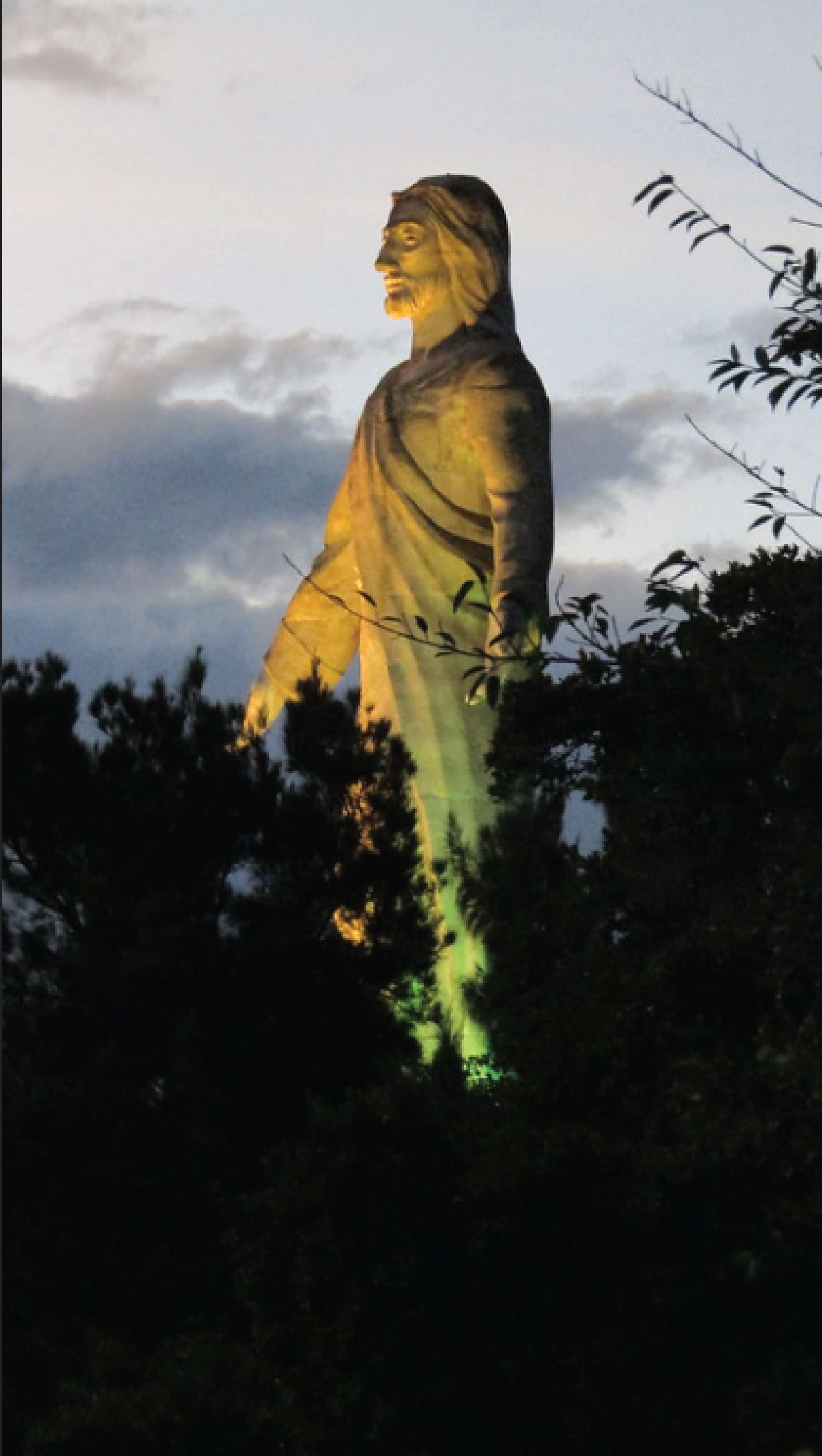
Christ at El Picacho
From most neighborhoods in Tegucigalpa, you cannot avoid it. The figure stands 98 feet tall on the western shoulder of Cerro El Picacho, arms raised in a gesture of resurrection, visible to roughly sixty percent of the capital's population. At night, when floodlights catch the pale concrete against the darkened hillside, it becomes the city's most recognizable landmark. Honduras has its own Christ statue, and while it lacks the global fame of Rio de Janeiro's Christ the Redeemer, the story of how it got there, told through committee meetings, rejected hilltops, and five million lempiras raised in a national campaign, is distinctly Honduran.
A Jubilee and a Vision
The idea began in 1997, as Honduras prepared for the celebration of the year 2000 Jubilee. Archbishop Oscar Andres Rodriguez, later a cardinal, expressed his desire to build a monument to Christ that would watch over the capital. A commission formed, headed by Armida de Lopez Contreras and composed of prominent members of Honduran society. The question was not whether to build the statue, but where. The obvious choice was the summit of Cerro El Picacho, the most prominent hill in the capital, the natural landmark from which the entire city spreads below. But the peak was occupied by a critical water distribution facility, and the commission had to look elsewhere. They briefly considered El Berrinche, a hill that closes the southern edge of the city, but its projection would have limited visibility to just the historic downtown. The committee returned to El Picacho, settling on a spot about 30 meters below and 300 meters away from the summit, in the Park of the United Nations. The chosen site had been occupied by an old sundial built in the 1940s that recalled an ancient Mayan symbol.
Five Million Lempiras
Building a colossal statue on a mountainside required serious funding, and the Honduran people responded with enthusiasm. Government agencies, private companies, and individual citizens contributed to a campaign that raised approximately five million lempiras in a remarkably short time. The commission hired Mario Zamora Alcantara, a Honduran sculptor who had been living and working in Mexico for years. They asked him for three sketches, which were presented to Archbishop Rodriguez. The chosen design depicted the Resurrected Jesus, arms lifted upward, a choice that distinguished it from the many images of Christ with outstretched arms seen elsewhere in Latin America. Zamora created a giant fiberglass mold in Mexico City, which was transported to Honduras and used to cast the reinforced concrete figure on a ten-meter pedestal at the El Picacho site.
Forty Workers, Seven Months
Construction took seven months and a crew of forty people. The structural engineering was led by the firm CONSULCRETO under Engineer Jose Francisco Paredes, with the surrounding park designed by architect Luciano Duron. The finished sculpture weighs 2,500 tons and rises 98 feet in total: a 65-foot figure atop a 33-foot pedestal. It was inaugurated on January 16, 1997. But the monument was never meant to stand alone. Over the following decade, the site grew into a pilgrimage and public gathering space, developed in phases. Terraces and gardens came first in 1997, followed by walls and towers on the north side between 1998 and 2005. A ceremonial plaza with handicapped access, commercial shops, and landscaped paths arrived between 2008 and 2009. By 2010, an amphitheater on the northern slope completed the complex.
Tegucigalpa's Sentinel
Cerro El Picacho rises to 4,353 feet above sea level in the northern part of Tegucigalpa, and the Christ statue occupies one of the hill's most prominent western ridges. The effect is deliberate: the figure faces the city, and the city faces it back. For residents of the capital, the statue is a daily presence, a fixed point in a landscape of steep hills and crowded neighborhoods. For visitors approaching Tegucigalpa by air or road, it serves as a wayfinding landmark, the white figure emerging from green hillside long before the city's other features come into focus. The park surrounding the monument has become one of the capital's few elevated public spaces, offering panoramic views across the valley. Like the great Christ statues of Latin America, the figure at El Picacho is both religious monument and civic symbol, a place where faith, national pride, and the simple desire for a good view converge on a Honduran hilltop.
From the Air
Located at 14.12N, 87.20W on Cerro El Picacho in northern Tegucigalpa, at an elevation of 4,353 feet ASL. The white 98-foot statue is visible from the air on the western shoulder of the hill, particularly striking against the green hillside. Tegucigalpa's Toncontin International Airport (ICAO: MHTG) lies approximately 5 miles to the south, with its famously challenging approach through a mountain valley. Best viewed from 2,000-4,000 feet AGL on a clear day. The statue faces west-southwest over the city, so approaches from the west or southwest offer the best perspective.