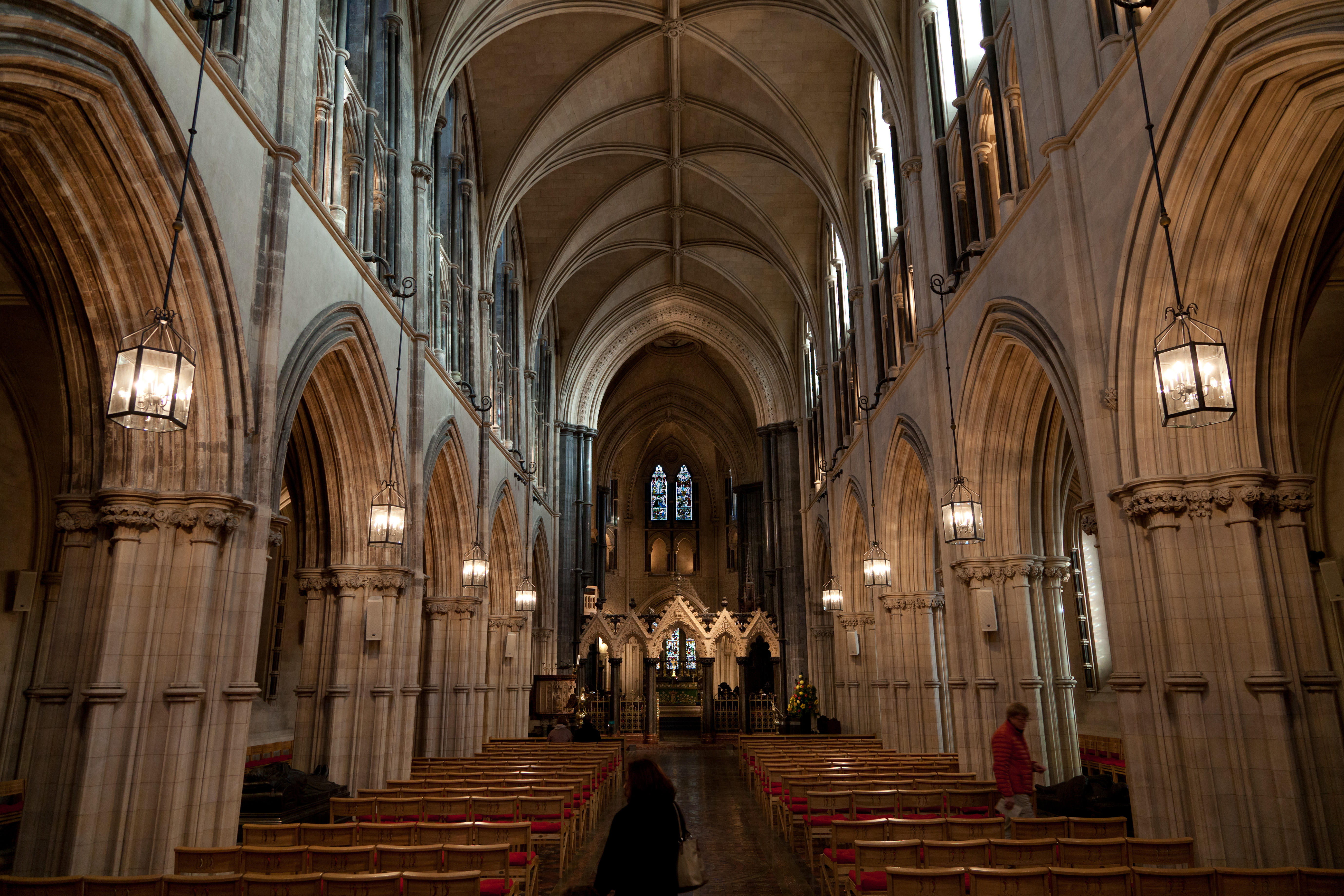
Christ Church Cathedral, Dublin
A Viking king built a wooden church here in 1030, on a ridge above the River Liffey where Dublin's Norse settlers had already worshipped for generations. Sitric Silkenbeard, ruler of the Hiberno-Norse kingdom of Dublin, founded what would become Christ Church Cathedral -- a building whose walls have absorbed nearly a thousand years of conquest, reformation, collapse, and resurrection. Today it stands as Dublin's oldest medieval structure, its stones layered with the fingerprints of every power that has shaped the city.
From Longships to Limestone
The original wooden church served Dublin's Viking community for over a century before the arrival of the Normans changed everything. In the late 12th century, the Anglo-Norman lord Richard de Clare -- better known as Strongbow -- rebuilt the cathedral in stone after his invasion of Ireland. Somerset craftsmen shipped stone across the Irish Sea, and the building that rose on the Viking ridge announced a new order in unmistakable terms: this was no longer a Norse trading town but a seat of Norman power. Strongbow's tomb, or what tradition claims is his tomb, still occupies a place of honor in the nave. The effigy beside it, a smaller half-figure, has been the subject of centuries of speculation -- some say it represents his son, whom legend holds Strongbow cut in two for cowardice in battle.
The Weight of Centuries
By the early 13th century, the cathedral had expanded considerably, incorporating a choir, transepts, and a substantial crypt -- one of the oldest and largest medieval crypts in Ireland or Britain. But stone buildings demand constant maintenance, and Christ Church received too little. In 1562, the south wall of the nave collapsed outward, bringing the stone-vaulted roof crashing down. For three centuries the cathedral stood wounded, its north wall leaning visibly, propped up by buttresses that were themselves improvised repairs. The building that survived was a patchwork of Norman ambition and structural compromise, beautiful in its bones but increasingly precarious.
Whiskey Money and Victorian Revival
Salvation arrived in the form of Henry Roe, a Dublin whiskey distiller whose fortune funded a massive restoration between 1871 and 1878. The architect George Edmund Street stripped away centuries of makeshift repairs and rebuilt much of the cathedral in a Victorian Gothic style, adding the distinctive covered bridge that connects it to the former Synod Hall across the street. Street's work was thorough, perhaps too thorough for modern tastes -- he removed as much medieval fabric as he preserved. Yet the result is the cathedral Dublin knows today: its flying buttresses, its tower, and its crisply carved exterior are largely Street's vision rendered in Irish limestone. The restoration cost Roe the equivalent of millions, and he received no honor for it during his lifetime.
Treasures Below Ground
The medieval crypt stretches the full length of the cathedral, a rare survival that predates much of the building above it. Down here the air changes. Thick Romanesque pillars hold up low vaulted ceilings, and the space houses an unlikely collection of artifacts: a mummified cat and rat, found trapped together in an organ pipe in the 1860s and immortalized by James Joyce in Finnegans Wake as 'the cat and the rat.' The crypt also holds medieval floor tiles, carved stonework salvaged from earlier versions of the building, and a set of wooden stocks used for public punishment. Among its more solemn treasures is the tabernacle and candlesticks donated by King William III after the Battle of the Boyne in 1690 -- a reminder that even a house of worship carries the marks of Ireland's political divisions.
A Cathedral Between Two Traditions
Christ Church occupies a peculiar position in Dublin's religious landscape. Though it is the cathedral of the Church of Ireland -- the Anglican communion -- it was originally Catholic, and its transition during the Reformation was neither sudden nor clean. For centuries, two archbishops claimed Dublin: one Catholic, one Protestant. The cathedral's congregation has always been a minority in a predominantly Catholic city, lending it an atmosphere that is less triumphalist than contemplative. Today, the cathedral serves as both a working place of worship and one of Dublin's most visited heritage sites. Its choir, one of the oldest in the country, still sings daily services in a nave where Vikings once prayed to a new god and Normans asserted an old authority.
From the Air
Christ Church Cathedral sits on a prominent ridge in Dublin's medieval quarter at 53.3433N, 6.2714W, near the River Liffey. From altitude, look for the distinctive covered bridge connecting the cathedral to the Synod Hall. Nearest airports: Dublin Airport (EIDW) 10km north, Casement Aerodrome (EIME) 10km southwest. The cathedral is close to other landmarks including Dublin Castle and the former Wood Quay Viking settlement site.