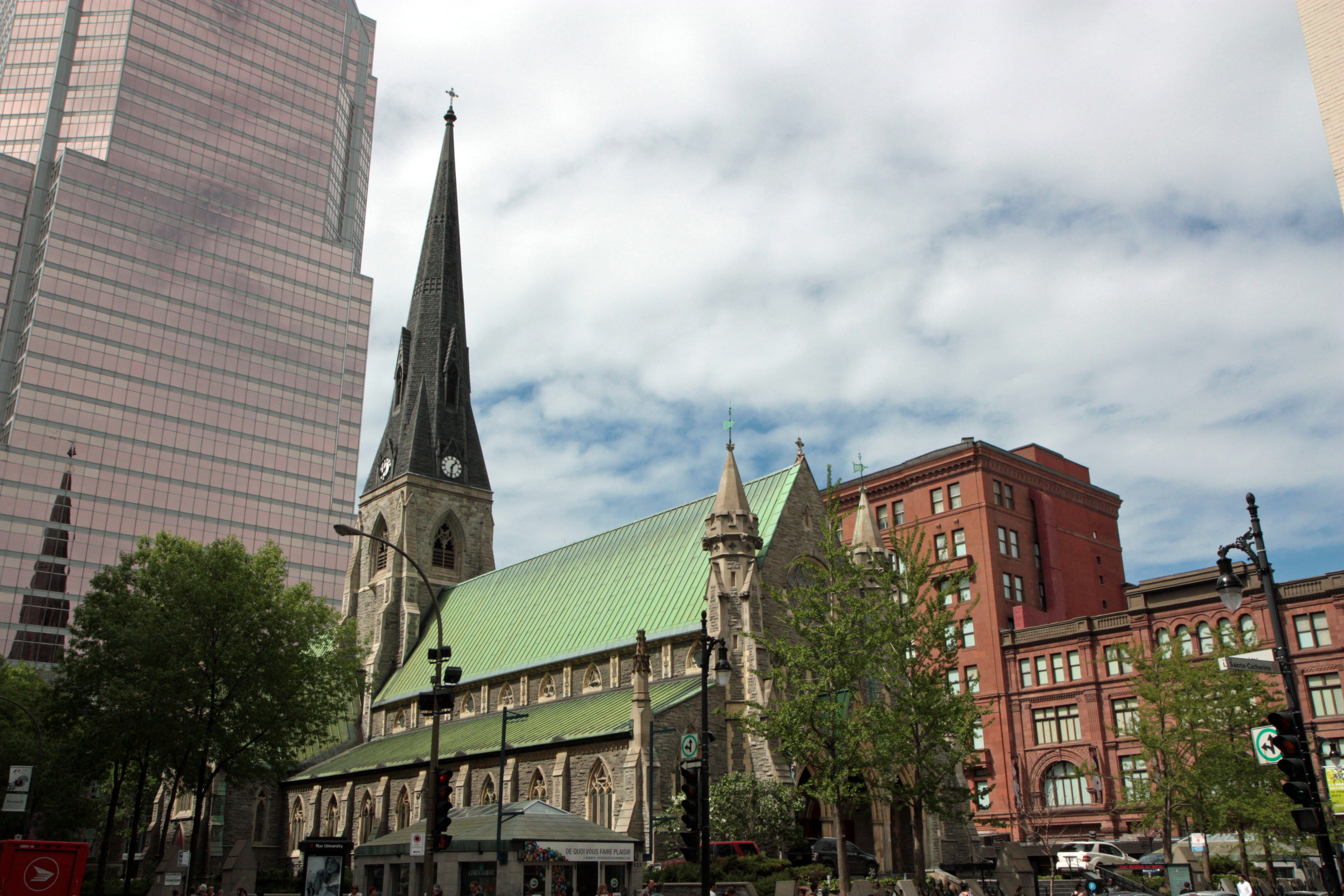
Christ Church Cathedral: The Church That Floats on Stilts
In 1987, an entire cathedral was lifted onto stilts. Not a modest chapel or a country church, but Christ Church Cathedral - the seat of the Anglican Diocese of Montreal, a neo-Gothic landmark on the busiest commercial street in Quebec. Engineers needed to excavate two levels of retail space directly beneath the building. So for a period that year, this 128-year-old stone church hung suspended above empty air while workers dug out the earth that had supported it since 1859. Below where worshippers had knelt for over a century, shoppers would soon browse the Promenades Cathedrale underground mall. It was perhaps the most Montreal thing imaginable: audacious engineering in service of commerce, with sacred architecture balanced on top.
Three Churches and Two Fires
Anglican worship in Montreal began in 1760, after the British conquest. For the first decades, services were held in borrowed Roman Catholic chapels - an ecumenical arrangement born of necessity rather than theology. In 1789, the congregation received a former Jesuit church, which they renamed Christ Church. That building lasted until 1803, when fire destroyed it. A second church was constructed in 1814 and elevated to cathedral status in 1850, when the Anglican Diocese of Montreal separated from the Diocese of Quebec. Four years after that distinction, fire claimed it too - the 1856 blaze left the young diocese without its seat. The present cathedral, the third to bear the name, was designed by architect Frank Wills, who also designed Christ Church Cathedral in Fredericton, New Brunswick. Wills died before construction began, and Montreal architect Thomas Seaton Scott carried out the design. The structure was completed in 1859 and consecrated in 1867 - the same year Canada became a nation.
The Tower That Would Not Stand Straight
Wills's design was modeled after 14th-century Gothic churches of the English countryside, and it won architectural praise. But it harbored a serious engineering flaw. The soft ground beneath the cathedral could not support the weight of its central stone tower and steeple, which began to subside and lean. The resulting lawsuit over builder's liability traveled all the way to the Judicial Committee of the Privy Council - then the highest court in the British Empire - which upheld the Quebec courts' finding that the builder was liable for constructing on ground that could not bear the load. The case, Wardle v. Bethune, became a landmark precedent in Quebec civil law. By 1920, the tower leaned visibly to the south. George Allan Ross designed alterations in 1923, and the heavy stone steeple was removed in 1927. New foundations were poured in 1939, and in 1940, an anonymous donation funded a replacement spire made of aluminum, carefully molded to simulate the appearance of the original stone. The lightweight aluminum steeple solved the engineering problem while preserving the cathedral's Gothic silhouette against the Montreal skyline.
Sacred Ground, Commercial Basement
The most dramatic chapter in the cathedral's life came in the 1980s, when a vast real estate project transformed what lay beneath it. The development included Tour KPMG, a 34-story skyscraper built just north of the cathedral, underground parking, and two levels of retail shops excavated directly below the church itself. The engineering feat of supporting the cathedral on stilts during excavation became a story in itself - a Gothic Revival church hovering above a construction pit in the heart of downtown Montreal. The completed Promenades Cathedrale linked the eastern and western branches of Montreal's famous underground city, connecting what was then the Eaton's department store with The Bay's Henry Morgan Building. The cathedral found itself in a unique position: a designated National Historic Site of Canada (since 1999) and a Quebec historical monument (since 1988) perched atop a shopping mall, anchoring a network of tunnels, transit stations, and commercial spaces that defines modern Montreal.
Guards, Music, and Living Tradition
Christ Church Cathedral is the regimental church of the Canadian Grenadier Guards. Each year on Remembrance Day, the Guards march from the Arts Building at McGill University to the cathedral, maintaining a military tradition that links the campus, the regiment, and the church. The cathedral also houses the Guards' retired regimental colours. Every Saturday at 2 PM, the cathedral opens its doors for L'Oasis musicale, a free concert series that supports young musicians studying at Montreal's music colleges. The performances range from solo instrumentalists and singers to small orchestras and choirs, with repertoire spanning classical, folk, and popular music. In a city famous for its festival culture, these weekly concerts offer something quieter and more intimate - music resonating through a space that has heard prayers in English and French for over two and a half centuries.
Stone, Aluminum, and Survival
Christ Church Cathedral sits at 635 Sainte-Catherine Street West, between Avenue Union and Boulevard Robert-Bourassa, in the commercial heart of Montreal. Its Gothic lines look anachronistic among the glass towers of downtown, and that is precisely the point. This is a building that has outlasted two predecessor churches destroyed by fire, survived its own structural failure, endured the indignity of being lifted into the air while commerce was tunneled beneath it, and traded its stone crown for aluminum without losing its dignity. From the air, the cathedral reads as a small green-roofed form amid the grid of downtown Montreal - easy to miss among the skyscrapers, yet impossible to replace. It is a reminder that cities are built in layers, and that sometimes the oldest layer is the one that holds everything together.
From the Air
Located at 45.504N, 73.570W on Sainte-Catherine Street West in downtown Montreal. The cathedral is a small Gothic form with a green copper roof and aluminum spire, situated among downtown skyscrapers just south of Tour KPMG. The nearest major airport is Montreal-Trudeau International (CYUL), approximately 20 km west. Montreal-Saint-Hubert (CYHU) lies to the southeast across the St. Lawrence. The cathedral is roughly 1.5 km south of Mount Royal's summit and 1 km north of the Old Port waterfront. Best viewed at lower altitudes in clear conditions; the spire is a modest landmark compared to surrounding towers.