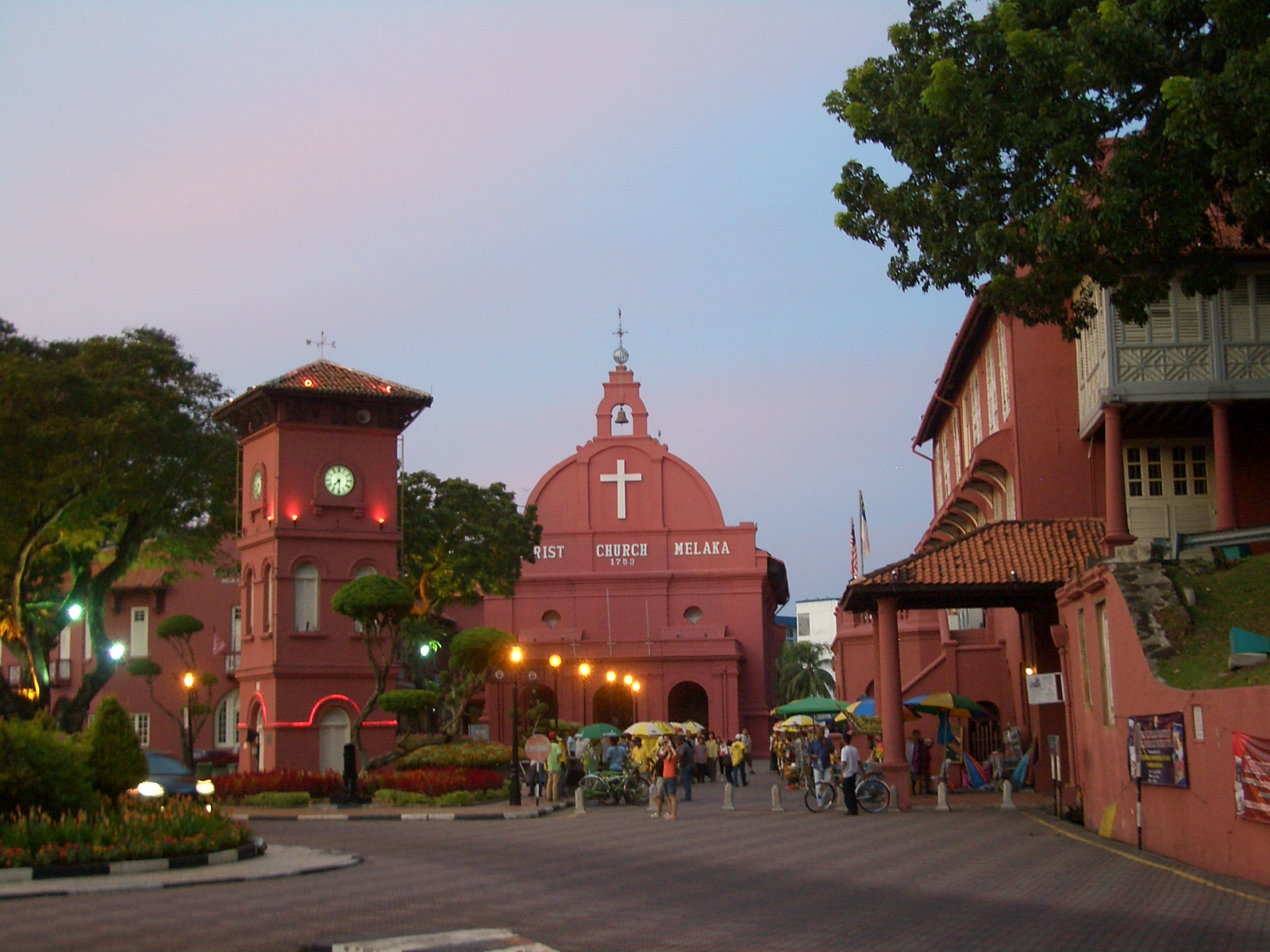
Christ Church, Malacca
The church is red. Not a faded, apologetic red, but a vivid terracotta that catches every ray of the equatorial sun and throws it back. Christ Church, Malacca, has been this color since 1911, though no one is entirely sure why the colonial authorities decided to repaint what had been a perfectly respectable white building. The decision stuck, and today the red church anchoring Dutch Square is the most photographed building in a city that has no shortage of colonial architecture. Look past the tourist selfies, though, and the building tells a more layered story -- one written in Dutch bricks, Chinese plaster, granite ballast, and an Armenian tombstone that reads like poetry.
A Centenary in Stone
The Dutch took Malacca from the Portuguese in 1641, and their first order of religious business was converting the existing Catholic churches to Dutch Reformed use. The old St. Paul's Church atop St. Paul's Hill was renamed the Bovenkerk -- the Upper Church -- and pressed into service. A century later, in 1741, the Dutch burgher community decided the aging Bovenkerk needed replacing. The foundation stone for a new church was laid by Abraham de Wind, a Malacca-born captain of the local burghers, on behalf of his father Claas de Wind, who had served as the secunde, or deputy governor, of the settlement. It took twelve years to build. When Christ Church -- then unnamed, simply the new Dutch Reformed Church -- was completed in 1753, it replaced the Bovenkerk as the primary place of worship for Malacca's Protestant community.
Ballast, Beams, and Borrowed Materials
The architecture is a catalogue of the trade routes that sustained Malacca. Dutch bricks form the walls, laid on blocks of local laterite and coated with Chinese plaster -- a technique that blended European structure with Asian finish. The ceiling rises forty feet, spanned by massive wooden beams each carved from a single tree. Most striking are the floors: paved with granite blocks that once served as ballast in merchant ships. When a vessel arrived empty to load Malacca's spices and tin, the ballast stones were offloaded onto the docks. Someone had the idea to put them to use, and so the church rests, quite literally, on the weight of maritime commerce. The church bell bears the date 1698 -- fifty-five years before the building it hangs in was completed, suggesting it arrived from another church or perhaps another colony entirely.
The Armenian's Farewell
Among the tombstones inside the church, one stands apart. It belongs to Jacob, grandson of Shamier, an Armenian who died on 7 July 1774 at the age of twenty-nine. His epitaph, carved in English verse, is startlingly personal: "Fortune brought me to distant Malacca, which my remains in bondage to keep." He writes of weeping for his countrymen's freedom, of hoping in vain for a good shepherd to look after "the scattered sheep." Born in Persia near a place he calls Inefa, Jacob was one of the Armenian traders who threaded through the ports of Asia long before the British formalized the routes. That a young Armenian could live, die, and purchase a burial plot inside a Dutch Reformed church in a Malay port city tells you everything about what Malacca was: a place where the world's currents deposited people from everywhere.
From Dutch to British to Malaysian
The Anglo-Dutch Treaty of 1824 transferred Malacca to the British East India Company, and in 1838 the church was re-consecrated by Daniel Wilson, Bishop of Calcutta, with the rites of the Church of England. What had been a Dutch Reformed church became an Anglican one, renamed Christ Church. The government of the Straits Settlements assumed maintenance in 1858. Through it all, the church kept its records: the Kerk Boek and Resolutie Boek from the Dutch era, baptism registers stretching back centuries, silver altar vessels from the earliest colonial period. These documents survive today in the National Archives of Malaysia. The altar Bible still rests on a brass cover inscribed with John 1:1 in Dutch -- a remnant of the original congregation that built the place.
The Red Heart of Dutch Square
Today Christ Church is the oldest functioning Protestant church in Malaysia, holding English services at 8:30 on Sunday mornings and Mandarin services at 11. The neighbouring Stadthuys, the former Dutch town hall, shares the red paint job, and together they form the visual anchor of Malacca's UNESCO World Heritage core. Tourists crowd the square for photos with the candy-colored trishaws that line up outside. But step through the heavy doors, and the temperature drops, the noise fades, and the centuries compress. The same wooden beams, the same granite floor, the same bell that rang before the building existed. Christ Church has been Portuguese ground, Dutch sanctuary, British parish, and Malaysian heritage site. It has survived conquest, treaties, and a coat of red paint no one asked for. It endures.
From the Air
Located at 2.194N, 102.249E in the heart of Malacca City's Dutch Square, on the western coast of Peninsular Malaysia. The red-roofed church complex is visible from low altitude near the Malacca River. Nearest airport is Malacca International Airport (WMKM), approximately 8 nm north. The Strait of Malacca lies to the west, with Sumatra visible on clear days. Sultan Abdul Aziz Shah Airport (WMSA) is 75 nm to the northwest.