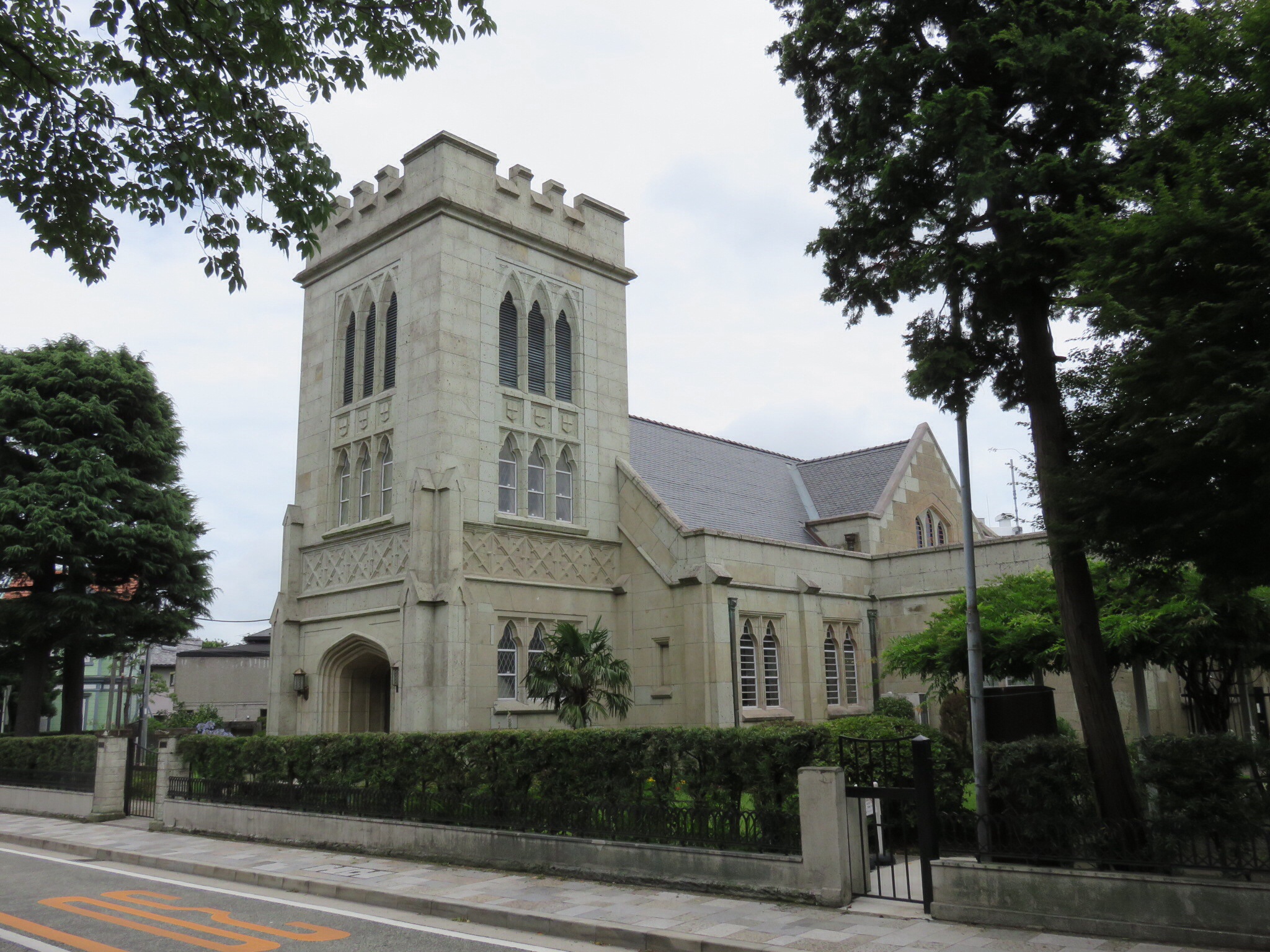
Christ Church, Yokohama: Three Buildings, Three Disasters, One Congregation
The first Anglican worship services in Yokohama took place in the British consul's living room. It was 1859, the treaty port had barely opened, and the handful of British subjects in the foreign settlement had nowhere else to pray. They moved next to the courtroom of the British consulate, then raised funds -- matched by the British government -- for a proper wooden church on lot 105 in Yamashita-cho, near the Nakamura River. The first consular chaplain, the Reverend Michael Buckworth Bailey, arrived in August 1862. Services began in the new building on October 18, 1863. That first Christ Church would survive a great fire that leveled much of the foreign settlement in 1866, sheltering the homeless in its pews. It was only the beginning of a pattern: disaster would come for this church again and again, and again and again, the congregation would rebuild.
Red Glasgow Brick on the Bluff
By 1901, the congregation had outgrown the original wooden structure and moved uphill to Yamate, the residential bluff overlooking the Kannai foreign settlement. The second Christ Church was a grand building constructed from red Glasgow brick, designed by the influential British architect Josiah Conder -- the same man who helped shape Meiji-era Tokyo with buildings like the Rokumeikan. The church was dedicated on Trinity Sunday, June 2, 1901. In 1922, Edward, Prince of Wales -- the future Edward VIII -- visited to dedicate war memorials at the adjacent Yokohama Foreign General Cemetery. The imposing red-brick church seemed built to last centuries. It lasted twenty-two years. On the morning of September 1, 1923, the Great Kanto earthquake leveled the building along with much of the city.
A Chaplain in the Rubble
The Reverend Eustace Mordaunt Strong, chaplain of Christ Church from 1917 to 1925, escaped unharmed from the collapse of the YMCA Seaman's Club during the earthquake. What he did next defined his ministry. Strong organized rescue efforts in the immediate chaos, helping to save some three hundred foreigners and Japanese from an advancing fire on the Yamate ridge. For his actions, he was awarded an OBE. He then turned to fundraising for a new, earthquake-resistant church on the same site. Between 1923 and 1930, the congregation worshipped in a temporary wooden church shipped from the United States -- a stopgap sanctuary while plans for a permanent replacement took shape.
Steel, Concrete, and Fire from the Sky
American architect Jay Hill Morgan designed the third and current Christ Church, completed in 1931. Morgan built it on a steel-reinforced concrete frame, clad in Oya Stone -- the porous volcanic tuff quarried north of Tokyo. The exterior blends Anglo-Saxon and Norman church design elements, and the tower remains true to the original 1930s vision. But even reinforced concrete could not withstand everything. On May 29, 1945, incendiary bombs gutted the interior during American air raids on Yokohama. After the war ended, American service personnel led the rebuilding effort, and the congregation held services outdoors until the nave and choir were reconsecrated in December 1947. Then, sixty years later, another fire struck in January 2005, requiring yet another interior restoration. The Oya Stone walls and tower have survived it all.
Carols on the Bluff
Christ Church is one of only three English-language Anglican or Episcopal churches in Japan, alongside St. Andrew's Cathedral in Tokyo and St. Michael's Cathedral in Kobe. The church hosts the festival of Nine Lessons and Carols before Christmas and occasional Choral Evensong services -- traditions that have continued, in one form or another, since the 1860s. The Mission to Seafarers has maintained a presence in Yokohama since the 1880s, and since 1952 the chaplain to the English-language congregation has also served as chaplain to the mission. Today the church serves both Japanese and English-language congregations as part of the Yokohama Diocese of the Nippon Sei Ko Kai, the Anglican Church in Japan. From the bluff in Yamate, looking down toward the harbor, the view is not so different from what those first worshippers saw when they left the consul's living room and walked into the treaty port sunlight.
From the Air
Located at 35.44N, 139.65E in the Yamate district of Yokohama, on the bluff overlooking the old foreign settlement and harbor. The church sits near the Yokohama Foreign General Cemetery, which is visible as a green space on the hillside. Best viewed at 2,000-4,000 feet AGL. The Yamate bluff runs along the southwest side of central Yokohama. Tokyo Haneda (RJTT) is approximately 15nm north-northeast. Yokohama's waterfront and port facilities provide a clear visual reference for navigation.