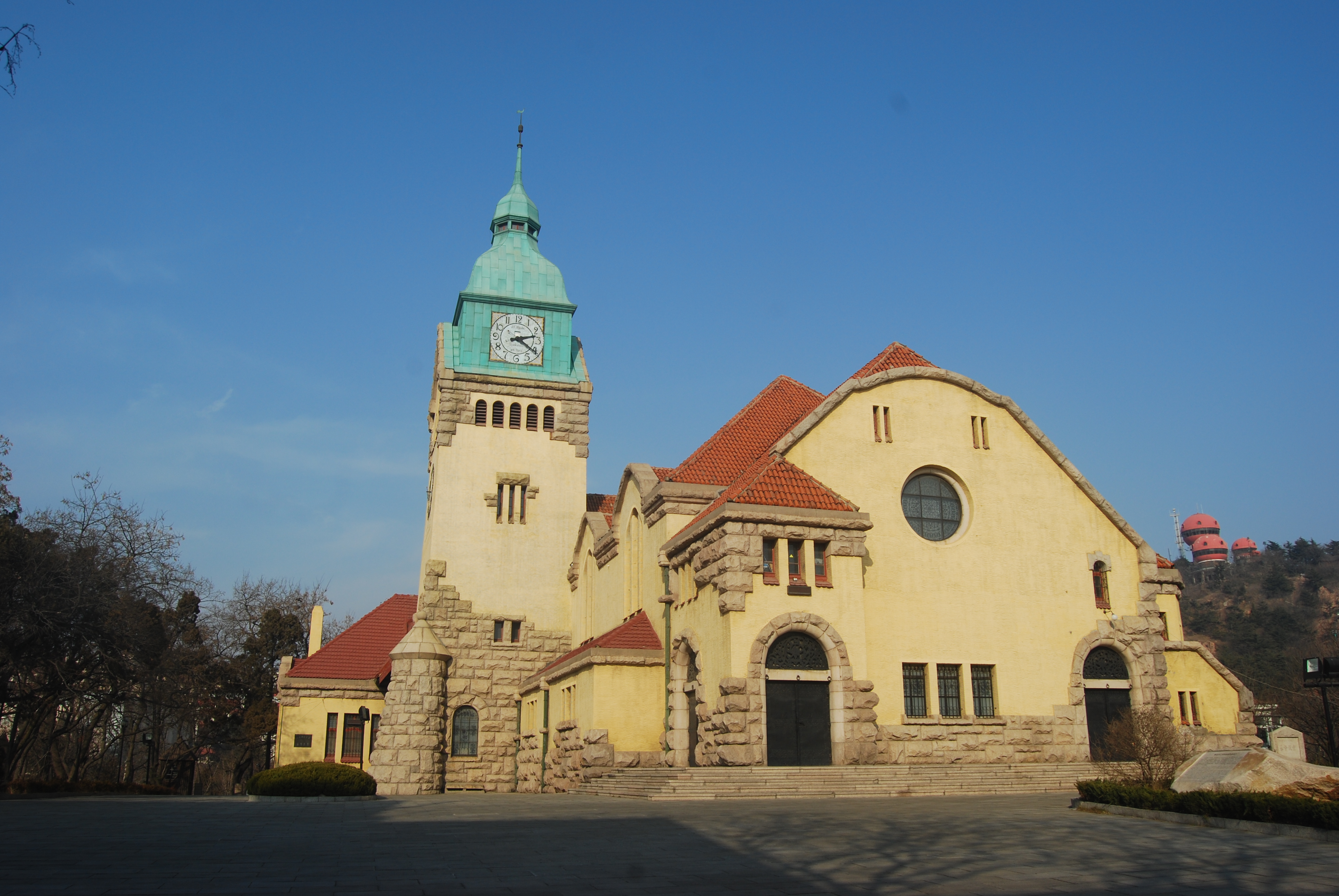
Christ's Church, Qingdao
On a hilltop in Qingdao's Shinan District, a church bell tower rises above the rooflines in a style that would look perfectly at home in a German provincial town. Christ's Church was designed by the German architect Curt Rothkegel, built between 1908 and 1910, and originally named Evangelische Kirche fur Tsingtau. It has survived more upheavals than most buildings see in five lifetimes: German colonial rule, Japanese military occupation, two world wars, a communist revolution, the Cultural Revolution, and thirty years of enforced closure. That it still stands and still holds services speaks to something more durable than stone.
A Church on the Governor's Hill
In 1898, Qingdao became a German concession territory. The Germans demolished the existing Chinese villages and rebuilt the area as a European-style city, complete with tree-lined boulevards, breweries, and churches. The Gouvernements-Hugel, known today as Guanhaishan, was selected as the site for both a Protestant church and a Roman Catholic church, placing the two institutions of worship at the symbolic center of the colony. On June 1, 1907, the Protestant congregation solicited design proposals from architects across East Asia. Rothkegel's design was chosen, though the bell tower's initially modern style drew criticism from Paul Richter and Hachmeister, who reviewed the drafts and suggested a more traditional treatment. Construction began on April 19, 1908, and was completed on October 23, 1910, funded by the German Governor's Office.
Changing Hands, Changing Flags
The church's first crisis came in 1914, when World War I brought Japanese forces to Qingdao's doorstep. The Imperial Japanese Army captured the city on November 7, ending German colonial rule. German missionaries were repatriated after the war, and the church passed to Qingdao's Lutheran community. When the Pacific War broke out in December 1941, all British and American residents in northern China were detained at the Weixian Internment Camp, and the church came under the care of Su Baozhi, a German priest associated with the Qingdao Tongshan Society. From 1945 to 1949, German and American believers held separate morning and evening services until the withdrawal of United States forces. On June 2, 1949, the People's Liberation Army took control of Qingdao.
Silence and Reopening
The new government confiscated the church in December 1949. Its ancillary buildings were converted for use by the Affiliated Hospital of Qingdao Medical College. During the Cultural Revolution, the church was closed entirely, joining countless other religious sites across China that fell victim to the campaign against traditional culture and foreign influence. The closure lasted thirty years. On November 2, 1980, Christ's Church reopened its doors to the public, one of the early beneficiaries of China's gradual relaxation of restrictions on religious practice. The congregation that returned found a building that had endured decades of neglect but remained structurally sound, its stonework and bell tower intact.
A National Treasure in Stone
Recognition came in stages. In 1992, the Shandong provincial government declared Christ's Church a cultural relic preservation site. In June 2006, the State Council of China elevated its status further, listing it among the sixth batch of Major National Historical and Cultural Sites in Shandong. The church building covers 1,297.51 square meters and can accommodate approximately 1,400 worshipers. Its architecture reflects the particular moment in early twentieth-century German design when traditional church forms were being challenged by modernist impulses, and the compromise between Rothkegel's original vision and his reviewers' corrections produced a building that is neither purely traditional nor fully modern. It occupies the same uncertain ground as Qingdao itself: a Chinese city shaped by German hands, Japanese occupation, and Communist transformation, still finding its balance between all the forces that made it.
From the Air
Located at 36.06N, 120.32E in the Shinan District of central Qingdao, Shandong Province. The church sits on a hilltop (Guanhaishan) near the historic colonial-era center of the city. The bell tower is a distinctive vertical feature amid the surrounding urban landscape. Nearest airport is Qingdao Jiaodong International Airport (ZSQD). The church and surrounding German-era architecture are best appreciated from 2,000-5,000 feet, where the hilltop location and tower are identifiable against the coastal cityscape.