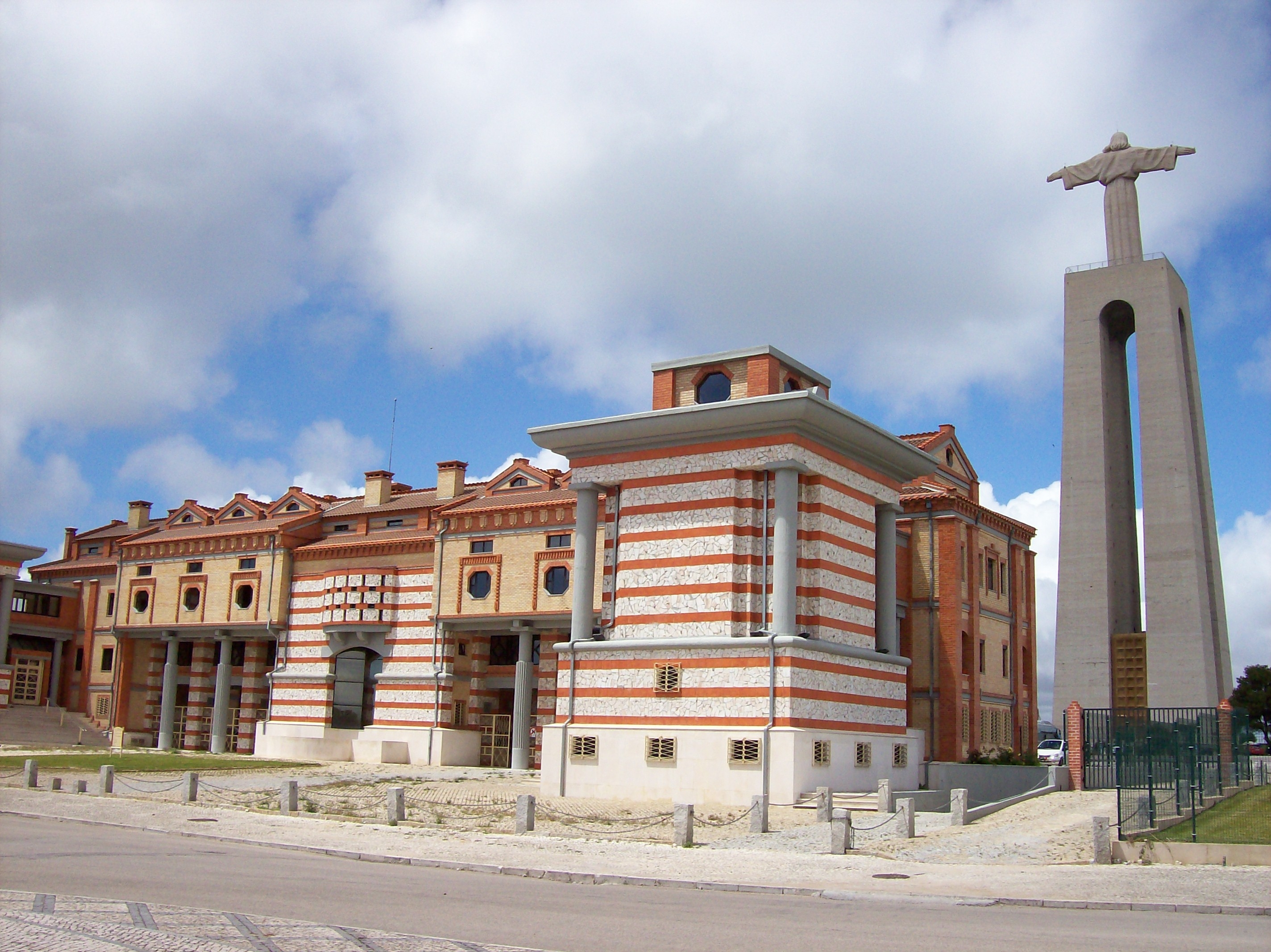
Christ the King (Almada)
In 1934, the Cardinal Patriarch of Lisbon stood at the base of Christ the Redeemer in Rio de Janeiro, looked up at the 38-meter statue overlooking Guanabara Bay, and had an idea. Portugal needed its own monumental Christ. The project took twenty-five years. Between the cardinal's inspiration and the statue's inauguration on May 17, 1959, there was the small matter of a world war -- one that Portugal managed to avoid, which became the very reason the monument was built. The Sanctuary of Christ the King stands not as a declaration of faith alone but as an expression of national relief: a country's gratitude, rendered in concrete and stone, for having been spared the devastation that consumed its neighbors.
A Plea Made Stone
The construction of Christ the King was formally approved at a Portuguese Episcopate conference held in Fatima on April 20, 1940, as Europe descended into its second catastrophic war in a generation. The monument was conceived as a dual offering: a plea to God to keep Portugal out of World War II and a celebration of the 50th anniversary of the consecration of the world to the Sacred Heart of Jesus. In 1941, the land was acquired on a clifftop in Almada, on the south bank of the Tagus River directly across from Lisbon. But the project moved slowly -- wartime austerity, postwar reconstruction, and the sheer engineering challenge of erecting a colossal statue on an exposed cliff all conspired to delay completion. It was not until 1959 that the monument was finally inaugurated, by which point Portugal's survival through the war had long since been confirmed.
Anatomy of a Colossus
The monument rises from an isolated clifftop 133 meters above sea level, the highest point in Almada. Its base, designed by architect Antonio Lino in the form of a gate, is a trapezoidal pedestal 82 meters high, formed by four arches oriented to the compass points. Atop this pedestal stands the 28-meter statue of Christ, designed by sculptor Francisco Franco de Sousa, with arms extended toward Lisbon as if embracing the city across the river. The total height -- pedestal plus statue -- reaches approximately 110 meters, making it one of the tallest Christ statues in the world. The figure forms a cross shape visible from across the Tagus, its silhouette unmistakable against the Almada skyline. At the base of the statue, an observation deck at 82 meters provides panoramic views of Lisbon, the river, and the 25 de Abril Bridge that now dominates the middle distance.
The Chapel Inside
Beneath the statue, occupying roughly a fifth of the pedestal's height, the Chapel of Our Lady of Peace opens from the northern facade. Its masonry-stone interior feels intentionally austere compared to the monument's dramatic exterior -- a space for private devotion inside a public declaration. Two of the pedestal's pillars contain elevator systems that carry visitors to the terrace 79 meters up, where the statue overlooks the Tagus from 192 meters above the river. The monument's interior also houses a library, a bar, two halls, and a main chapel, along with religious spaces dedicated to the Confidants of Jesus. Relics of Margaret Mary Alacoque, John Eudes, Faustina Kowalska, and Mary of the Divine Heart are displayed for public veneration -- all figures connected to the revelations of the Sacred Heart that inspired the monument's creation.
Between Two Bridges
The Christ the King monument has become inseparable from Lisbon's visual identity, though it technically stands outside the city, across the Tagus in the municipality of Almada. The 25 de Abril Bridge, completed in 1966 -- seven years after the statue's inauguration -- now frames the monument in every westward view from Lisbon, the suspension bridge's red steel cables creating a foreground for the white statue on the cliff behind. The monument can be reached by car over the bridge, by train to Pragal station, or by the traditional Cacilheiro ferry that crosses from Lisbon to Cacilhas. From any approach, the statue grows gradually larger, its outstretched arms becoming more defined as distance diminishes. The planned development around the monument -- eighteen buildings including restaurants, lookouts, and commercial spaces proposed in 1987 -- was only partially realized. What remains is the monument itself, more powerful for its relative isolation on the clifftop, a figure of gratitude standing at the edge of a river, facing the city it was built to protect through prayer.
From the Air
Located at 38.68N, 9.17W on the south bank of the Tagus River in Almada, directly across from Lisbon. The 110-meter monument is one of the most prominent landmarks in the Lisbon metropolitan area, visible from considerable distance. The statue stands on a clifftop near the southern end of the 25 de Abril Bridge. Recommended viewing altitude: 2,000-4,000 feet for best perspective showing the monument, bridge, and river together. Nearest airport: Lisbon Humberto Delgado (LPPT), approximately 5 nm north across the river. Montijo Air Base (LPMT) is about 10 nm east.