Christchurch Arts Centre
Somewhere in these stone buildings, a young Ernest Rutherford bent over laboratory equipment that would eventually help him split the atom. Canterbury College, as it was then known, educated the father of nuclear physics in halls designed by Benjamin Mountfort, New Zealand's foremost Gothic Revival architect. When the university relocated to its suburban Ilam campus in 1974, the buildings could have been demolished or left to decay. Instead, Christchurch turned them into something rare: a cultural commons, held in trust for the people of Canterbury, where Gothic archways frame art galleries, weekly markets, and the memory of what these walls once witnessed.
Mountfort's Gothic Ambition
The Arts Centre comprises 23 buildings, 21 of which hold Category I heritage status with Heritage New Zealand -- making it the country's largest collection of top-tier heritage structures on a single site. Benjamin Mountfort designed many of them in the Gothic Revival style that became Christchurch's architectural signature, with pointed arches, stained glass windows, and stone faces carved into window surrounds. The buildings originally housed Canterbury College, Christchurch Boys' High School, and Christchurch Girls' High School. When the university completed its move to Ilam in 1974, the Christchurch Arts Centre Association was formed to repurpose the campus. Ownership transferred to a charitable trust in 1979, and the buildings reopened as studios, theatres, and galleries. The Court Theatre, a professional company, called the Arts Centre home from 1976 until the 2010 earthquake forced it to relocate.
Rutherford's Den and Other Ghosts
The restored buildings now house Rutherford's Den, a museum in the very rooms where Ernest Rutherford studied before going on to Cambridge and his Nobel Prize-winning work on radioactive decay. Visitors can stand in the space where one of the twentieth century's most consequential scientists first learned to experiment. Nearby, the University of Canterbury's Teece Museum of Classical Antiquities displays Greek and Roman artifacts in a setting that feels more Oxford cloister than New Zealand city. Outside on Worcester Boulevard, the Twelve Local Heroes -- a series of bronze busts -- commemorate prominent Christchurch figures from the latter twentieth century, though the busts are currently inaccessible while an adjacent building awaits restoration. In May 2017, the university itself returned to the site, opening its classics and music departments in the restored old Chemistry building. Some 400 students now study in the same campus their predecessors left four decades earlier.
Shaken to the Foundations
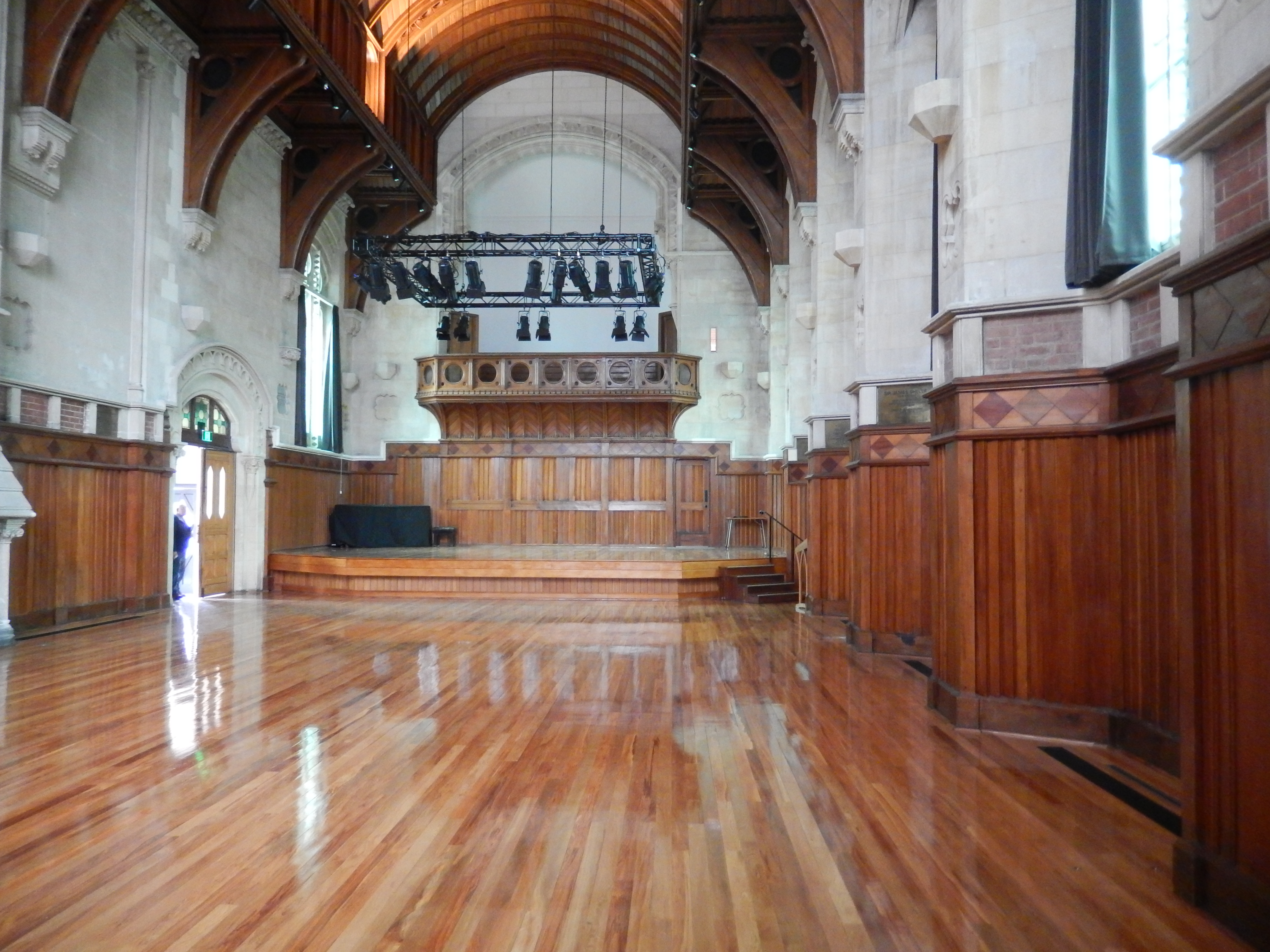
The early hours of 4 September 2010 brought the first blow. The Canterbury earthquake collapsed chimneys and damaged the Great Hall, the Observatory Tower, and the Clock Tower. Director Ken Franklin noted that prior reinforcement work may have prevented worse damage. Insurance stood at $95 million, raised to $120 million in January 2011. Then came the far more destructive February 2011 earthquake, and the estimated restoration cost climbed past $200 million. Andre Lovatt, appointed chief executive in October 2012, accelerated the program, but as the full scope of damage became clear, costs escalated to $290 million -- making it one of the largest heritage restoration projects in the world. The first buildings to reopen were the Registry and The Gym in July 2013. The Great Hall followed in June 2016. More than two-thirds of the buildings have now reopened, but significant work remains.
Rebuilding Without a Safety Net
The Arts Centre receives no ongoing funding from central or local government. It relies entirely on donations and the revenue from its tenants -- boutique galleries, eateries, retailers, and offices -- to fund both operations and the continuing restoration. A substantial shortfall remains, with the next phase including the $10 million restoration of the Observatory Tower and the conversion of the Physics and Biology buildings into a boutique hotel. The Observatory Hotel has already opened in the restored Townsend Observatory, signaling the direction of travel: heritage preservation sustained by commercial creativity. It is a precarious model, dependent on the willingness of a mid-sized New Zealand city to keep investing in stone buildings that a cheaper age might have replaced with glass and steel. That Christchurch has chosen this harder path says something about what these walls mean to the people who walk between them.
From the Air
Located at 43.5315°S, 172.628°E, immediately west of Cathedral Square in central Christchurch. The Gothic Revival buildings with their distinctive towers and archways are identifiable from low altitude. Christchurch Airport (NZCH) lies approximately 12 km northwest. Best viewed at 1,500-2,500 ft AGL to appreciate the campus layout along Worcester Boulevard.