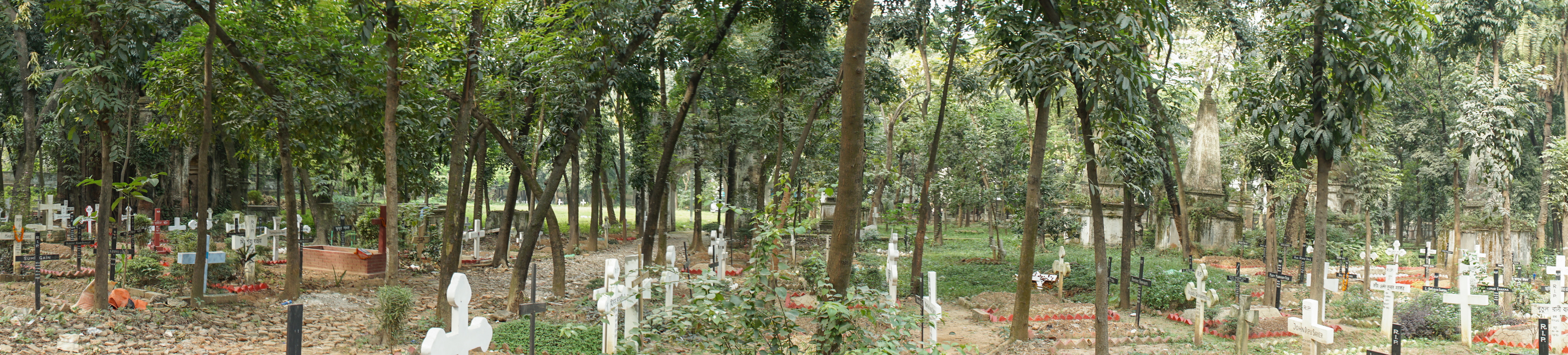
Christian Cemetery, Dhaka
On 16 March 1892, a woman named Jennette Rummary ascended in a hot-air balloon from the southern bank of the Buriganga River. The Nawab of Dhaka had invited her American aerial exhibition troupe to perform, advertising that the female pilot would fly over Ahsan Manzil and descend by parachute. Strong winds caught the balloon. Rummary jumped. Her parachute snagged in a tree in what is now Ramna Park, and rescuers severely injured her trying to free her from the branches. She died three days later in hospital and was buried in the Dhaka Christian Cemetery in the Wari neighborhood. Her grave is unmarked. But then, this cemetery has always been better at keeping secrets than keeping records.
Portuguese Roots, British Branches
Portuguese traders established the burial ground in the 17th century, making it one of the oldest European-founded sites in Dhaka. The Augustinian priests who built a church on or near the cemetery grounds were documented as early as the 1620s, when Sebastian Manrique recorded a church at this location during his visit between 1624 and 1629. French gem merchant Jean Baptiste Tavernier confirmed the church's presence during his 1666 visit, as did Niccolo Menucci soon after. When the Portuguese departed Bengal, they handed the cemetery to the British, who eventually transferred it to the Anglican Church. The Anglicans, lacking the manpower to maintain such a sprawling site, passed responsibility to the Catholic Church. Today the Roman Catholic Metropolitan Archdiocese of Dhaka manages the grounds on behalf of all Christian denominations, and burials still take place regularly.
The Columbo Sahib Mystery
The cemetery's most imposing structure is a mausoleum that has puzzled visitors for two centuries. Reginald Heber, the Bishop of Calcutta, described it during an 1824 visit as resembling the tombs raised over Muslim saints, with a high octagonal gothic tower, a cupola, and eight windows with elaborate tracery. He called it the Columbo Sahib mausoleum, and the name stuck even though no one has definitively identified who Columbo Sahib was. The Dhaka Department of Archaeology has declared the mausoleum and the 1724 tomb of Reverend Joseph Paget, a young chaplain who died at twenty-six while visiting Dacca, as two of the city's 22 heritage sites. A Moorish-type gateway built during the Mughal period using thin jafri bricks marks what was once the entrance to a specific section of the graveyard, though its original purpose has been obscured by centuries of change.
The Living and the Dead
The tombstones read like a cross-section of colonial Bengal. Robert Craufurd, a factor of the East India Company, shares a double tomb with his wife in the original southern section. Jane Thackarey took a silver model of her infant daughter's grave back to England when she left Dacca. Flight Lieutenant Edward N. Owens, a Royal Air Force pilot whose Gloster Javelin jet crashed over the Meghna River on 5 August 1961, rests under a gravestone refurbished by the Commonwealth War Graves Commission in 2023. A white stone fence demarcates the area of a mass grave from 1943. Each marker tells a story of someone who came to Dhaka from far away and never left, or who was born here in an era when the city spoke Portuguese, then English, then Bengali.
Heritage Under Pressure
The cemetery is recognized as an archaeological site by the Bangladesh government and UNESCO, but recognition has not guaranteed preservation. The old graves are crumbling, and for years the church authorities lacked permission to renovate structures on what the government had declared a protected site. Illegal occupation has further encroached on the grounds. Toward the end of 2024, the Anglican Church finally managed to begin some renovation work, an effort that remains ongoing. The cemetery is not open to the general public without special permission, a restriction meant to protect an active burial ground that also happens to be a four-century archive of Dhaka's connection to the wider world. It is, as its defenders insist, not merely a Christian asset but a witness to the history of Bangladesh.
From the Air
Located at 23.716°N, 90.420°E in the Wari neighborhood of Old Dhaka. The cemetery grounds are shaded by mature trees and set within dense urban fabric. Nearest major airport is Hazrat Shahjalal International Airport (VGHS), approximately 12 km north. The Buriganga River lies roughly 1 km to the south. The cemetery is near the intersection of several Old Dhaka thoroughfares, identifiable from low altitude by its green canopy amid the surrounding concrete.