Christiansted National Historic Site
In 1750, a sixteen-year-old woman named Rachel Faucette was locked in a 10-by-13-foot cell with a single small window inside Fort Christiansvaern on St. Croix. Her crime: refusing to live with her husband. Danish law allowed him to have her jailed for it. Rachel endured several months in that cell before being released. She fled to the British West Indies, where she met a Scotsman named James Hamilton. Their son, Alexander, would go on to build the American financial system, write much of The Federalist Papers, and die in a duel with the sitting vice president. The fort that held his mother still stands in Christiansted, its yellow walls overlooking the harbor -- one of six structures that make up the Christiansted National Historic Site, and one of many places on St. Croix where the past refuses to stay buried.
A Grid Drawn in the Tropics
The Danes began developing Christiansted in May 1735 using a formal grid system -- orderly streets laid out with European precision on a Caribbean island. The Building Code of 1747 dictated street widths, setbacks, zoning, and building materials, and by the 1760s masonry construction was the norm. Neoclassical architecture characterized the colonial government buildings that still line the waterfront. The result is a town that looks, from certain angles, as though a corner of Copenhagen had been transplanted to the tropics and left to weather in the salt air.
The six structures preserved by the National Park Service span more than a century of construction: Fort Christiansvaern (1738-1749), Government House (1747), the Danish West India and Guinea Company Warehouse (1749), the Steeple Building (1753), the Customs House (1840-1842), and the Scale House (1856). Each served a function in the machinery of colonial commerce -- taxing goods, housing governors, weighing cargo, worshiping God, and defending it all with cannon.
The Warehouse Where People Were Sold
The Danish West India and Guinea Company Warehouse, built in 1749, is the building that tests a visitor's ability to hold beauty and horror in the same glance. The architecture is handsome -- thick masonry walls, generous proportions, the solidity of an institution built to endure. Inside those walls, the Company held slave auctions until 1803, when Denmark outlawed the slave trade. The building's commercial purpose was inseparable from the trade in human beings: the company that built it existed to profit from the triangular trade that brought manufactured goods to West Africa, enslaved Africans to the Caribbean, and sugar back to Denmark.
St. Croix's plantation economy depended entirely on enslaved labor. At the time of emancipation in 1848, there were roughly 17,000 enslaved people and 5,000 free Black residents on the island. That emancipation did not arrive as a gift from Danish benevolence -- it was forced by rebellion, when General Buddhoe led 8,000 people in a freedom march to Frederiksted. The warehouse stands as a reminder that the elegant colonial architecture of Christiansted was built on, and paid for by, human suffering.
The Fort That Held Hamilton's Mother
Fort Christiansvaern was constructed in 1738 on the ruins of an earlier French fortification destroyed by a hurricane. Its original purpose was military: protecting commerce from pirates and privateers, and the colonial population from slave revolts -- a revealing pairing that shows who and what the Danes considered threats. The fort housed the first Danish governors and later served as police headquarters, courthouse, and jail.
The British occupied St. Croix twice during the Napoleonic Wars -- from 1801 to 1803 and again from 1807 to 1815 -- and both times the fort changed hands without a shot fired. In 1878, the soldiers garrisoned there were replaced by 60 gendarmes, and in 1906 those gendarmes remained until Transfer Day in 1917, when the United States purchased the Danish West Indies for $25 million in gold. Rachel Faucette's imprisonment here is almost incidental to the fort's long history, but it has become its most famous chapter, thanks to her son's improbable rise. Alexander Hamilton later lived in Christiansted with his mother and brother at 34 Company Street, clerking for the trading firm of Beekman and Cruger before local businessmen funded his education in New York in 1772.
Where Empires Left Their Mark
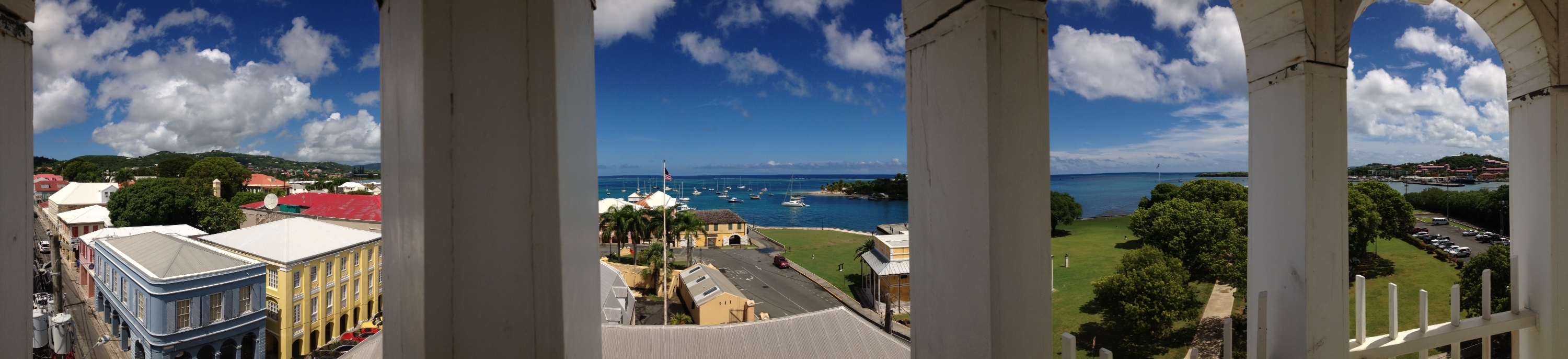
From the Steeple Building, the view encompasses Christiansted Harbor and the town's rooftops -- a cityscape that has changed less than you might expect in 250 years. The building codes that the Danes enforced in the 1740s created a built environment durable enough to survive centuries of hurricanes, occupations, and changes of sovereignty. The town passed from French to Danish to British to Danish to American control, and through it all the masonry held.
Today the National Park Service maintains the six structures as a testament not to any single era but to the accumulation of eras -- layers of colonial ambition and exploitation, of commerce and cruelty, stacked atop one another in yellow stone. The Scale House where goods were weighed. The Customs House where duties were paid. The warehouse where people were sold. The fort where a young woman was locked away for refusing to submit to her husband. Christiansted does not offer a simple story, and the National Historic Site does not try to provide one. It preserves the evidence and lets visitors reckon with what they find.
From the Air
Located at 17.75N, 64.70W on the northeastern coast of St. Croix. The Christiansted waterfront and fort are visible at lower altitudes along the island's north shore. The yellow-and-white fort complex sits prominently on the harbor. Henry E. Rohlsen International Airport (TISX/STX) is approximately 7 nm to the southwest. Buck Island Reef National Monument is visible just offshore to the northeast. St. Thomas (Cyril E. King Airport, TIST/STT) is approximately 40 nm to the north-northwest.