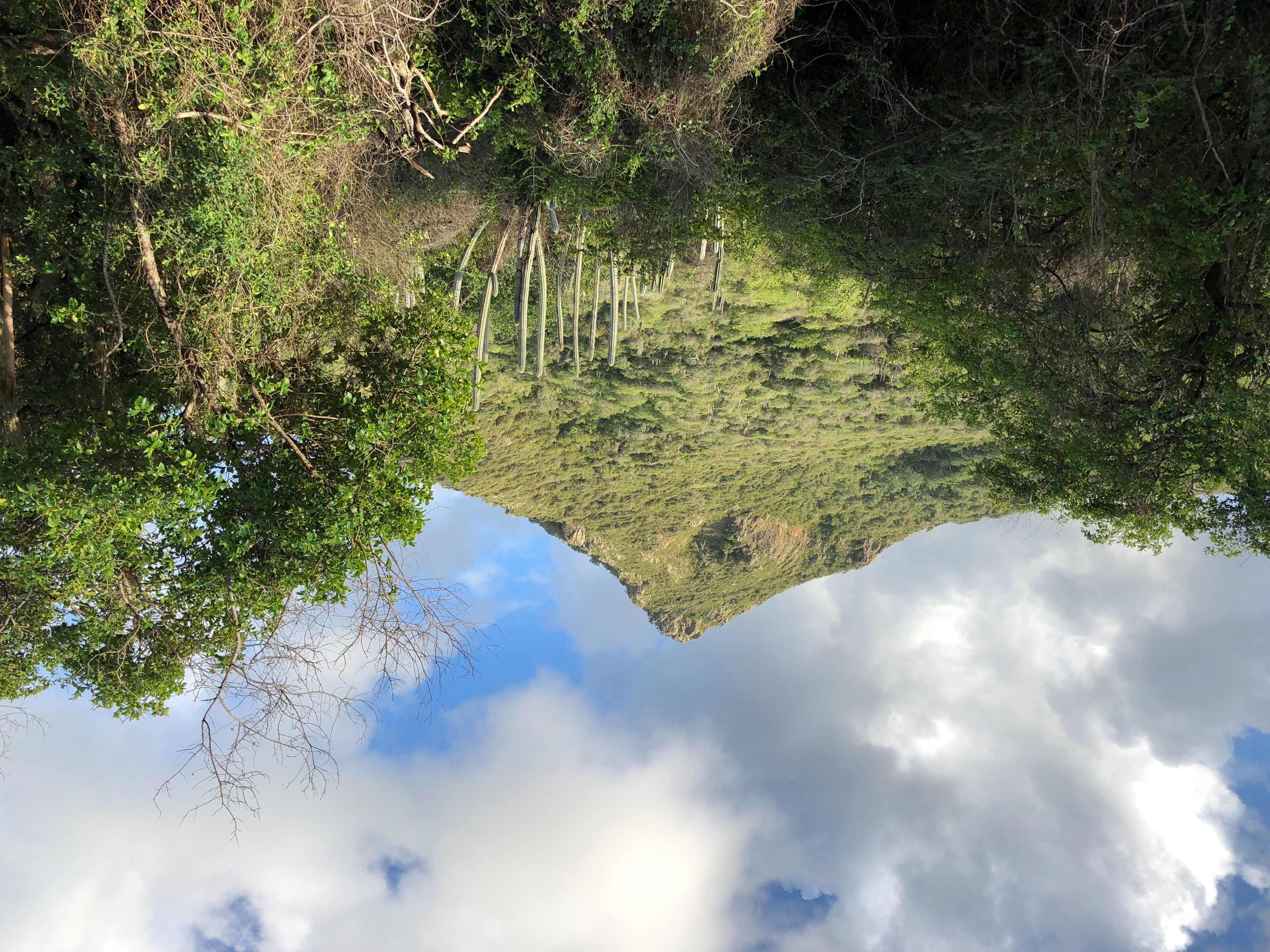
Christoffelpark
Curacao is not the island most people picture when they think of national parks. It is flat, arid, and better known for its pastel harbor facades and blue liqueur. But at the northwestern tip of the island, where the land crumples into the closest thing Curacao has to mountains, Christoffelpark guards 1,860 hectares of something unexpected: genuine wilderness, with 1,040 hectares designated as nature reserve. The park wraps around Christoffelberg, the island's highest point, and contains more biodiversity than the rest of Curacao combined. Cacti grow ten feet tall here. Rare orchids bloom on their trunks. White-tailed deer - a species found nowhere else in the southern Caribbean - move through the scrub at dawn. And woven through the landscape are the ruins of three plantations whose names still anchor the park's geography: Savonet, Zorgvlied, and Zevenbergen.
Plantations and the People Who Worked Them
Plantation Savonet is one of the oldest on Curacao, and its history is written into the park's landscape. The eighteenth-century plantation house still stands near the entrance, now serving as the Savonet Museum. Its irrigation system remains reasonably intact, a testament to the engineering required to farm in a climate this dry. The colonists attempted to grow aloe, indigo, sorghum, corn, cotton, and beans, and they raised cows, sheep, goats, and poultry. Uphill, at Zorgvlied, only ruins remain of the plantation house. About 100 meters to the west stands the house of the bomba - the enslaved person appointed to oversee other enslaved workers - and a slave-pole, a blunt physical reminder of the violence that sustained the plantation economy. The Savonet Museum recounts this history, placing the lives of the enslaved people alongside those of the owners who profited from their labor.
Orchids on Cactus Trunks
The park's flora defies the assumption that arid means barren. Three species of pillar cactus dominate the landscape: datu, kadushi, and kadushi di pushi, their columnar forms rising like organic architecture against the dry hills. Divi-divi trees, permanently bent by the trade winds, dot the lower elevations. But the real surprises grow in the cracks and folds of the terrain. The lady of the night orchid blooms on cactus trunks, its fragrance intensifying after dark. Humboldt's schomburgkia, another rare orchid, clings to the same unlikely hosts. Two plant species found in Christoffelpark exist nowhere else on Earth: Myrcia curassavica, endemic to Curacao alone, and Maytenus versluysii, shared only with neighboring Bonaire. The park functions as a botanical ark, preserving species that development and grazing have eliminated from the rest of the island.
The Deer, the Hawk, and the Barn Owl
White-tailed deer, introduced to Curacao centuries ago, have found their last refuge in Christoffelpark. The park offers a sunset deer-spotting tour for visitors hoping to catch them in the golden light of late afternoon. But the deer are only part of the fauna that makes this pocket of wilderness distinctive. The white-tailed hawk, rare across its entire range, patrols the skies above the park. An endemic subspecies of barn owl, Tyto alba bargei, hunts the park after dark - found here and virtually nowhere else. Hummingbirds flash through the undergrowth: the common emerald and the ruby topaz, its throat a metallic blaze of red and gold. The endemic yellow oriole adds its song to the chorus. Bats occupy the caves that honeycomb the limestone beneath the hills. For a park on an island most visitors associate with cruise ships and beach bars, the wildlife list is startlingly rich.
The Climb and the View
Eight hiking trails thread through Christoffelpark, but the signature experience is the climb up Christoffelberg itself. The park enforces a strict rule: no one may begin the ascent after 10 a.m., because the heat and sun exposure on the exposed upper slopes become dangerous by midday. Those who start early enough follow a trail that climbs through cactus scrub, past rocky outcrops, and up to the summit. The reward is a panoramic view of the entire island - Willemstad's harbor to the southeast, the arid interior, the turquoise sea on all sides. On clear days, the coast of Venezuela is visible to the south, a reminder of how close the mainland sits. The park opens at 6 a.m. and closes its gates at 3 p.m., with last admittance at 1:30. Beyond the summit hike, visitors can explore by car on four sealed roads, by bicycle, or on horseback. Organized tours include a pickup safari and the Savonet history tour, which traces the plantation story from colonization through emancipation.
From the Air
Located at 12.33N, 69.12W at the northwestern tip of Curacao. From altitude, Christoffelpark is visible as a rugged, undeveloped area surrounding Christoffelberg (Mt. Christoffel), the island's highest point at 372 meters. The park contrasts sharply with the developed southeastern part of the island around Willemstad. Hato International Airport (TNCC) is approximately 25 kilometers to the southeast. The Venezuelan coast is visible to the south on clear days. The terrain is arid and hilly, with sparse vegetation punctuated by tall cacti visible even from moderate altitudes.