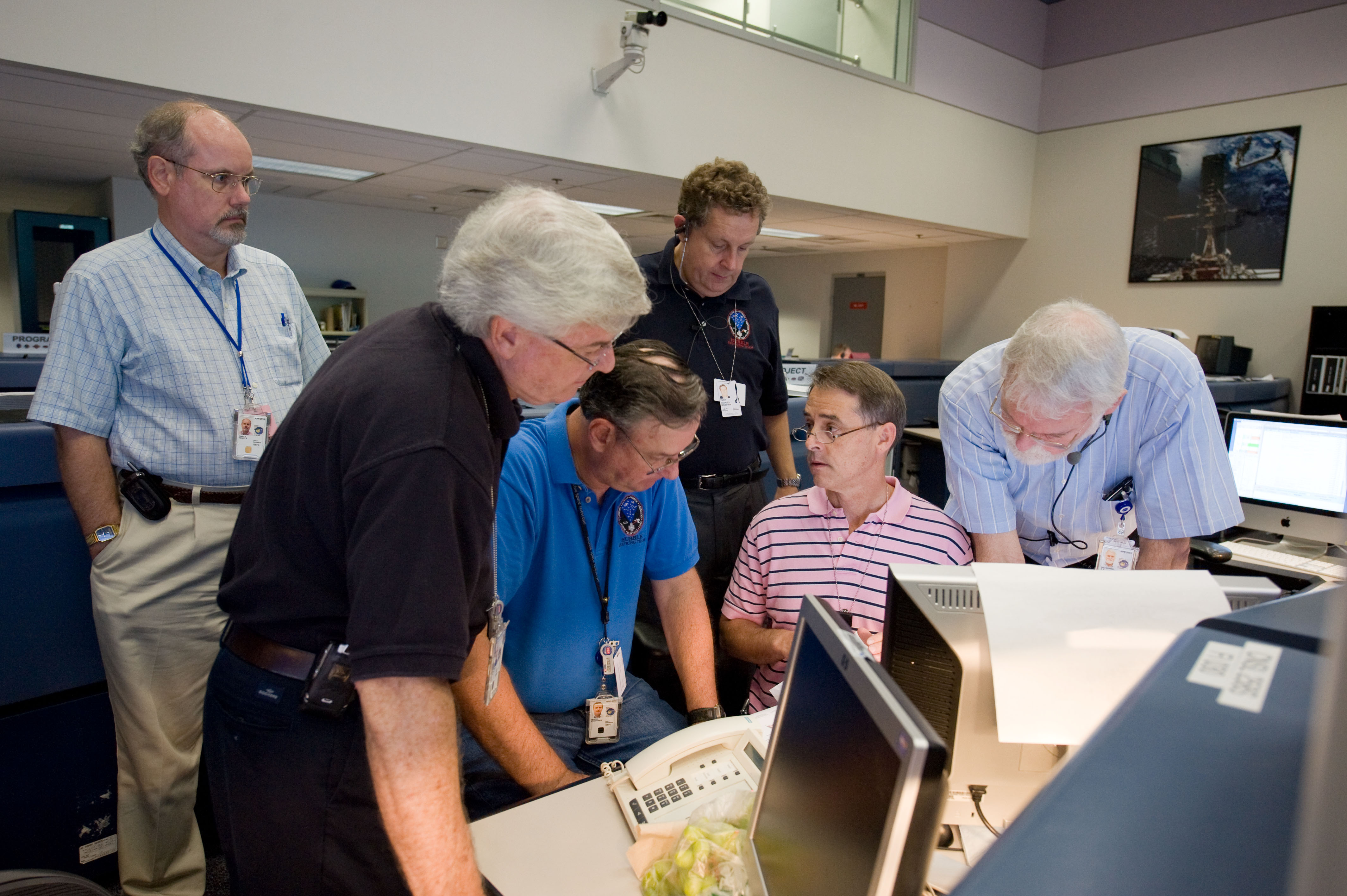
Christopher C. Kraft Jr. Mission Control Center
The voice on the radio simply says 'Houston.' No last name, no formal title -- just a city that became synonymous with human spaceflight. Inside Building 30 at the Johnson Space Center, the Christopher C. Kraft Jr. Mission Control Center has served as the nerve center for every American crewed space mission since June 1965, when flight controllers first took command of Gemini 4 from their new consoles in southeast Texas. Named for the NASA engineer who invented the concept of mission control and became the agency's first Flight Director, this unassuming building on the Texas coastal plain has witnessed humanity's greatest voyages -- from the first Moon landing to thirty years of Space Shuttle operations to the continuous crewed presence aboard the International Space Station.
From the Cape to the Bayou
Before Houston, there was Cape Canaveral. The original Mercury Control Center, housed in the Engineering Support Building at the east end of Mission Control Road in Florida, guided every Mercury and early Gemini mission from a modest three-row facility. But as spacecraft grew more complex -- maneuverable Gemini capsules replacing the ballistic Mercury -- NASA needed something far more capable. Christopher Kraft and three fellow flight controllers designed the requirements for a new center, and Philco's Western Development Laboratory won the contract to build it. Construction began in 1963 in Building 30 of what was then the Manned Spacecraft Center. The new facility featured two Mission Operations Control Rooms, each a four-tier auditorium dominated by a large map screen showing a Mercator projection of Earth with tracking stations and a sine-wave orbital path. The Cape facility, after decades of salt air exposure, was demolished in May 2010 due to asbestos concerns and an estimated $5 million repair cost.
The Room That Reached the Moon
MOCR 2, on the third floor of Building 30, is where history lives. Pronounced 'moh-ker,' this Mission Operations Control Room guided every Saturn V flight, including Apollo 11 -- the first crewed Moon landing on July 20, 1969. In 1985, it was designated a National Historic Landmark. After its last operational use during STS-53 in 1992, the room was painstakingly restored to its Apollo-era configuration. Consoles were shipped to the Kansas Cosmosphere in January 2018 for archival cleaning and refurbishment. When the room reopened to the public on July 1, 2019, every detail had been recreated: period-appropriate cigarette packs and ashtrays on the consoles, the original wallpaper patterns, even the carpeting that flight controllers paced during tense moments. Visitors now view the room from behind the glass of a restored Visitor's Gallery, accessible via the tram tour at Space Center Houston. In 2010, air-to-ground voice recordings from the Apollo 11 powered descent were re-synchronized with film footage and released for the first time.
Thirty Years of Shuttle Hands
When the Space Shuttle program launched in 1981, the control rooms were rechristened flight control rooms -- FCRs, pronounced 'ficker.' From the instant a Shuttle cleared its launch tower in Florida until it touched down on Earth, Mission Control was in command, staffing the room around the clock in three shifts. In 1992, JSC began building a five-story extension to Building 30. The new section went operational in 1998 and introduced two additional rooms: the White FCR and the Blue FCR. The White FCR handled all Shuttle flights from STS-77 through the program's end in 2011. FCR 2, meanwhile, served mostly for classified Department of Defense missions before being restored to its Apollo configuration. Each room told the story of an evolving relationship between humans and machines -- from the Apollo-era Trench, where RETRO, FIDO, and GUIDO controllers tracked trajectories with analog instruments, to the digital displays that monitored the Shuttle's complex systems.
The Room That Never Sleeps
Today, the International Space Station flight control room in Building 30 operates continuously, 24 hours a day, 365 days a year. Since October 2006, ISS operations have run from the completely revamped FCR 1, which abandoned the traditional tiered floor layout in favor of a flat arrangement accommodating new technologies unavailable when the station first launched in 1998. During quiet periods, a scheme called Gemini consolidates six specialist disciplines into just two 'super-consoles' named Atlas and Titan, allowing two controllers to do the work of eight. The center has also weathered Texas-sized challenges: when Hurricane Ike struck Galveston in September 2008, it caused minor damage to Mission Control itself, and NASA activated backup control centers in Round Rock and Huntsville. Building 30 was officially named for Christopher Kraft on April 14, 2011, honoring the man whose vision created the entire concept of centralized flight control that keeps astronauts safe in orbit.
From the Air
Mission Control Center sits at 29.558N, 95.088W within the Johnson Space Center campus in the Clear Lake area southeast of Houston. From the air, the JSC complex is a distinctive cluster of white buildings near the western shore of Clear Lake, adjacent to NASA Parkway. The nearby Ellington Field (KEFD) is 5nm to the northwest. William P. Hobby Airport (KHOU) is 15nm northwest, and George Bush Intercontinental (KIAH) is 30nm north. Best viewed at 2,000-4,000 feet AGL. Look for the Saturn V rocket display near the Space Center Houston visitor complex as a visual landmark.