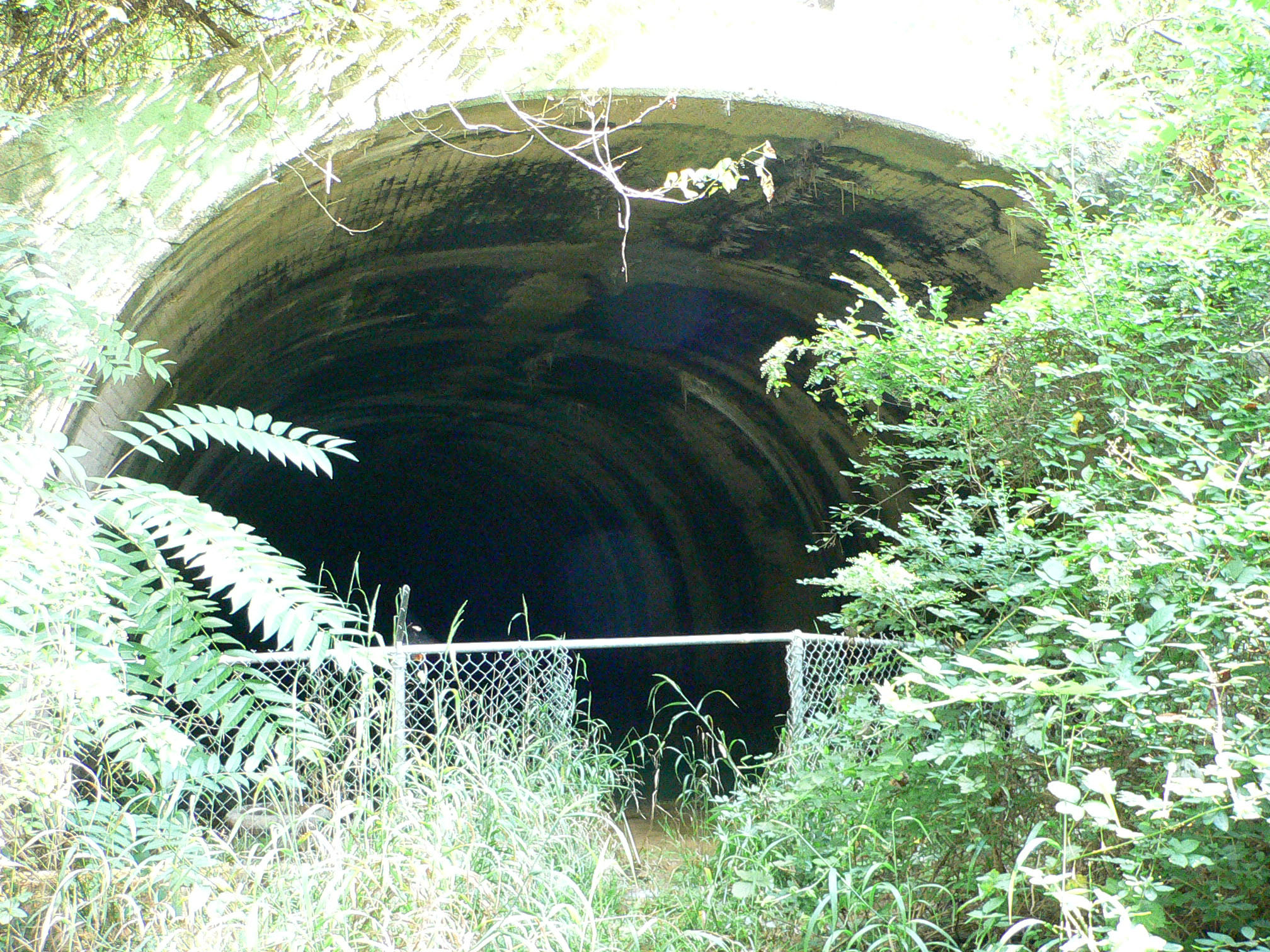
Church Hill Tunnel
Somewhere beneath the brick rowhouses and quiet gardens of Church Hill, a steam locomotive sits entombed in wet darkness. Engine No. 231, a Chesapeake and Ohio Railway switch engine, has not moved since October 2, 1925, when the tunnel around it collapsed, killing four men and burying the locomotive along with ten flat cars under tons of Richmond's treacherous blue marl clay. A century later, the machine is still down there. Every attempt to reach it has failed, and the tunnel remains sealed, a time capsule of early-twentieth-century railroading locked beneath one of Virginia's oldest residential neighborhoods.
Coal, Clay, and Bad Geology
The Chesapeake and Ohio Railway completed Church Hill Tunnel in 1873 to connect its existing Virginia Central Railroad terminus in the Shockoe Valley with a new line running southeast down the Virginia Peninsula to Collis Potter Huntington's coal pier in Newport News. The route burrowed under Church Hill, entering east of North 18th Street and emerging near 31st Street by Williamsburg Road. The Peninsula Subdivision opened in late 1881, and Appalachian coal flowed eastward in massive quantities. But from the start, the geology fought back. Unlike the solid bedrock the C&O had carved through in the mountains of western Virginia, the ground under Church Hill was blue marl clay, a shrink-swell soil that shifted with rainfall and groundwater. Deadly cave-ins plagued the construction. The tunnel was trouble from its first day and remained so throughout its operational life.
The Day the Hill Swallowed a Train
On October 2, 1925, a work crew was inside the tunnel performing maintenance when the earth gave way. The collapse trapped Engine No. 231 and ten flat cars. Approximately 200 workmen managed to crawl beneath the flat cars and escape through the eastern end of the tunnel. Fireman Benjamin F. Mosby made it out alive but died hours later at Grace Hospital from burns caused by the locomotive's ruptured boiler. Engineer Thomas Joseph Mason was killed instantly. Initial reports claimed six Black laborers were also missing, though the number was later revised to two: day laborers Richard Lewis and a man identified only as H. Smith. For the next week, Richmond watched as rescue teams tried to dig through. Each time they made progress, further cave-ins forced them back. Only Mason's body was recovered, on October 10. Lewis and Smith were never found. The following spring, the Virginia State Corporation Commission ordered the western end of the tunnel sealed with a concrete plug.
The Bypass That Made It Obsolete
The tunnel had already been living on borrowed time. In the 1890s, the C&O acquired the Richmond and Alleghany Railroad, which followed the James River's north bank on a gentler water-level route into Richmond. To connect this line with the Peninsula Subdivision and bypass the unstable tunnel, the C&O built a double-track elevated viaduct along the riverfront. The viaduct stretched from near Hollywood Cemetery east past downtown Richmond, through the Shockoe Valley, and on to Fulton Yard, joining the Peninsula Subdivision east of the tunnel. With a connection at Main Street Station, coal trains could now reach Newport News without ever entering the collapsing bore under Church Hill. That viaduct, believed to be the longest in the United States, is still in use today by CSX Transportation, the C&O's successor. The tunnel it rendered unnecessary remains CSX property as well, an abandoned liability they can neither use nor fully abandon.
The Vampire in the Dark
In 1998, Richmond Times-Dispatch reporter Mark Holmberg and photographer P. Kevin Morley entered portions of the tunnel from its eastern portal with professional caving equipment. They found that most of the western section not already caved in was filled with water. The History Channel later expressed interest in excavating the buried train, but when a camera was drilled through the tunnel's seal, it revealed silt and water filling the passage. Engineers concluded that any excavation would trigger further collapse and open massive sinkholes beneath the homes above. The project was shelved. But the tunnel's grip on Richmond's imagination runs deeper than lost locomotives. The Church Hill Tunnel collapse spawned the legend of the Richmond Vampire. According to the tale, a pale, bloodied figure emerged from the wreckage and fled to nearby Hollywood Cemetery. The story has attached itself to the grave of William Wortham Pool, a real person buried in the cemetery, and has become one of Richmond's most enduring pieces of urban folklore.
From the Air
Located at 37.54N, 77.42W beneath the Church Hill neighborhood of Richmond, Virginia. The tunnel runs roughly east-west under the residential district. The sealed western portal is near 18th and Broad Streets; the eastern portal is near 31st Street and Williamsburg Road, below Libby Terrace Park. The CSX viaduct that replaced the tunnel is clearly visible along the James River waterfront south of the tunnel route. Nearest airport is Richmond International (KRIC), approximately 7 miles southeast. The Virginia State Capitol dome is a prominent landmark to the west. Best viewed at 2,000-3,000 feet AGL to see the tunnel alignment relative to the neighborhood grid above it.