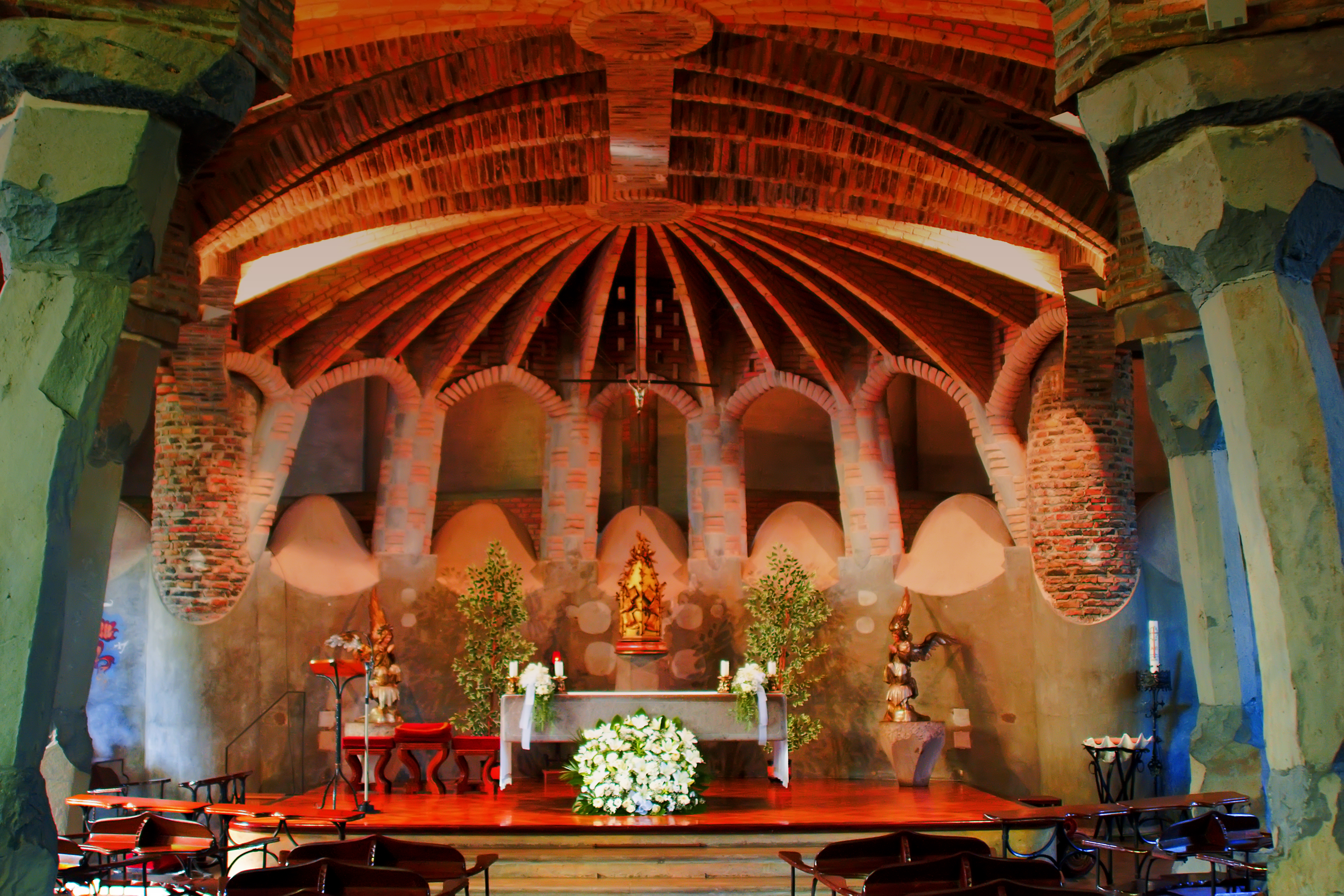
Church of Colonia Guell
Antoni Gaudi hung sacks of lead from hemp ropes on the ceiling of his workshop, photographed the sagging curves, flipped the image upside down, and traced over it. This was how he designed buildings. The Church of Colonia Guell, commissioned by Count Eusebi de Guell in 1898 for the workers of his manufacturing colony near Barcelona, became the laboratory where Gaudi tested nearly every structural idea he would later deploy at the Sagrada Familia. Hyperbolic paraboloids, hyperboloids, inclined columns that follow the lines of force rather than standing obediently vertical - all of it was rehearsed here first. And then, in 1914, the Guell family ran into financial difficulties, funding stopped, and the church was left forever half-built. Only the crypt was completed, between 1915 and 1917. The upper nave, the towers, the forty-meter dome that Gaudi had envisioned - none of it was ever constructed.
The Gravity Model
Gaudi's funicular method was radical in its simplicity. By suspending weighted ropes from a ceiling frame, he created an inverted model of his structure at 1:10 scale. Gravity shaped the ropes into catenary curves - the natural form that a hanging chain assumes under its own weight. Canvas sheets draped between the ropes simulated walls and vaults. The lead weights represented the loads that floors, roofs, and congregants would place on the real structure. When Gaudi photographed this hanging model and flipped the image, the drooping curves became soaring arches, and the load paths were already solved. No guesswork, no trial and error - gravity itself had done the engineering. The only surviving record of this model is an image in a book by architect Josep Francesc Rafols i Fontanals. The model itself was destroyed, but the architectural vocabulary it generated - the hyperbolic paraboloids and hyperboloids that would become Gaudi's signature - lives on in every surface of the Sagrada Familia.
A Crypt That Breathes
The completed crypt, built from 1908 to 1915, sits partially underground on the hillside of Santa Coloma de Cervello. Gaudi designed it to merge with the surrounding landscape rather than impose upon it. The exterior columns are a deliberately irregular forest: some built from stacked bricks, others carved from single blocks of stone, and at least one fashioned from basalt hauled from Castellfollit de la Roca. They lean at angles that follow structural forces rather than aesthetic convention, giving the building the appearance of growing from the earth. Inside, the crypt is dimly lit - a consequence of its semi-subterranean position - but 22 stained glass windows pierce the walls, their colored glass cut into shapes resembling butterfly wings, scattering fragments of tinted light across surfaces that never repeat the same geometry twice.
The Patron and the Unfinished Dream
Eusebi de Guell was more than a patron - he was Gaudi's enabler, the industrialist who gave the architect permission to experiment without commercial constraint. Colonia Guell was Guell's model workers' village, a manufacturing settlement outside Barcelona where employees lived, worked, and worshipped in purpose-built facilities. Gaudi received the church commission at the age of 46 and spent a decade refining his plans before construction began in 1908. The Guell family's financial difficulties halted construction in 1914, ending the ambition. The plan had called for an upper nave, two towers, and a forty-meter central dome. None were built. Between 1915 and 1917, the lower nave was completed and readied for worship, and the project stopped there. What remains is a foundation waiting for a building that will never come - a permanent rehearsal.
Walking on the Unbuilt Floor
In 2000, local architects repaired the crypt and made a decision that would have horrified purists but delighted visitors: they opened the roof for walking. The surface that visitors now stand on would have been the church floor, had the upper nave been completed. From this vantage point, you look down into the crypt below and out across the pine-covered hillside, standing at the exact elevation where Gaudi imagined congregants gathering beneath his dome. The Church of Colonia Guell is one of seven Gaudi properties near Barcelona designated as UNESCO World Heritage Sites under the collective title Works of Antoni Gaudi, recognized for their exceptional creative contribution to architecture in the late 19th and early 20th centuries. Every pew, kneeler, and piece of furniture inside was designed by Gaudi himself - rare survivals from an architect whose furniture has mostly been lost. The church remains unfinished, and in its incompleteness it reveals something that finished buildings conceal: the thinking behind the form.
From the Air
Located at 41.36N, 2.03E in Santa Coloma de Cervello, approximately 20 km southwest of central Barcelona, Catalonia, Spain. The church sits on a wooded hillside within the former Colonia Guell workers' village. The crypt and its distinctive inclined columns are partially embedded in the terrain and are not easily visible from high altitude, but the surrounding colony buildings and the church site are identifiable at moderate altitudes. Nearest airport: Barcelona-El Prat (LEBL) approximately 10 km east. The Llobregat River valley is a prominent nearby landmark.