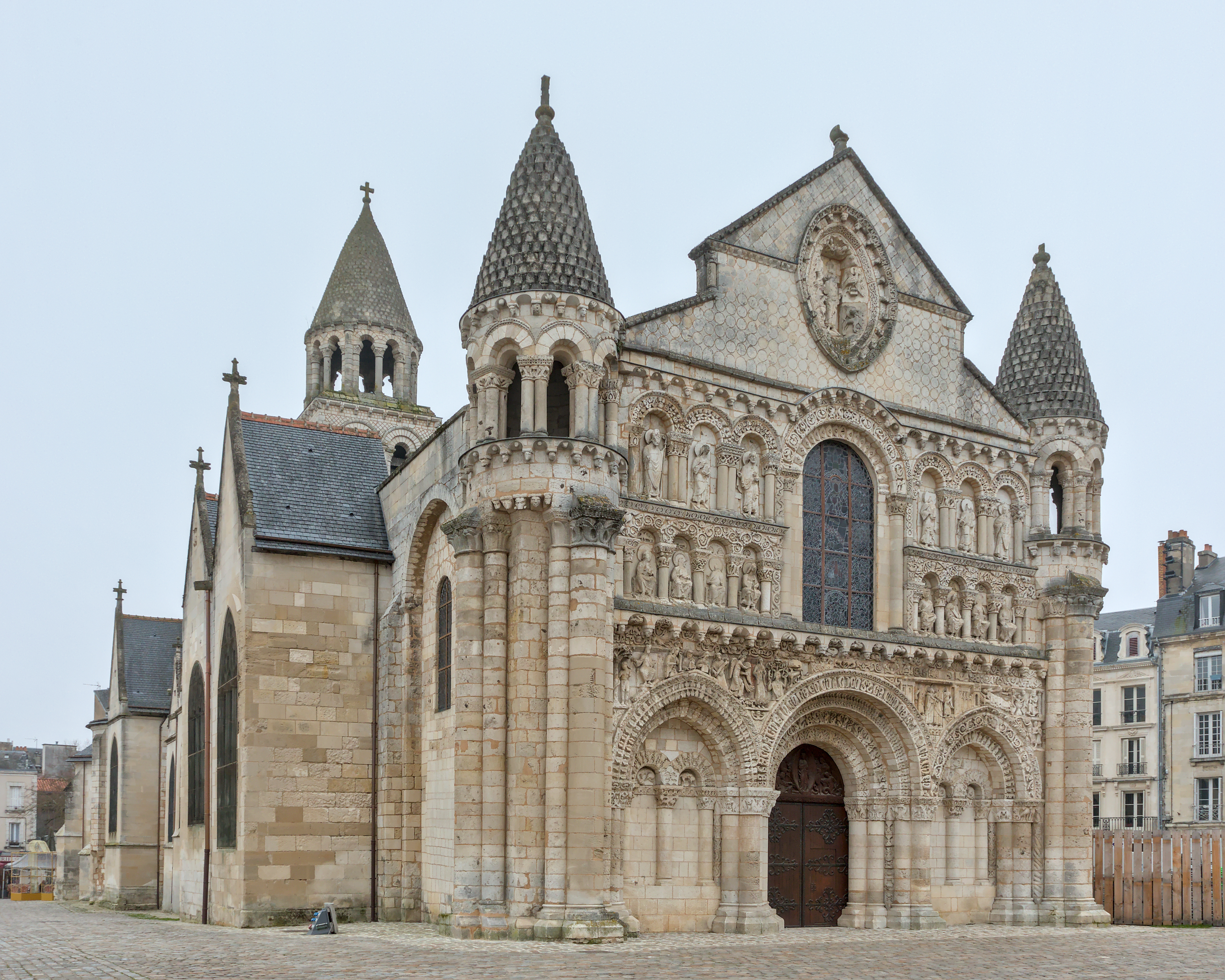
Church of Notre-Dame la Grande, Poitiers
On summer evenings, the west front of Notre-Dame la Grande erupts in color. Projected light restores the polychrome painting that once covered every carved figure on the facade, a reminder that medieval churches were never the austere stone monuments we imagine today. By day the carvings speak for themselves: Adam and Eve, Nebuchadnezzar, prophets, apostles, and the Nativity, all crowded onto a single wall in what art historians consider one of the supreme achievements of Romanesque sculpture. The church has stood at the heart of Poitiers since the 11th century, quietly accumulating stories the way old buildings do.
A Theology Carved in Stone
The west front reads like a Bible compressed into limestone. Above the doorway, high-relief panels march from left to right through the Old Testament and into the New: the Fall of Man, Nebuchadnezzar, the prophets Daniel, Moses, Isaiah, and Jeremiah, then the Annunciation, the Tree of Jesse, and King David. On the opposite side, the Visitation unfolds between miniature depictions of Nazareth and Jerusalem, rendered as medieval towns. The Nativity follows, with a scene drawn from apocryphal texts showing the infant Christ's bath, the eucharistic cup subtly foreshadowing the Passion. Above it all, twelve apostles and two bishops stand in arcaded niches. Local tradition identifies the bishops as Saint Hilary of Poitiers and Saint Martin of Tours. Art historians believe the facade's sculptors took their compositions directly from the Romanesque frescoes still visible in the apse vault above the choir, where the same figures appear in nearly identical poses.
Inaugurated by a Future Pope
The site has been occupied since Roman times, and traces of brick-and-stone construction remain embedded in the church's northern wall. The current building rose during the second half of the 11th century, part of the High Romanesque flowering in Poitou, and was inaugurated in 1086 by the man who would become Pope Urban II. Its position next to the Palace of the Counts of Poitou carried political weight: the bishops of Poitiers were barons of Poitou, and the church served as both collegiate foundation and parish. The plan follows the typical Poitevin scheme of a central nave with aisles beneath a slightly flattened barrel vault, creating an interior that feels like a single vast hall. In the second quarter of the 12th century, the old bell-tower porch was removed and the church extended westward, making room for the celebrated facade-screen. The bell tower, rising from a square base to a circular tiled roof, became a model that 19th-century architects including Paul Abadie replicated in cathedrals at Angouleme, Perigueux, and Bordeaux.
Scars of the Wars of Religion
In 1562, Huguenot soldiers sacked Poitiers and smashed the heads off the facade's sculpted figures, regarding them as heretical. The equestrian statue of Constantine that stood at the southern gate was destroyed. Inside, the miraculous statue of the Virgin was obliterated. The salt workshops of merchant salters, whose operations pressed against the west front for decades afterward, further eroded the calcareous stone through chemical corrosion. Centuries of damage accumulated until a major restoration campaign began in 1992, with stones cleaned in laboratory conditions and carefully reinstalled. The restored facade was unveiled in 1995, and to mark the occasion the artists of Skertzo created the summer polychrome light show that continues today, bathing the carved figures each evening in the vivid colors they once wore permanently.
The Legend of the Keys
In 1202, the story goes, the English besieged Poitiers. The mayor's clerk had sold them his loyalty and promised to deliver the city's keys on Easter Day. But when the clerk crept into the mayor's chamber to steal them, the keys had vanished. The alarmed mayor rushed to Notre-Dame la Grande and found the statue of the Virgin Mary holding the missing keys. That same night, the English forces beneath the ramparts saw apparitions of the Virgin, Saint Hilary, and Saint Radegunda and, seized by terror, turned on one another and fled. Historians note that in 1202 Poitou actually belonged to the English duchy of Aquitaine, making the legend chronologically implausible. But plausibility never troubled a good miracle story. Until 1887, the citizens of Poitiers celebrated the event with a solemn annual procession. A 19th-century stained-glass window inside the church still depicts the scene, and a statue of the Virgin clutching her rescued keys stands at the center of the nave.
Tattoos and Frescoes
The original Romanesque frescoes survive in the apse vault and the 11th-century crypt. Above the choir, an unusual depiction of the Apocalypse shows the Virgin and Child in a mandorla, Christ in Majesty between a circle and a square, and the Lamb of God surrounded by the Twelve Apostles. In the 1851 restoration, Joly-Leterme repainted the columns and vaults with elaborate Romano-Byzantine motifs, reflecting the then-fashionable theory that Crusaders had carried Eastern artistic influences back to western France. The writer Joris-Karl Huysmans dismissed the results as "tattoos." Heavy-handed or not, they remain, layered atop nearly a millennium of accumulated worship, commerce, revolution, and repair. Private chapels added during the 15th and 16th centuries by wealthy merchant families press against the Romanesque structure in Flamboyant Gothic style. The largest was built by Yvon the Insane, Grand Seneschal of Poitou, whose tomb once occupied its floor.
From the Air
Located at 46.583N, 0.344E in the historic center of Poitiers. The church sits near the Palace of Justice (former Palace of the Counts of Poitou). Best viewed at low altitude, look for the distinctive tiled circular bell tower. Nearest airport: Poitiers-Biard (LFBI), approximately 3 km west of the city center. The Romanesque west front faces the Place Charles de Gaulle. Poitiers sits on a promontory at the confluence of the Clain and Boivre rivers, making the old town readily identifiable from the air.