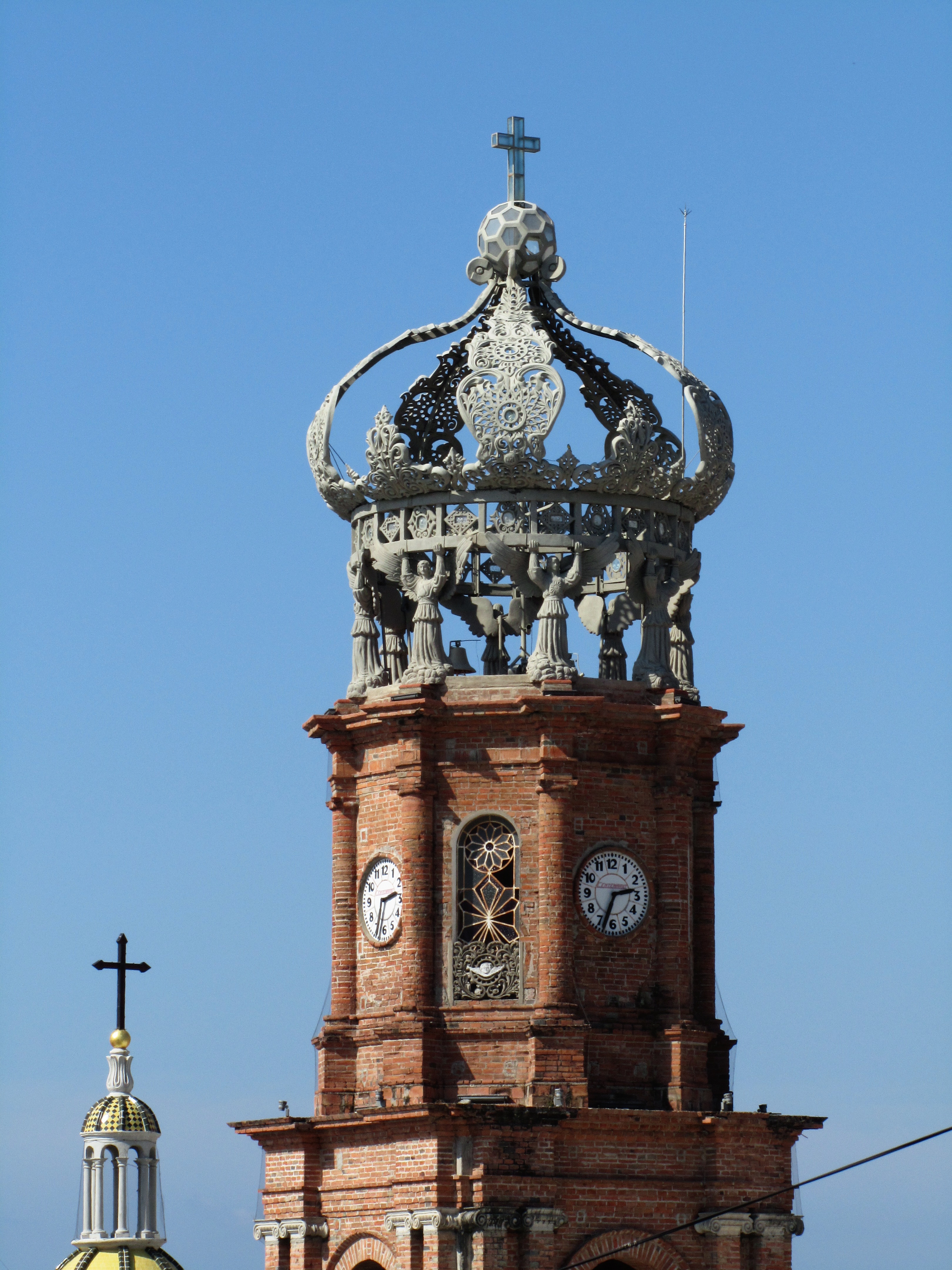
Church of Our Lady of Guadalupe (Puerto Vallarta)
For ten nights each December, fireworks crack above the Pacific coast of Jalisco. They follow the evening rosary at the Church of Our Lady of Guadalupe in Puerto Vallarta, building toward the feast day on December 12, the date tradition holds the Virgin first appeared to Juan Diego on a hill outside Mexico City in 1531. Homes throughout the city fill with makeshift altars: a painting of Guadalupe surrounded by candles, flowers, personal tokens. The church that anchors these celebrations sits in the heart of Puerto Vallarta's old town, its distinctive crown-topped spire visible from the malecón, from the beach, from the bay itself. In a resort city increasingly defined by tourism, the Iglesia de Nuestra Señora de Guadalupe remains the spiritual center that predates the hotels.
The Vision on the Hill
The story begins 500 years ago and 500 miles away. In 1531, an Indigenous man named Juan Diego was crossing Tepeyac Hill near what is now Mexico City when he encountered what he described as the Holy Mary of Guadalupe. The encounter transformed Diego into a missionary, known by turns as "the humble and obedient Indigenous," "Our Lady's Visionary," and "The humble Ambassador of the Virgin." His testimony spread Christianity across Mexico with a power that colonial force alone had not achieved. The Virgin's message, as tradition records it, was disarmingly personal: no instruction to say the rosary or attend church, simply "love me, trust me and believe in me." The original tilma bearing the Virgin's image survives in the Basilica of Our Lady of Guadalupe in Mexico City on Tepeyac Hill. Pope Pius XII proclaimed her "Empress of the Americas" in 1945. In Puerto Vallarta, the devotion is not a historical curiosity. It is ongoing, daily, lived.
An Expression of Village Art
The church itself is Catholic in faith and distinctly Mexican in character. Father Luis Ramirez, in parish documents, called it "an expression of village art, which symbolises the authentic urban look of Puerto Vallarta." Above the altar hangs a replica image of Our Lady of Guadalupe painted by Ignacio Ramirez in 1945, an oil painting that serves as the focal point of worship. The building offers services in English on Saturdays and mass in both Spanish and English on Sundays, a concession to Puerto Vallarta's dual identity as Mexican city and international resort. But the architecture, the devotional calendar, and the rhythms of worship belong to the community that built the church before tourism arrived. The crown topping the spire has become the city's most recognizable silhouette, a visual anchor that orients visitors and residents alike.
More Than a Saint
Our Lady of Guadalupe long ago transcended her religious origins to become inseparable from Mexican national identity. She is a symbol of liberation from the colonial period, when the Spanish Conquest of the Aztec Empire dismantled indigenous traditions, rituals, and deities. For the Indigenous people of Mexico, Guadalupe offered hope of salvation within a faith that had been imposed upon them. She embodies both the maternal and the revolutionary: a figure of motherhood and female empowerment embraced by Mexican-American women as an affirmation of dignity. Across the United States, her image appears in social justice movements, invoked by communities that lack power. She stands for life, health, and hope, a supernatural mother and a natural one, carrying both political and religious aspirations on a single tilma.
December Nights
The feast day celebrations reveal how deeply Guadalupe is woven into daily life along this coast. For ten days before December 12, fireworks follow the evening rosary at the church. Families construct shrines in their homes, surrounding her image with flowers, candles, and personal offerings. The celebration is communal and domestic at once, visible in the streets and intimate behind closed doors. Puerto Vallarta, known for its beaches and nightlife, becomes during these days a city of devotion. The tourists still come, the resorts still operate, but the rhythm shifts. The church that sits quietly in the old town the rest of the year becomes the center of a city-wide observance that predates any hotel, any cruise ship, any international flight to Gustavo Diaz Ordaz International Airport.
From the Air
Located at 20.6083°N, 105.235°W in downtown Puerto Vallarta, Jalisco. The church's crowned spire is the most prominent vertical structure in the old town, visible from the bay and from altitude. Puerto Vallarta sits between the Sierra Madre Occidental and Banderas Bay. Nearest airport is Gustavo Diaz Ordaz International (MMPR/PVR), just north of the city. From 2,000-4,000 feet, the church is identifiable in the dense grid of Centro, near the malecón waterfront promenade. The bay curves south toward Mismaloya and the Costalegre coast.