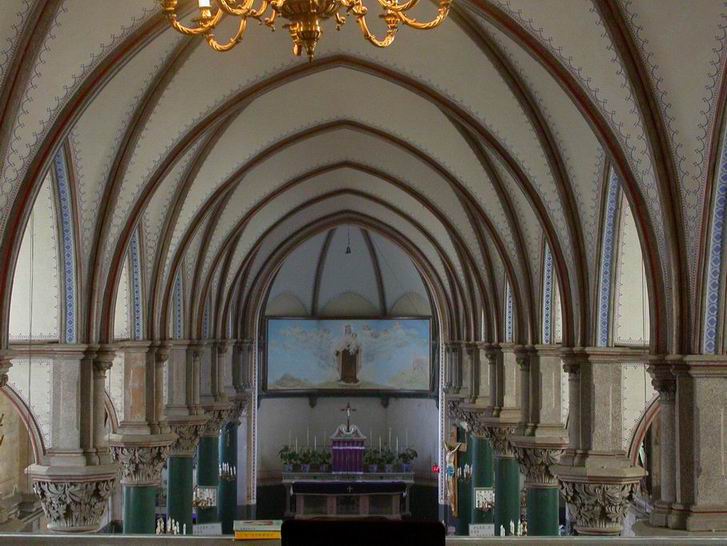
Church of Our Lady of Mount Carmel, Beijing
Red characters scrawled across a church wall in a moment of revolutionary fury. The Cultural Revolution has been over for decades, but the Church of Our Lady of Mount Carmel -- known to locals simply as Xitang, the West Church -- has deliberately kept the graffiti. The paint has faded but remains legible, a scar the church chose to preserve rather than whitewash. It is a fitting gesture for a building that has been destroyed and rebuilt three times, each iteration absorbing another layer of Beijing's turbulent relationship with Christianity.
The First Non-Jesuit Church
The West Church was the last of Beijing's four historic Catholic churches to be established, and the first to break the Jesuit monopoly. In 1723, the Italian Lazarist missionary Teodorico Pedrini -- who also served as music tutor to the children of the Kangxi Emperor -- used his own funds to purchase the land and build a church dedicated to the Seven Sorrows of the Blessed Virgin Mary. Pedrini was a remarkable figure: a priest, musician, and diplomat who navigated the complex politics of the late Kangxi court. After his death, the church passed to the Carmelites, then to the Augustinians. In 1811, during a wave of anti-Christian persecution under the Jiaqing Emperor, the church was destroyed for the first time.
Destruction and Resurrection
The pattern of destruction and rebuilding defines this place. Bishop Mouly rebuilt the church in 1867, giving it a second life that lasted only 33 years. On June 15, 1900, during the Boxer Rebellion, the church was burned to the ground. The parish priest, Father Mauritius Dore, was killed in the attack. In 1912, funded by a donation from Rosalie Branssier of the Daughters of Charity, the church rose a third time under its current name -- Our Lady of Mount Carmel -- rededicated with a new title but the same stubborn refusal to disappear. A stone inscription in both Chinese and Latin, erected by Bishop Jarlin in 1913, records the church's three lives in precise detail, naming each builder, each destroyer, each benefactor.
Gothic Arches on a Beijing Street
The church that stands today at No. 130 Xizhimen Neidajie is a Gothic Revival structure whose interior is framed by delicate Corinthian pillars and pointed arches. It is a surprisingly graceful building for a site with such a violent history. Mass is conducted in French every Sunday at 11 a.m. -- a detail that connects the present church to its long relationship with the French Catholic mission in China. The three other historic Catholic churches in Beijing -- the Wangfujing Cathedral (East Church), the Cathedral of the Immaculate Conception (South Church), and Xishiku Cathedral (North Church) -- each have their own stories of destruction and rebuilding. Together, the four churches form a compass rose of faith across the capital, each pointing to a different chapter in the centuries-long, often painful encounter between China and Western Christianity.
From the Air
Located at 39.94N, 116.36E near Xizhimen in Beijing's Xicheng District. The church is a small Gothic structure in a dense urban neighborhood, difficult to spot from high altitude but identifiable at lower altitudes by its pointed roofline among flat-roofed buildings. Nearest major airport is Beijing Capital International Airport (ZBAA/PEK), approximately 24 km northeast. Beijing Daxing International Airport (ZBAD/PKX) lies about 48 km south. Best viewed below 3,000 ft.