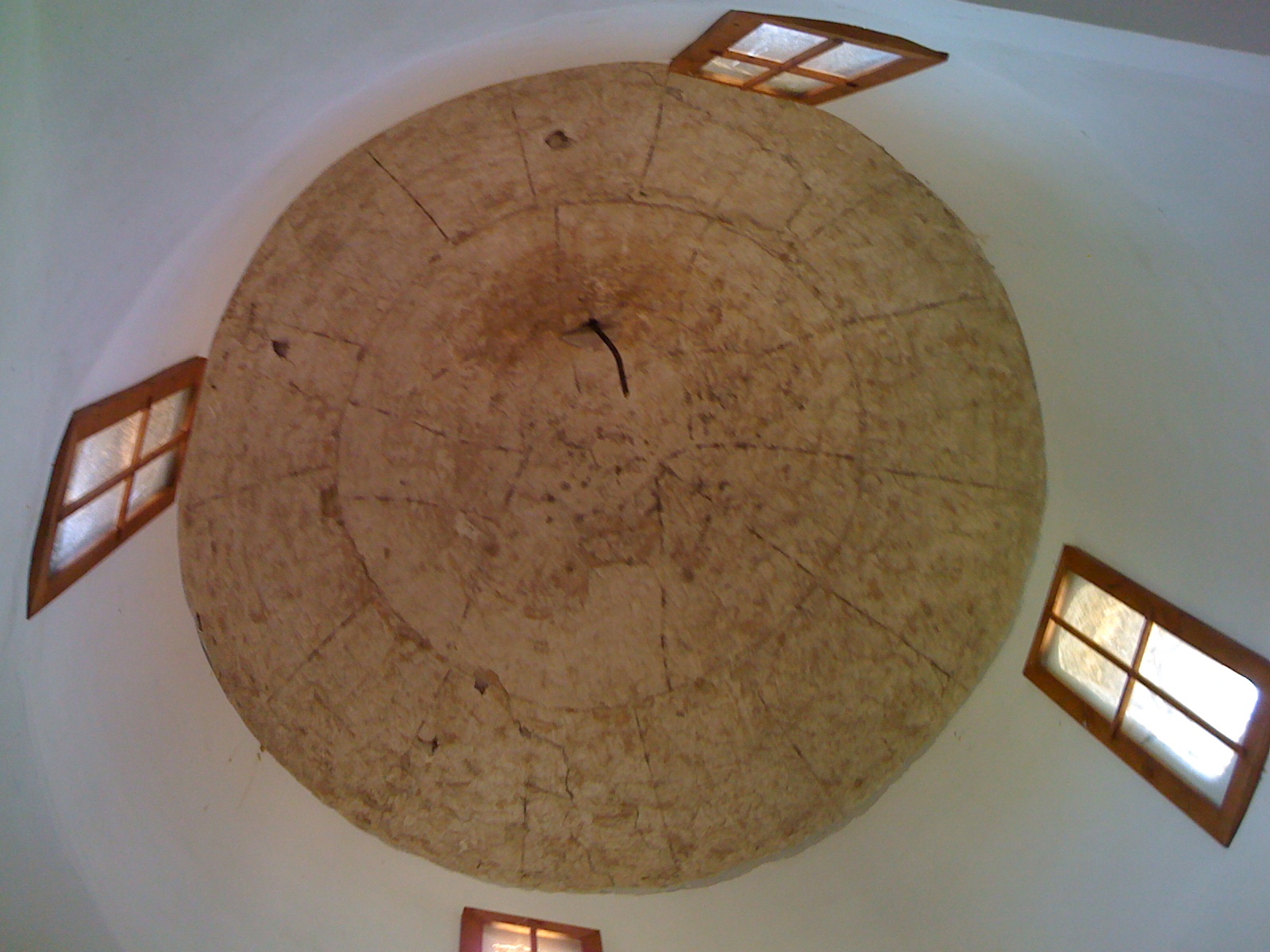
Church of Saint Euphemianos, Lysi
When Dominique de Menil's foundation paid for thirty-eight pieces of cut-up Byzantine fresco in 1984, she was not buying art. She was rescuing evidence. The fragments arrived in Houston still bearing the toolmarks of whoever had hacked them out of a small medieval dome in Cyprus, somewhere between 1974 and 1983. The seller was a German-based Turkish art dealer named Aydin Dikmen, a notorious smuggler who claimed the frescoes had come from an abandoned church in southern Turkey. They had not. They had come from the Church of Saint Euphemianos, a tiny single-domed chapel two kilometers southwest of the village of Lysi, in the Famagusta district of Northern Cyprus, behind a line of soldiers that had been drawn across the island in 1974. The villagers who had visited that chapel every November 14, on the saint's feast day, in numbers reaching into the thousands, were no longer allowed to go home.
A Saint with Three or Four Names
The dedication inscription on the arch of the church is a small puzzle on its own. It records that the chapel was built by a monk and abbot named Lavrentios of St. Andronikos Monastery, dedicated to Saint Themonianos. No saint by that name is known. The most likely explanation is that Themonianos is a corruption of the name Euphemianos, a local 12th-century Cypriot saint who lived an ascetic life in a cave near the village of Lefkoniko in the plain of Mesaoria. Tradition holds that he was one of three hundred Palestinian Christians who fled to Cyprus during the Arab persecutions, hiding in caves and ravines on the island. His name shifted with each generation that prayed to him: Phenianos, Thymianos, Thomianos. The villagers around Lysi simply called him Ais Phenianos. The chapel was technically not a parish church but a small place of pilgrimage, with no resident priest, opened mostly on the saint's feast day. Thousands would walk out from the surrounding villages on November 14, every year. They had been doing so for centuries.
What the Dome Held
Step inside the chapel before 1974 and you stood under one of the most accomplished surviving programs of Byzantine fresco painting in Cyprus. The dome was filled by a Christ Pantocrator, the All-Sovereign, in his usual position above the worshippers. Around him, in a double ring, angels moved toward an empty throne, the Hetoimasia, the throne prepared by God the Father for the Second Coming. The throne was guarded by Archangel Michael and Archangel Gabriel and two seraphim. The Virgin Mary led one line of angels toward the throne. John the Baptist led the other. In the apse below, the Virgin appeared again, flanked by the same two archangels, this time wearing a medallion on her breast that contained the infant Christ, the visual sign of the Incarnation. The frescoes had been carefully maintained by the Department of Antiquities of Cyprus, with conservation work completed in 1972, two years before the war.
Cut Into Thirty-Eight Pieces
On 20 July 1974, Turkey invaded northern Cyprus. The line was drawn. Lysi ended up on the Turkish-controlled side. The Greek Cypriot villagers fled south as refugees and could not return. Sometime between 1974 and the spring of 1983, the dome of Saint Euphemianos was cut. The Christ Pantocrator and the apse Virgin were removed in thirty-eight separate fragments. Whoever did the cutting knew enough to slice along the painted seams of the original Byzantine method, but they were also working quickly, in a closed military zone, against an interior surface they were never going to put back. The frescoes were smuggled to Munich. Aydin Dikmen, an art dealer with a long, well-documented record of trafficking in stolen Cypriot heritage, took possession of them and prepared them for the European market. He produced paperwork claiming a Turkish provenance. The Cyprus Department of Antiquities was eventually able to prove, decisively, that the murals had been forcibly removed from this specific chapel. Negotiations dragged for years. Ownership was confirmed by international agreement to belong to the Orthodox Church of Cyprus.
Houston, of All Places
Dominique de Menil and the Houston-based Menil Foundation purchased the thirty-eight fragments on behalf of the Greek Orthodox Church of Cyprus, the legitimate owner. The Foundation funded a careful restoration of the paintings, piecing the fragments back together over years of patient work. A February 1992 agreement between the Church of Cyprus and the Menil specified the terms: the Menil would care for the frescoes and cover all conservation costs in exchange for the right to display them publicly for twenty years, ending in February 2012. In 1997, the Foundation opened the Byzantine Fresco Chapel in Houston, a purpose-built sacred space designed by François de Menil to receive the restored frescoes in something approximating their original architectural setting. For fifteen years, anyone in Texas could visit a small chamber in Houston and stand under a Cypriot Christ Pantocrator and an apse Virgin from a 13th-century chapel they could not visit at home. The Byzantine Fresco Chapel was, for that period, the only intact Byzantine frescoes of this size and importance anywhere in the entire western hemisphere.
Returning at Age 700
On 23 September 2011, the Church of Cyprus and the Menil Foundation announced an agreement: when the loan expired in February 2012, the frescoes would be repatriated to Cyprus. They were. The chapel that received them was not the chapel that had lost them. Saint Euphemianos still stands behind the line, still empty inside its battered dome, the toolmarks of the smugglers still visible where the frescoes had been removed. The repatriated paintings now reside in the south, in a setting under the care of the Church of Cyprus, available to the displaced communities whose families had walked out to the chapel every November for hundreds of years. The story of the Lysi frescoes has become, in international cultural-property law, one of the most cited cases of post-conflict art repatriation. It is also a much smaller story, the story of a chapel built by an abbot named Lavrentios, dedicated to a saint named Euphemianos who lived in a cave eight hundred years ago, painted with a Christ in glory that watched over villagers for seven centuries until soldiers and a dealer in Munich came between the painting and the people who knew it.
From the Air
The Church of Saint Euphemianos sits at 35.0857 N, 33.6647 E, on open countryside about 2 km / 1 nm southwest of the village of Lysi, in the Mesaoria plain of Northern Cyprus. The chapel itself is too small to identify reliably from the air (a single-dome stone structure), but its setting on the wide Mesaoria, the great central plain of Cyprus, is unmistakable. Best viewed at 2,000 to 4,000 ft AGL on a clear day, with the Kyrenia Mountains visible to the north and the Famagusta coast to the east. Nearest airports: Ercan International (LCEN) about 25 nm west on the same plain, and Larnaca International (LCLK) about 30 nm south in the Republic of Cyprus. The current Lysi village lies on the Turkish-controlled side of the UN buffer zone.