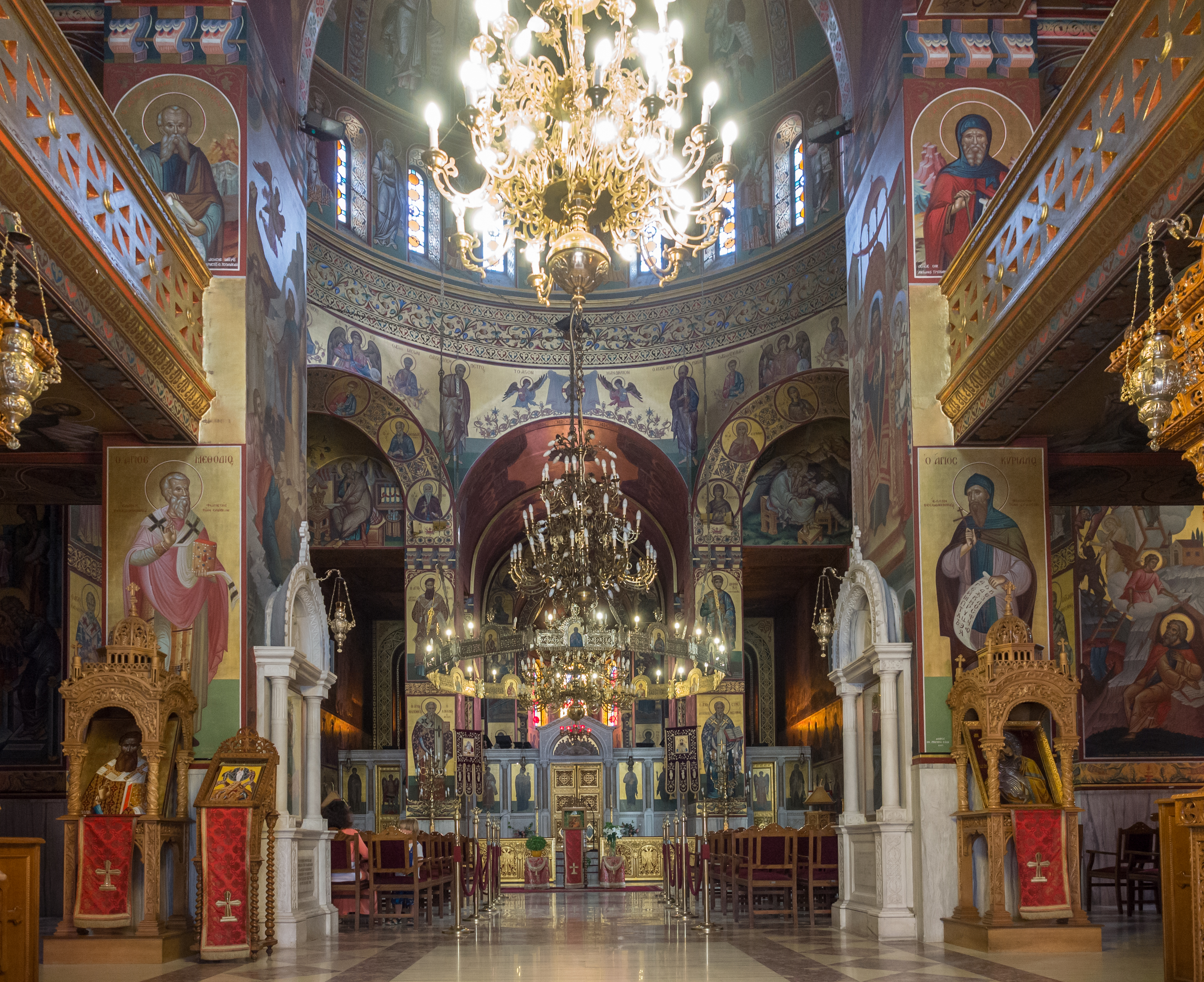
Church of Saint Gregory Palamas
Construction took twenty-three years and went badly. The architect was the most celebrated builder in modern Greece. The site was unstable, the soil was too close to the sea, the contractors were dismissed, the original drawings were lost, the city ran out of money, a war broke out, and a metropolitan cathedral that should have been finished in three or four years instead limped its way to completion in 1914. By then the city around it had changed hands. Saloniki was Thessaloniki again, the Ottoman flag had come down, and the church needed a new dedication. They gave it to Gregory Palamas, the fourteenth-century mystic whose bones lay inside, and who had been waiting eight hundred years for a cathedral named after him.
The Old Cathedral That Burned
On August 22, 1890, fire destroyed the previous church on this site, a three-aisled basilica that had stood at the corner of Metropolis and Hagia Sophia streets for more than five hundred years. Built in the late thirteenth and early fourteenth centuries by the Palaiologan emperor Andronikos II, it was originally dedicated to the Theotokos. After the Ottoman conquest of 1430 it was rechristened for Saint Demetrius, the patron saint of Thessaloniki. During the Greek Revolution of 1821, hundreds of Thessalonian Greeks sought sanctuary inside its walls. The Ottomans broke the doors down and killed them where they stood. The miraculous icon of Saint Demetrius and the Patriarchal throne survived, but the building burned down sixty-nine years later, leaving the city without its principal cathedral and the Greek community without a center of worship.
Ziller's Difficult Project
Ernst Ziller was the obvious choice as architect. A German-Greek who had built half the public buildings of newly independent Athens, he was the leading figure in Greek nineteenth-century architecture. The foundation stone went down on June 16, 1891. By the next year, work had stopped. The municipality accused the contractors of using cheap materials and ignoring Ziller's drawings. Ziller's student Achilleas Kambanakis was fired. The replacement asked for the plans, but Kambanakis refused to surrender them, and Ziller said he had no copies. The half-built shell stood empty for a decade. The Greco-Turkish War of 1897 ate the rest of the budget and the energy of the Greek community, and it was not until 1902 that work resumed under Xenophon Paionidis, the official municipal architect. Rough construction was finished in 1906. The whole building cost 302,229 gold lira, an enormous sum for a community still living under Ottoman rule.
The Saint Beneath the Floor
Gregory Palamas was a fourteenth-century monk who became archbishop of Thessaloniki and the most influential Orthodox theologian of his age. He was the chief defender of hesychasm, a contemplative practice in which monks on Mount Athos sat motionless for hours repeating the Jesus Prayer, claiming that the divine light they sometimes glimpsed was the same uncreated energy that surrounded Christ at the Transfiguration. Palamas argued the case at four church councils between 1341 and 1351 and won. The Orthodox Church canonized him within a few decades of his death in 1359. His bones, kept in Thessaloniki ever since, are now housed in the cathedral that bears his name. Pilgrims come to venerate the relics on the second Sunday of Lent, the feast day Orthodoxy assigns to him, and the Hesychast tradition he defended is still practiced on Mount Athos seventy kilometers down the coast.
Earthquake and After
On June 20, 1978, an earthquake of magnitude 6.5 struck Thessaloniki and killed forty-seven people across the city. The cathedral cracked badly, and inspectors blamed the same problems that had plagued the original construction: poor materials, departures from Ziller's drawings, foundations laid in unstable soil. Some argued for demolition. Others insisted the building had to be saved. After significant reconstruction, it reopened on November 13, 1980. The form is unusual for nineteenth-century Macedonia, an octagonal neo-Byzantine plan with a large central dome and four bell towers, eclectic in its borrowings from neoclassical, neo-Romanesque, and neo-Renaissance vocabularies. The interior was painted by the Constantinople-born artist Nikolaos Kessanlis, who arrived in Thessaloniki in 1911 as the new church neared completion. A secret door once connected the building to the Greek Consulate next door, the headquarters between 1904 and 1908 of the armed Greek struggle for Macedonia. Stories build up around buildings the way frescoes build up on church walls, layer over layer, and the cathedral wears them all.
From the Air
Located at 40.6308 N, 22.9439 E in central Thessaloniki, near the waterfront. Recommended viewing altitude: 2,000 to 4,000 feet AGL. Visual landmarks include the four corner bell towers of the cathedral itself, the White Tower waterfront landmark just southeast, and Aristotelous Square one block west. Nearest airport is Thessaloniki Makedonia International (LGTS), about 15 km southeast. Best visibility in autumn and winter mornings before the Thermaic Gulf haze sets in.