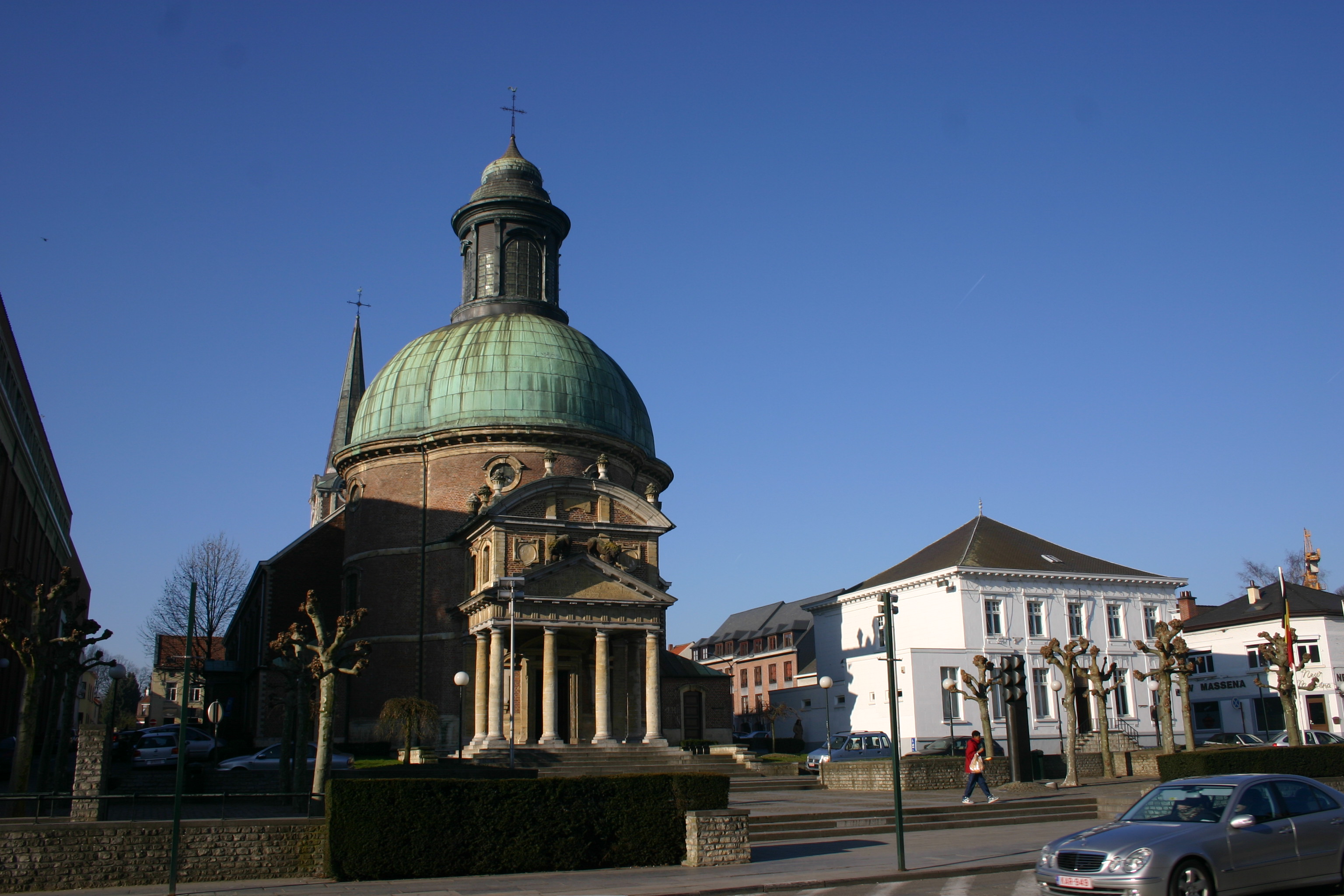
Church of Saint Joseph, Waterloo
The marble plaques line the walls in two languages, English and Latin, and most of them mention young men by name: Captains, Lieutenants, Colonels of regiments whose colours hung in London cathedrals long ago. They died on 18 June 1815 in the wheat fields a few miles south of this church, at the Battle of Waterloo. Some are buried here; many more are commemorated here because there was no other grave. The Church of Saint Joseph in the small Belgian town of Waterloo was not built for them - it was built more than a century earlier, in the 1680s, by a Spanish governor desperate to produce an heir for his sickly king. The wars that history wrote across it were not yet written.
A Chapel for a Sterile King
In 1685 the Spanish Netherlands had a problem, and his name was Charles II of Spain. The last Habsburg of the senior line was thirty-four years old, twice married, and almost certainly infertile - his physicians blamed bewitchment and bled him constantly. Don Francisco Antonio de Agurto, marquis de Gastanaga, the new governor-general, hit on a pious solution. He would build a chapel near Waterloo dedicated to Saint Joseph, foster-father of Christ and patron of fathers, and pray for the king to produce a son. The first stone was laid on 26 June 1687 in the presence of the Archbishop of Mechelen, and the chapel was inaugurated with full ceremony on 19 February 1690. The Walloon architect Philippe Delsaux gave it a domed rotunda and a colonnaded portico, two stone lions on the pediment - the language of French baroque classicism, the language of royal solemnity. Charles II remained childless and died in 1700 without an heir, triggering the War of the Spanish Succession. The marquis was recalled to Madrid in disgrace for losing the city of Mons to the French. The chapel, however, was built.
The Roof Sold for Bullets
A century later the French Revolution swept across the southern Netherlands and the royal chapel - now state property of a republic that had no use for royalty or for chapels - was auctioned off. A speculator from Paris named Thomas Gillet bought it cheap, along with two neighbouring abbeys, and began stripping the buildings for materials. He had the lead torn off the dome and sold to army suppliers, who melted it down for rifle bullets. He would have demolished the rest if the local people had not opposed him so fiercely that he hesitated. Meanwhile a brave priest called Abbot Bierlaire celebrated mass in secret, in a barn belonging to the widow of one Philippe Pastur. Napoleon's Concordat with the Pope in 1801 restored the chapel to Catholic use. Its first official Mass was held on 10 June 1806 - exactly nine years and eight days, as it happened, before the battle that would change everything about this place.
After the Battle
On 18 June 1815, while Wellington's army held the ridge of Mont-Saint-Jean to the south, the chapel and the parsonage and every other building in Waterloo filled up with the wounded. They lay on doors lifted off their hinges, on straw, on the bare stone floor. The surgeons worked for three days without sleep. When it was over, the British began burying their dead and commissioning memorials, and the modest baroque rotunda became the chosen place. Plaques went up to officers of the Royal Scots Greys, whose famous cavalry charge had cut through D'Erlon's column - their barracks at Restalrig in Edinburgh are named on more than one inscription. Plaques went up to colonels of the Foot Guards, to artillery officers, to staff officers whose horses had been shot under them. The Duke of Wellington visited and paid his respects. The chapel became a place of British pilgrimage, and the congregation grew so large - up to 1,500 people on big anniversaries - that the building had to be extended in 1823 and again in the 1850s, the British contributing money to the second expansion.
The Architecture Today
What survives is a layered building, like the history that made it. The original baroque rotunda still stands, with its dome, its portico, and the two stone lions over the door. Behind it stretches the long neo-classical nave that the nineteenth century added, three aisles wide, lit by a lantern in the cupola and six bullseye windows. The interior was rebuilt in white stone and stucco, with Ionic pilasters supporting the entablature, and there is a pulpit and a set of massive sculpted-oak communion benches rescued from the suppressed abbey of the Blanches Dames at Aywier. A renovation in the 1960s, led by descendants of the soldiers who fought at Waterloo, stripped away the Victorian additions and walled off the original royal chapel as a separate space - you reach it now through a glass door that traces the dimensions of the old portico. The presbytery next door, in its handsome neo-classical facade, now houses the town's tourist office and a small museum of local history.
Why You Stop
You stop here because the Lion's Mound and the battle panorama, two kilometres south, give you the scale of Waterloo, but this church gives you the names. To stand in a small Belgian rotunda and read, in English, that a particular twenty-six-year-old captain of the Scots Greys was killed by a French lance at four o'clock in the afternoon - and that his mother in Edinburgh paid for the marble - is to feel the battle as something other than a Wikipedia entry. Two hundred years on, fresh flowers still appear beneath some of the plaques. The British, and the descendants of the Hanoverians and the Dutch and the Belgians who died with them, have not entirely stopped coming.
From the Air
Located at 50.72 N, 4.40 E in the centre of Waterloo, on the Chaussee de Bruxelles 298, about 15 km south of Brussels. The church's copper-clad spire (22 m, added in 1899) is the most visible landmark from the air, standing well above the surrounding two- and three-storey town. The battlefield and Lion's Mound lie 3 km further south. Recommended viewing altitude 1,500-2,500 ft AGL. Brussels Airport (EBBR) is 25 km north-east; Charleroi/Brussels South (EBCI) is 30 km south.