Church of Saint Mary of the Mongols
Maria Palaiologina was an emperor's daughter sent away to be a peace offering. In 1265 her father Michael VIII shipped her overland to the court of Hulagu, the Mongol Ilkhan whose grandfather Genghis had nearly destroyed the world her family ruled. She was sixteen, illegitimate but well loved, and she went because the Mongols were the most useful allies a beleaguered Byzantine emperor could imagine. Hulagu died before she arrived. She married his son Abaqa instead and lived among the Mongols for fifteen years, raising a daughter, surviving palace intrigues, watching one Khan after another fall to assassination or war. When Abaqa died in 1282 she came home to Constantinople. She rebuilt a small monastery on the fifth hill, retired into it as a nun, and gave the church the shape it still has today. Greeks have called her foundation Panagia Mouchliotissa, the Virgin of the Mongols, ever since.
The Fifth Hill
The site is in Fener, the Greek quarter that climbs the slope above the Golden Horn. A high wall surrounds the courtyard, and the doors are usually shut. Visitors ring a bell to be let in. Inside, behind the wall, a tetraconch building with a central dome rises out of a tangle of roofs and trees, the only Byzantine church in Istanbul whose dedication has never changed. Its history began at the start of the seventh century, when Princess Sopatra, daughter of Emperor Maurice, and her friend Eustolia built a nunnery on land the emperor gave them, ground that had been a cemetery before. The Latin Crusaders destroyed everything during their occupation of the city after 1204. Maria's uncle Isaac Doukas built a small replacement monastery in 1261, the year the Byzantines retook Constantinople, and Maria rebuilt it on a grander scale twenty years later when she came home from the steppe.
The Sultan's Promise
When Mehmed II conquered Constantinople in 1453, he did something almost no other Byzantine church received: he left it alone. Tradition holds that he gave the building to the mother of Christodoulos, the Greek architect who designed his Fatih Mosque, in gratitude for his work. Bayezid II, Mehmed's son, renewed the grant in honor of Christodoulos's nephew, who built the Bayezid Mosque a generation later. The original firmans, the imperial decrees granting the church to the Greek community, are still kept on the property. Twice in the centuries that followed, sultans tried to convert the church anyway. Selim I in the early sixteenth century made an attempt that failed. At the end of the seventeenth century, Grand Vizier Koprülü was on the verge of doing it when the Moldavian prince and scholar Dimitrie Cantemir intervened, presenting the original firmans to the court and persuading the sultan to honor his ancestors' word. The church remained Greek. It has been ever since.
The Bloody Church
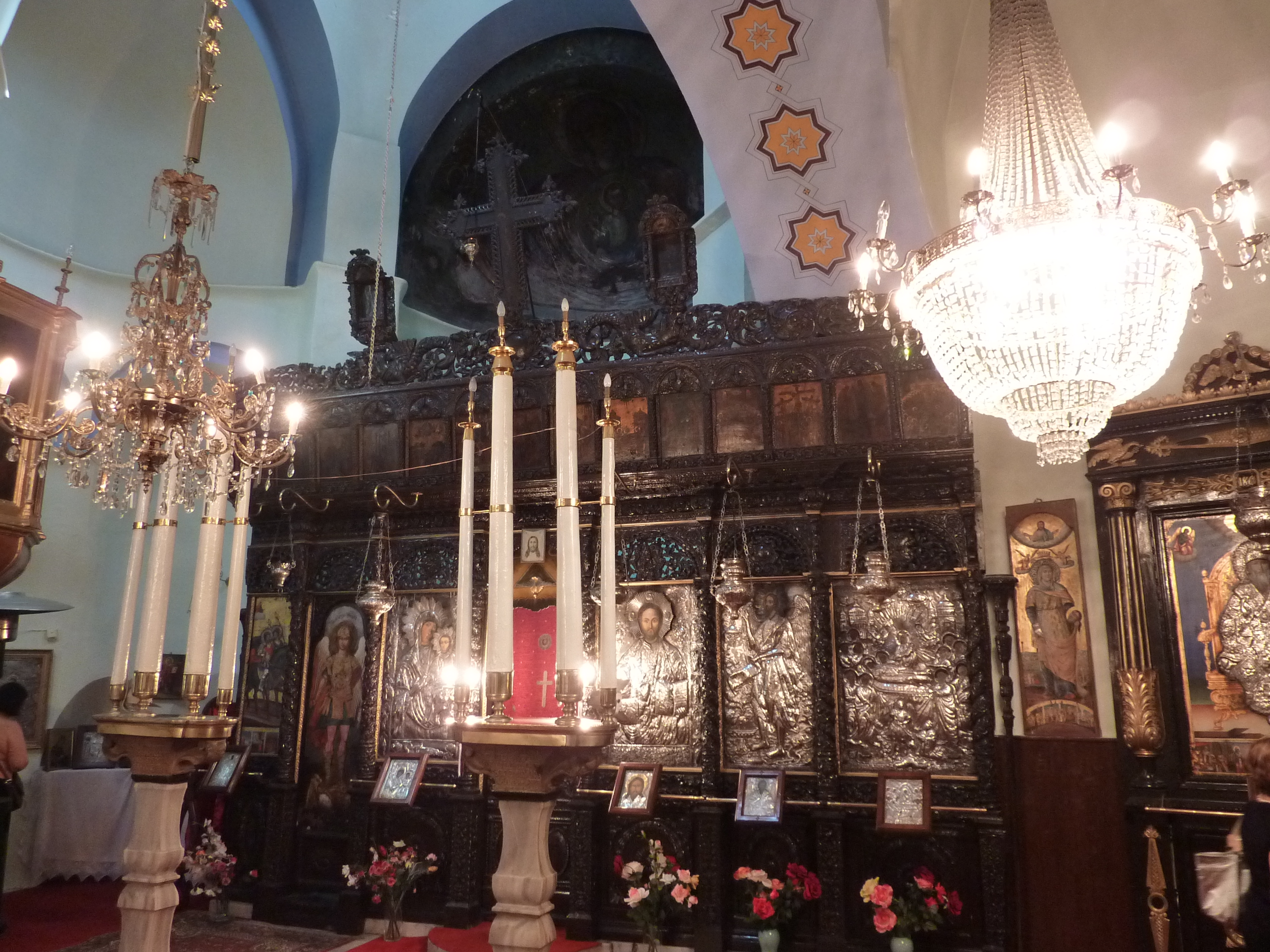
Turks call the building Kanlı Kilise, the Bloody Church. The name attaches to the night of May 29, 1453, when the city fell. According to local tradition the streets around Fener ran with blood from the fighting and the massacres that followed, and the rivulets reached the church doors. Whether the story is literal or symbolic, it captures the texture of what the conquest meant for the Greeks who survived it: a wall of fire and slaughter inside which, somehow, this one small building was preserved. Fires later swept through Fener in 1633, 1640, and 1729, damaging the church each time. Repairs altered the original elegance. The southern half-dome and the southern bay of the narthex were removed and replaced with three aisles. The interior was stripped of its early decoration, then refilled with later icons and ornaments, the kind of accumulation that suggests a working parish rather than a museum.
What Survives
On the eastern wall, a large representation of the Last Judgment may have been painted by an artist named Modestos in 1266, just before Maria came home. An eleventh-century mosaic icon shows the Theotokos. Four other icons date from the thirteenth and fourteenth centuries. Below the church, excavations have revealed older foundations, and an underground passage that legend insists connects to Hagia Sophia, several kilometers away. No one has tried to confirm the passage in modern times. The church has never been studied properly from an architectural perspective, partly because it remains an active parish and partly because its ownership and access make systematic work difficult. It is small, tucked behind a wall, easy to walk past. It is also the single thread that connects the living Greek Orthodox community of Istanbul, now reduced to perhaps two thousand people, to the Byzantine city it descended from.
From the Air
Located at 41.0297 N, 28.9489 E on the fifth hill of Istanbul's old city, in the Fener neighborhood overlooking the Golden Horn. Recommended viewing altitude: 2,000 to 4,000 feet AGL. Visual landmarks include the Phanar Greek Orthodox College, a tall red-brick building uphill, and the Golden Horn waterway curving below. Nearest airports are Istanbul (LTFM), about 35 km northwest, and Sabiha Gokcen (LTFJ) on the Asian side. Bosphorus haze and afternoon thermals are common; mornings are clearest.