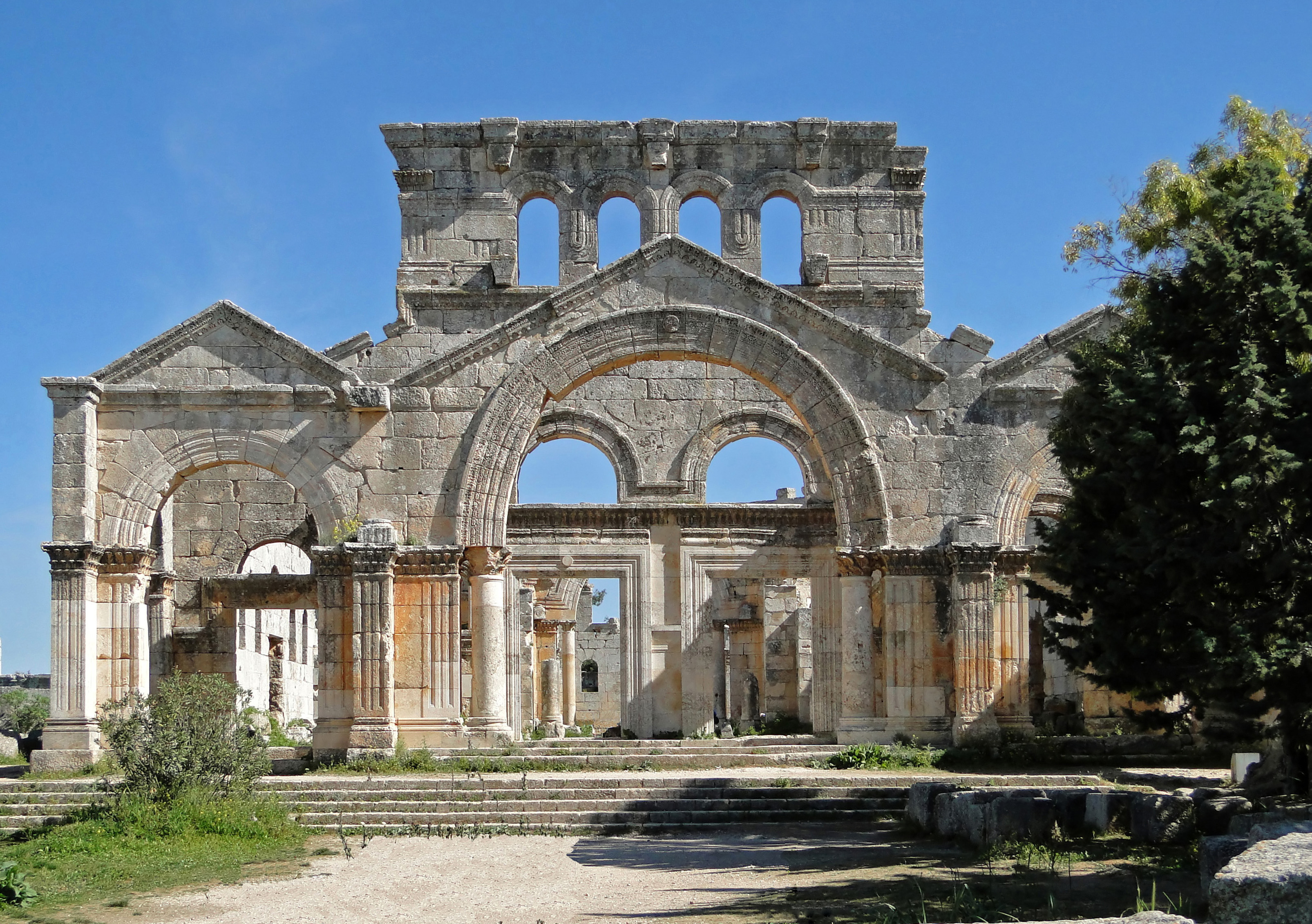
Church of Saint Simeon Stylites
For thirty-seven years, a man stood on a pillar. Simeon Stylites climbed his column around 423 AD in the limestone hills northwest of Aleppo, and he did not come down until his death in 459. Pilgrims walked for weeks to reach him. Emperors sent messengers. The faithful gathered below, craning their necks toward this gaunt figure silhouetted against the Syrian sky, seeking blessings from a man who had renounced every earthly comfort except the stone beneath his feet. When he finally died, the question was not whether to build a church on the spot, but how grand it should be.
The Grandest Church on Earth
The answer, completed around 490, was breathtaking. Four basilicas radiated outward from a central octagonal courtyard, forming a massive cruciform layout spanning over 5,000 square meters. At the heart of the octagon stood Simeon's column, now enclosed beneath a dome. No Christian church in the world was larger. It would hold that distinction for nearly half a century, until Constantinople's Hagia Sophia was completed in 537. The complex included two smaller churches, pilgrim hostels, a baptistery, and a processional avenue leading up from the monastery of Deir Semaan in the valley below. The baptistery was an architectural marvel in its own right -- an octagonal drum set atop a square base, its interior richly detailed. Pilgrims arrived by the thousands, following a monumental arched road from the valley monastery to the hilltop sanctuary, climbing toward the column that had made this remote ridge one of the most famous places in Christendom.
A Pillar Worn to a Boulder
Century after century, visitors chipped away at Simeon's column, carrying home fragments as sacred relics. By the 17th century, only stumps of the original shaft remained visible. The dome held on until the 19th century before it, too, collapsed. When modern visitors reached the octagonal courtyard, they found not a towering column but something resembling a boulder -- roughly two meters high, weathered and rounded by the hands of centuries of pilgrims. That this remnant survived at all is remarkable, given everything the site has endured. The church fell to the Miaphysites in 638 and was sacked by Arab tribes in 985. The emir of Aleppo, Sa'd al-Dawla, fortified the complex and used it as a military stronghold, though worshippers still came. Long abandoned, the church became part of Syria's haunting Dead Cities -- a constellation of Byzantine-era ruins scattered across the limestone massif, silent testimony to a civilization that once flourished here.
Fortress, Ruin, Battleground
The Byzantines understood the site's strategic value as well as its spiritual importance, fortifying it during the Arab-Byzantine wars. Known as Qalaat Semaan -- the Fortress of Simeon -- the hilltop complex served military and religious purposes simultaneously. Worshippers kept coming even after the emir of Aleppo seized the site. That resilience echoes through the centuries. When Syria's civil war engulfed the region after 2011, the ancient church found itself caught between multiple armed factions. Kurdish YPG forces captured the site in May 2015, only to lose it to opposition groups. In May 2016, Russian airstrikes struck the ruins, damaging what remained of the pillar and surrounding structures. By February 2020, Turkish forces occupied the hilltop nearby. Illegal excavation and stone theft compounded the destruction, part of a broader catastrophe that has degraded ancient sites across northern Syria.
What the Stones Still Say
Even in its damaged state, the Church of Saint Simeon Stylites speaks clearly to anyone who visits -- or who studies the photographs taken before the war. The cruciform plan remains legible in the surviving walls. The south facade's carved stone patterns, the remains of the atrium, and the octagonal courtyard still convey the ambition of the builders who raised this monument in barely a generation. The baptistery's design influenced Christian architecture across Syria and beyond. The site was nominated for UNESCO World Heritage status in 2006 as part of the "Simeon Citadel and Dead Cities" project, and was inscribed on the World Heritage List as part of the Ancient Villages of Northern Syria. What draws the eye, though, is still that worn stump at the center of the courtyard. Fifteen centuries after a monk decided to stand on a pillar and never come down, the place he chose still compels people to look upward.
From the Air
Located at 36.33N, 36.84E, on a hilltop roughly 30 km northwest of Aleppo, Syria. The cruciform layout of the ruins is visible from moderate altitude. The site sits atop a limestone ridge in the Dead Cities region. Nearest major airport is Aleppo International (OSAP). The surrounding limestone massif is dotted with other Byzantine ruins. Best viewed at 3,000-5,000 ft AGL for the cruciform plan to become apparent.