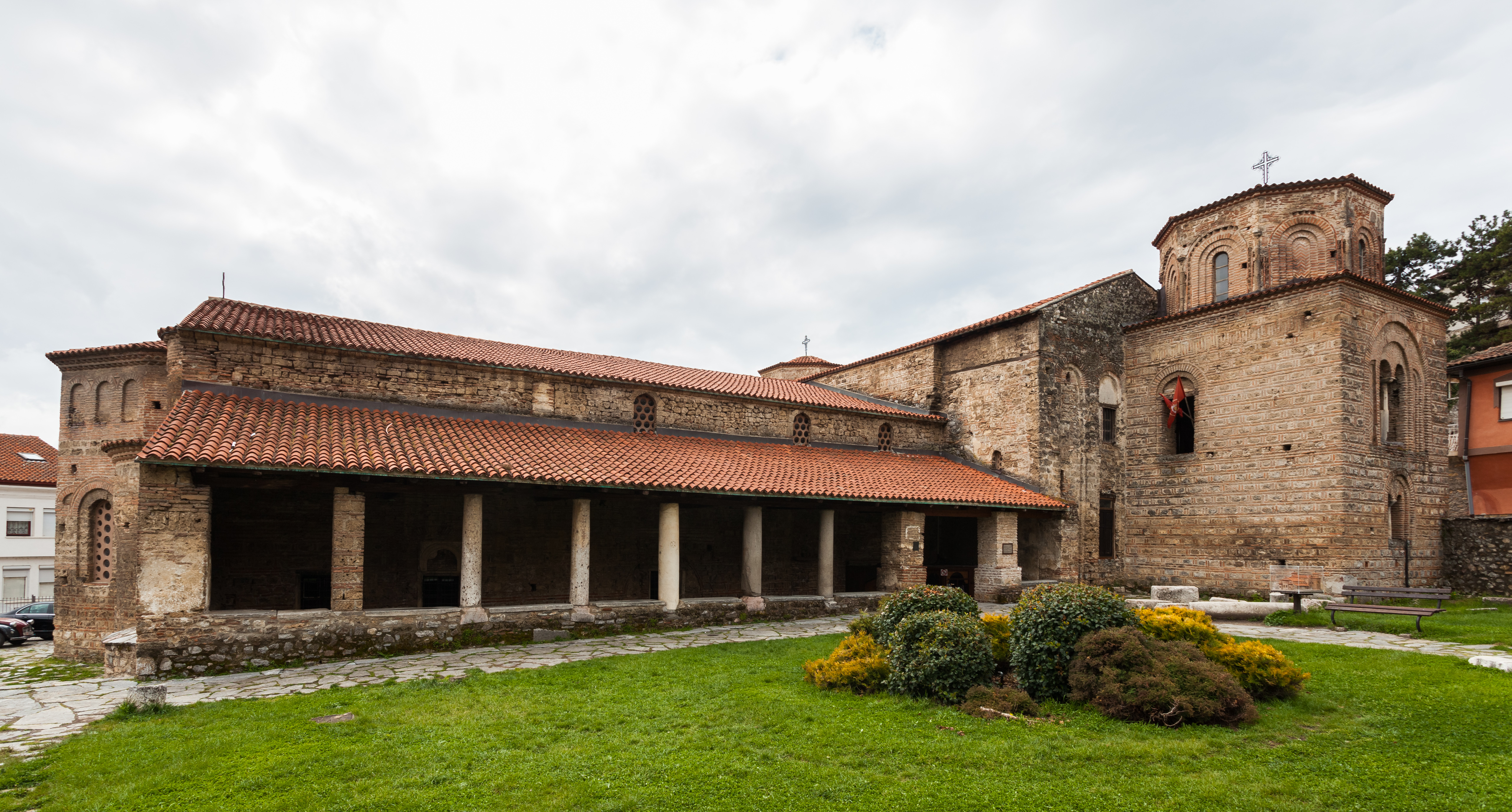
Church of Saint Sophia, Ohrid
Step inside and look up. The Virgin Mary gazes down from the apse, her robes rendered in lapis blue and gold by an 11th-century painter whose name has been lost but whose skill has not. The Church of Saint Sophia in Ohrid, North Macedonia, holds frescoes from the 11th, 12th, and 13th centuries that art historians consider among the most significant achievements in Byzantine painting -- and they survived only because the Ottoman Turks, when they converted the building to a mosque, plastered over the images rather than destroying them. Centuries later, when the plaster was carefully removed, the faces beneath were still vivid, still startling, still looking back.
Foundations Upon Foundations
The church stands on ground that has been sacred for over a millennium. An earlier metropolitan cathedral occupied this site until the first decade of the 6th century, when barbarian invasions swept the early Slavs into the region and demolished it. A replacement rose during the First Bulgarian Empire, after Bulgaria's official conversion to Christianity -- some sources place its construction during the rule of Knyaz Boris I, between 852 and 889. But the building visitors see today is essentially a late-10th-century creation, rebuilt as a patriarchal cathedral in the form of a domed basilica when Tsar Samuil moved the Bulgarian capital to Ohrid. At that moment, Saint Sophia became the seat of the Bulgarian Patriarchate, an autocephalous body that governed its own affairs. Later it served the Archbishopric of Ohrid, under the Patriarchate of Constantinople, a role it held until the 18th century.
Painted Walls, Hidden and Found
The frescoes are the reason people come. Painted across the 11th, 12th, and 13th centuries, they cover the interior with scenes of sacred narrative executed in a style that bridges the gap between earlier rigid iconography and the more expressive painting that would emerge later in the Byzantine tradition. The figures have weight and emotion; the colors remain rich after nearly a thousand years. When the Ottoman Empire converted the church into a mosque, the frescoes disappeared beneath layers of whitewash and plaster. Islamic tradition forbids figural imagery in places of worship, so the paintings were covered rather than admired -- but also rather than scraped away. This act of concealment became an act of accidental preservation. When restorers peeled back the plaster in the 20th century, they found the pigments remarkably intact, protected from light, moisture, and the abrasions of time by their very concealment.
Stone and Power
Architecture tells political stories, and Saint Sophia's walls are fluent. The main body of the church dates to the 11th century, built to project the authority of the patriarchate that it housed. The scale is substantial for a Balkan medieval church: high ceilings under a central dome, thick walls that have absorbed earthquakes and centuries of weather. In the 14th century, Archbishop Gregory II added external structures, expanding the footprint and updating the facade. The result is a building that reads as a palimpsest -- each era of construction visible in different stonework, different proportions, different decorative choices. A Byzantine Greek inscription on the exterior hints at the building's deep roots in the Greek-speaking ecclesiastical tradition, even as Slavic culture flourished around it. Today, a detail from the church appears on the reverse of North Macedonia's 1,000-denar banknote, and in 2009, the Macedonian Orthodox Church adopted a coat of arms featuring Saint Sophia as its central image.
Between Faiths, Between Eras
The conversion from church to mosque and back again is not unusual in the Balkans, where Ottoman rule lasted centuries and the boundary between Christian and Islamic sacred space shifted repeatedly. What makes Saint Sophia remarkable is how much survived the transitions. The structure itself was never torn down, only modified. The minarets that once marked it as a mosque are gone, but the building's bones are medieval, its interior paintings largely original. Standing in the nave, you occupy a space that has been continuously used for worship -- Christian, then Muslim, then Christian again -- for roughly a thousand years. The acoustics are extraordinary: voices carry and linger under the dome in a way that must have served both liturgy and the call to prayer. Outside, the old town of Ohrid cascades downhill toward Lake Ohrid, and Saint Sophia sits near the top of the slope, its stone walls catching the afternoon light as they have since Tsar Samuil's builders set them in place.
From the Air
Located at 41.11°N, 20.79°E in the old town of Ohrid, North Macedonia, near the crest of the hill overlooking Lake Ohrid. The church sits between Tsar Samuel's Fortress above and the lakeshore below. Ohrid St. Paul the Apostle Airport (LWOH) is approximately 10 km to the northwest. From the air, look for the cluster of historic structures on the hillside above the lake's northeastern shore. Best viewed at 3,000-5,000 ft AGL.