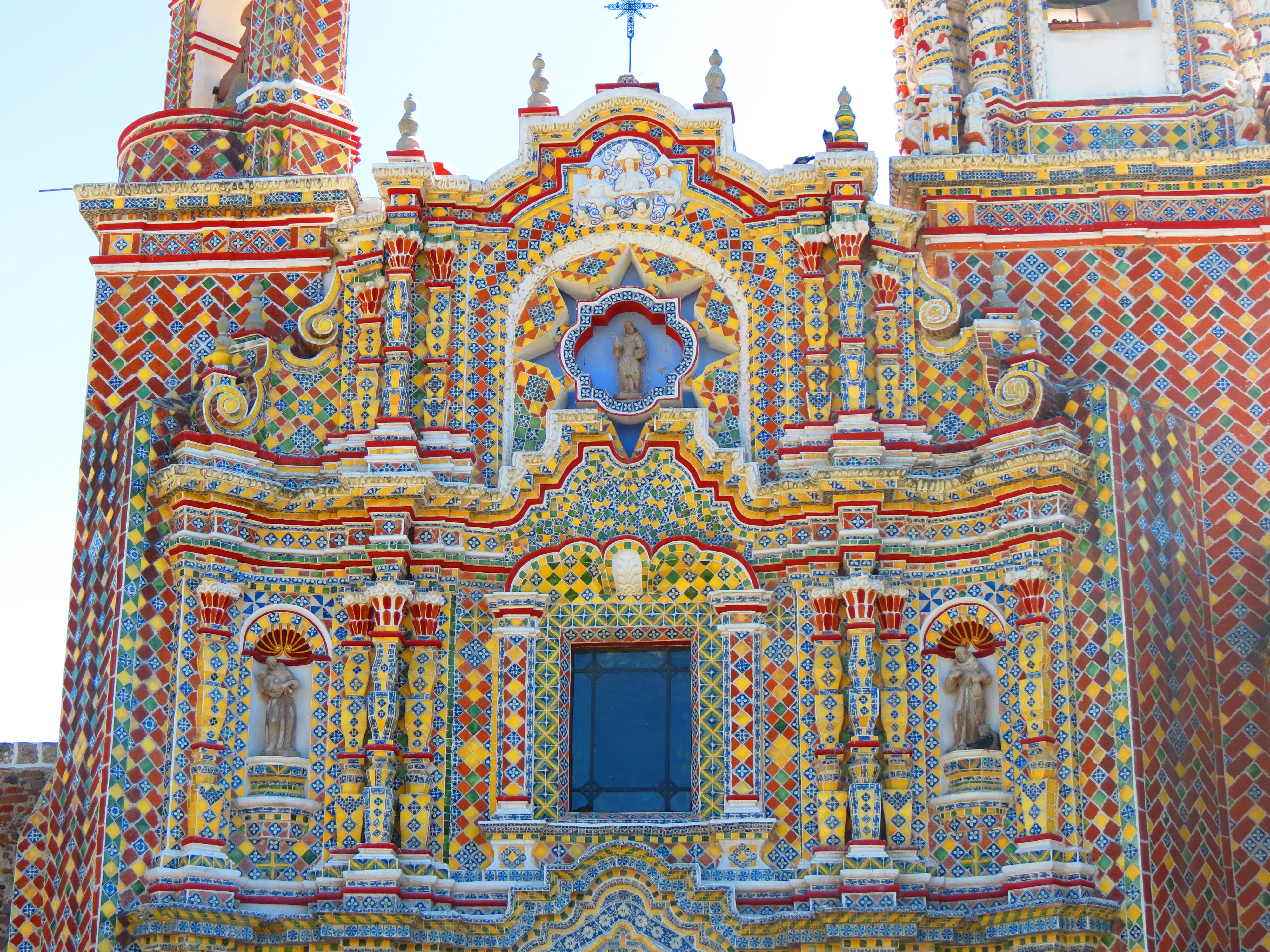
Church of San Francisco Acatepec
Art historian Manuel Toussaint called it a 'porcelain church,' and from a distance the description makes perfect sense. The Church of San Francisco Acatepec, standing in a small town in San Andres Cholula on the outskirts of Puebla, does not look like it is made of stone. Its facade shimmers with hand-painted Talavera azulejo tiles — blues and whites for the Virgin Mary, greens and yellows for Saint Joseph — interlocking with red brick in patterns so dense and colorful that the entire structure appears glazed, as if it had been fired in a kiln rather than built by masons. Each tile was made by hand between 1650 and 1750, during the century when Pueblan Talavera pottery became the defining decorative language of the region's Baroque architecture.
Two Centuries in the Making
The Franciscans arrived at this site in the sixteenth century and founded a small convent. In 1560, they began construction of a church, though the building that stands today took shape largely in the second half of the seventeenth century and the eighteenth. The facade, with its elaborate estipite columns — the inverted-obelisk pilasters characteristic of late Mexican Baroque — dates from the late 1700s. Art historian Elisa Vargas Lugo noted that the facade defies traditional forms: alongside the estipites, it features a star-shaped oculus and molded cornices that push the Baroque vocabulary into something idiosyncratic. The church was completed in 1760, two full centuries after the Franciscans first broke ground. That patience shows. Every surface has been considered, every transition between brick and tile deliberate.
A Facade Like No Other
What makes the church extraordinary is the completeness of its Talavera covering. The facade's small estipite pilasters are entirely sheathed in azulejos, as are the Solomonic columns on the church's single tower. The color scheme is theological: blue and white tiles reference the Virgin Mary, while green and yellow invoke Saint Joseph. The tower itself is covered in majolica with Baroque detailing, and a secondary bell tower on the right side is decorated with red bricks and azulejos of varying colors. Unlike many churches where Talavera serves as accent, here it is the entire architectural statement — hundreds of individually painted tiles forming a unified surface that catches the Puebla Valley light differently depending on the hour. From across the octagonal atrium, the effect is less a building than a piece of oversized ceramics.
Gold and Angels Within
Step inside and the palette shifts from ceramic blues to burnished gold. The interior is rich with golden moldings, polychrome figures, and carved wooden saints finished in the estofado technique — a method of applying paint over gold leaf to create the appearance of elaborately patterned fabric. A golden altarpiece dominates the main altar, recalling elements of the celebrated Chapel del Rosario in Puebla, but interpreted here in what scholars describe as a more 'popular' style. Countless small angels populate the Solomonic columns of the side altars, a feature that the chronicler Ciancas described as giving the interior its 'naive and popular note.' These angels were renewed after a fire damaged the interior. On the side arches, plaster reliefs depict passages from the Gospels through the four evangelists and their traditional symbols: Matthew with an angel, Mark with a lion, Luke with a bull, and John with an eagle.
Lights, Camera, Acatepec
In 1946, the great Mexican film director Emilio Fernandez chose the Church of San Francisco Acatepec as a location for Enamorada, a Golden Age drama starring Maria Felix and Pedro Armendariz. The church's photogenic facade — those tiles, that light — made it a natural backdrop for a story about passion and pride in small-town Mexico. The film cemented the church's reputation beyond architectural circles. Unlike its more famous neighbor, the Church of Santa Maria Tonantzintla a few kilometers away, whose interior is covered in exuberant indigenous-influenced iconography, Acatepec's decoration does not reflect indigenous motifs so profusely. Its artistry is rooted in the Pueblan Talavera tradition and the European Baroque vocabulary the Franciscans brought with them. The church stands today as one of the finest surviving examples of a style that defined an entire region's architecture for more than a century.
From the Air
The Church of San Francisco Acatepec is located at 19.022°N, 98.309°W in the town of San Francisco Acatepec, San Andres Cholula, in the Puebla metropolitan area. From altitude, the town is a small cluster south of the Great Pyramid of Cholula. The church's colorful Talavera facade is not individually visible from flight altitude, but the church compound and its octagonal atrium are identifiable as a distinct block. Puebla's Hermanos Serdan International Airport (MMHC/PBC) is approximately 15 km east. The volcanoes Popocatepetl and Iztaccihuatl are visible to the northwest. Clear conditions typical in the dry season.