Church of St. Catherine (Saint Petersburg)
On Nevsky Prospekt, between the bookshops and the eighteenth-century facades, a Latin-cross church rises behind a row of self-supporting columns. Above its main portal sits an inscription from the Gospel of Matthew: "My house shall be called the house of prayer." The building is the only Catholic basilica in Russia and the oldest Catholic church in the country, completed in 1783 after seven decades of false starts and four different architects. For one hundred and forty years, the body of the last king of Poland lay in its crypt. He had not asked to be buried there. He had been the tsarina's lover, then her king, then her prisoner.
Four Architects, Seven Decades
Peter the Great signed a charter in December 1705 allowing Catholics to build churches in Russia, and the parish itself was founded in 1710. The current building came much later. In 1738 Empress Anna granted the parish permission to construct on Nevsky Prospekt, the spine of the new capital. The first designs were done by Domenico Trezzini, the Swiss-Italian architect who had built the Peter and Paul Cathedral, but Trezzini died and his plans were quietly shelved by 1751. The French architect Jean-Baptiste Vallin de la Mothe took over in the 1760s, then returned to France in 1775, and the project finally fell to the Italian Antonio Rinaldi to complete. On October 7, 1783, the church was consecrated. The reigning empress was Catherine II, so the church was given to Catherine of Alexandria. She was a fourth-century Egyptian martyr and an unlikely patron for the construction headache the building had been, but she stuck.
The King in the Crypt
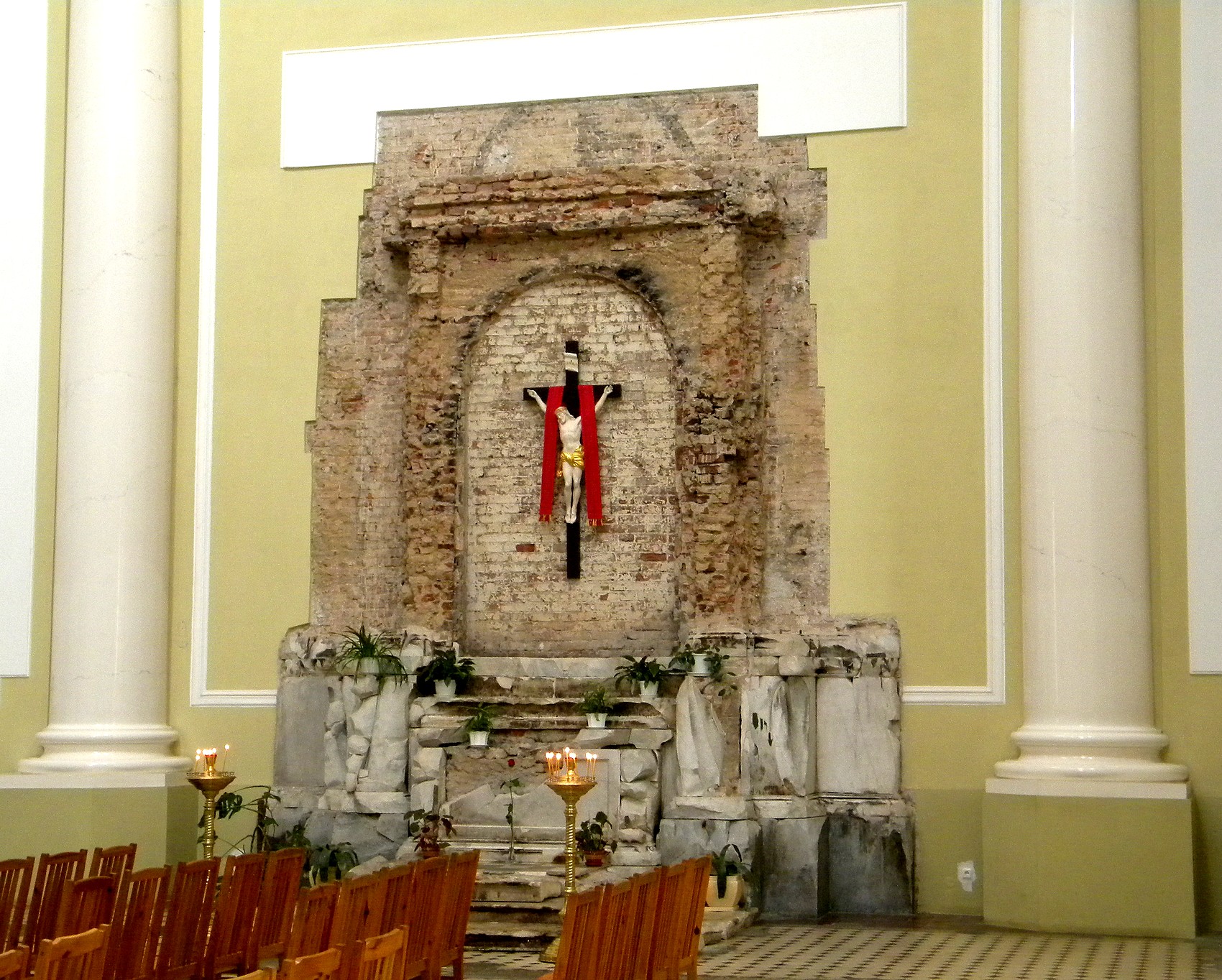
Stanislaw August Poniatowski had been the lover of the future Catherine the Great when both were young in Saint Petersburg. He went home to Poland, and in 1764 Catherine, now empress, arranged his election as king of Poland. He was meant to be her instrument. He was, eventually, a reformer who tried to save his crumbling state. The three partitions of Poland by Russia, Prussia, and Austria erased the country anyway. Poniatowski abdicated in 1795 and lived out his last years as a Russian pensioner in Saint Petersburg. When he died in 1798, Tsar Paul I gave him a funeral fit for a sovereign and had him buried in the Catholic Church of St. Catherine. He stayed in the crypt for one hundred and forty years. In 1938, when the Soviet government closed and ransacked the church, his remains were transferred quietly to Poland by Soviet authorities, who handed them to the Polish state. The body moved several more times before reaching its present resting place in St. John's Archcathedral in Warsaw in 1995. The empty original tomb is still in the basilica.
A Catholic Island
Through the Russian Empire the parish was the heart of Catholic life in Saint Petersburg. It belonged first to the Archdiocese of Mohilev, the institution Catherine had set up to govern her newly acquired Catholic subjects after partitioning Poland. The congregation included Polish nobles, French émigrés escaping the revolution, German artisans, and Italian musicians and architects working at the imperial court. The interior, once full of Italian paintings and an organ, was the meeting point of the foreign communities that built so much of the city. The parish ran schools, libraries, and charitable societies. The neighborhood around the church on Nevsky was, for a long stretch of the nineteenth century, the most cosmopolitan corner of the empire.
1923 and After
On Easter Sunday 1923, the Soviet government tried Monsignor Konstantin Budkiewicz, the parish's vicar general, on charges of conspiring against Soviet power. He was sentenced to death. While Pope Pius XI publicly prayed for his life and the rabbis of New York cabled Moscow asking that he be spared, Soviet officials told foreign diplomats the trial had been just. On April 4 the truth came out: the Monsignor had been shot three days earlier. A requiem Mass for him was celebrated at the church. Several foreign diplomats attended. The parish kept functioning until 1938, when the church was finally closed and ransacked. Books from its library were thrown into the street. A 1947 fire destroyed the interior decoration and the organ. The building survived the Soviet period as a warehouse and a concert venue. It was returned to the Catholic community after 1991. Restoration of the interior is ongoing, and on July 23, 2013, Pope Francis raised the church to the rank of basilica, the only such in the Russian Federation.
Standing on Nevsky
The building is in the form of a Latin cross, with the transept crowned by a large cupola. It measures forty-four meters long, twenty-five wide, and forty-two tall, with seating for around two thousand. The monumental arched portal rests on free-standing columns and the high parapet above it carries figures of the four evangelists and angels. From the sidewalk on Nevsky, the basilica reads almost like an Italian provincial cathedral that wandered north and stayed. Inside, scaffolding sometimes still stands where restorers are at work. The Catholic minority in Russia is small, numbering perhaps a few hundred thousand, and the basilica serves as their cathedral church for a city of five million. Mass is said in several languages. The empty crypt of Stanislaw August is open. So is the door.
From the Air
The basilica is at 59.936°N, 30.329°E on Nevsky Prospekt in central Saint Petersburg, three blocks east of the Kazan Cathedral and a short walk from the Hermitage. Pulkovo (ULLI) is the only commercial airport, about 18 km south. From the air, look for the Neva River curving past the Hermitage and follow Nevsky Prospekt inland; the cupola is modest compared to the Kazan or St. Isaac's domes nearby. Best viewed at low altitude on approach to or departure from Pulkovo. Saint Petersburg's notorious low ceilings and Baltic haze can obscure rooftop detail; clearest visibility is typically May through September.