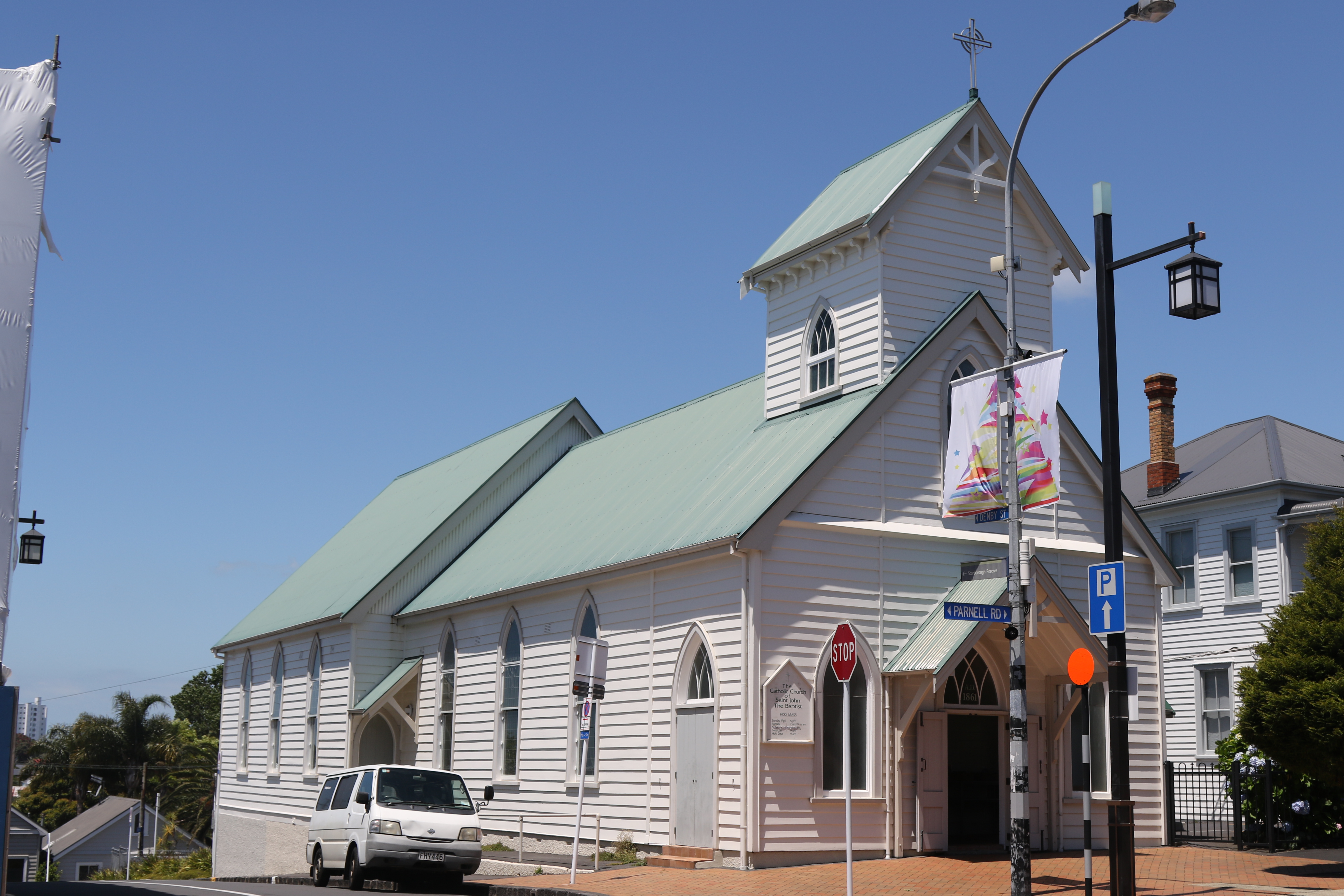
Church of St. John the Baptist, Parnell
The land that became St. John the Baptist Church in Parnell changed hands in a way that says something about colonial New Zealand. An Anglican missionary named Robert Maunsell purchased it, then sold it in June 1858 to Bishop Jean Baptiste Pompallier -- the man who had brought Catholicism to New Zealand -- for religious and educational purposes. Pompallier named the church after his patron saint, and architect Edward Mahoney designed a small timber building in a pared-back Gothic Revival style. On 12 May 1861, Pompallier opened the doors. More than 160 years later, those doors have never permanently closed.
The Bishop's Church
Pompallier was a significant figure in New Zealand's religious history -- the founder of the Catholic Church in the country, arriving as a missionary in the 1830s before becoming Bishop of Auckland. The church he opened in Parnell began as a chapel of ease attached to the cathedral, with Father Michael O'Hara as its priest. By December 1862 it became a formal parish, run initially by Franciscans for eleven years. The building Mahoney designed was notable for its well-lit interiors and cross-braced roof trusses, a practical approach to Gothic architecture using the timber available in colonial Auckland. Alongside the church, a wooden convent was built for the Sisters of Mercy, who ran a school from the premises. The Catholic school predated the church itself -- it had operated on the adjacent site even before construction began, initially staffed by lay teachers.
The Colourful Clergy
What makes St. John the Baptist's history distinctive is the parade of personalities who served there. Monsignor Henry Fynes, the first diocesan priest from 1873 to 1887, navigated the politically charged debate over secular education with a conciliatory approach that earned respect across denominational lines. When he died, the New Zealand Herald praised his "soundness of judgement, devotion to duty, and a happy disposition of mind." Father Lenihan, who followed in the 1890s, painted the interior walls light blue and was described as "indefatigable." Father Kehoe oversaw the 1898 enlargement and was remembered after his death in 1914 as "an able preacher and a very accomplished musician." Monsignor Jeremiah Cahill, the "genial and sporting Irishman," was a life member of the Auckland Marist Brothers Old Boys Rugby Club. These were not remote ecclesiastical figures but characters woven into the social fabric of Parnell.
Loss and Adaptation
The most consequential change came in 1964 when the Sisters of Mercy withdrew from Parnell and the school closed. Father Edward Forsman, parish priest since 1949, was reportedly upset by the loss. He was simultaneously navigating the liturgical upheaval of Vatican II, changes that unsettled him even as he cooperated by upgrading the altar and lectern. Forsman, described as a scholar, philosopher, and "born raconteur," served until his retirement in 1974. The parish passed through Marist Fathers' hands in the 1980s before returning to diocesan control. In 1997 the church was completely refurbished, and from 2001 the old convent building found a second life as commercial office space. The transformation was practical rather than romantic -- heritage buildings survive by finding new purposes.
Standing Ground in a Changing Suburb
Parnell has not always been kind to its heritage. In 2009, developers proposed a four-storey building next to the church that would have shaded it completely in winter and brought heavy traffic to the narrow side road. Parish priest Monsignor Kevin Hackett fought the plan, and the volume of public submissions helped defeat it. When a revised application appeared in 2011 without community consultation, Hackett was blunt: "This is all back door stuff." The church earned its formal protection in 2012, when Heritage New Zealand registered it as a Category 1 Historic Place alongside the convent, citing historic, social, aesthetic, archaeological, and spiritual significance. Auckland Council's 2019 thirty-year plan for Parnell names St. John the Baptist among the suburb's "many hearts" -- heritage buildings that anchor a neighborhood's identity even as the skyline transforms around them.
From the Air
Church of St. John the Baptist (36.855S, 174.780E) sits in Parnell, Auckland's oldest suburb, on the eastern side of the CBD. The small timber church with its tower and spire is difficult to distinguish from altitude among the larger buildings of modern Parnell. Holy Trinity Cathedral and St Mary's Church are nearby to the southeast. Auckland Airport (NZAA) is 21km south. The Parnell heritage cluster -- including Ewelme Cottage, Kinder House, and St Stephen's Chapel -- is concentrated in this area.