Church of the Acheiropoietos
Acheiropoietos is a Greek word that means, almost untranslatably, made without hands. In the early Christian world it described certain images of Christ and the Virgin that were said to have appeared on cloth or wood without any artist touching them, miraculous self-portraits left for the faithful to find. A church in Thessaloniki took the name in the fourteenth century because one of those icons was kept inside it, an image of the Virgin Hodegetria the locals believed had not been painted by any human. The icon is gone now, lost to one of the fires or wars that periodically swept through the city. The church is still here. Its bricks were laid in the fifth century, perhaps as early as the 450s, which makes it not just one of the oldest standing churches in Thessaloniki but one of the oldest surviving churches anywhere in the world.
A Building From Before the Empire Ended
The Roman Empire still ruled the Mediterranean when this basilica went up. Constantine had moved the capital to Constantinople a hundred years earlier. The western half of the empire was crumbling under barbarian pressure, and would fall within a generation. Thessaloniki, the second city of the eastern empire, was wealthy and busy and Christian. Builders here laid out a three-aisled basilica in brick and stone, twenty-eight meters wide and thirty-six and a half long, with green Thessalian marble columns separating the central nave from the side aisles, galleries above the aisles where women could attend services, and a clerestory raised over the nave to let light pour down on the worshippers. The original roof was higher than the present one. Light, in early Christian architecture, was not decoration. It was theology, the visible presence of the divine inside a building, and this church was designed to drink it in.
What Survives From the Fifth Century
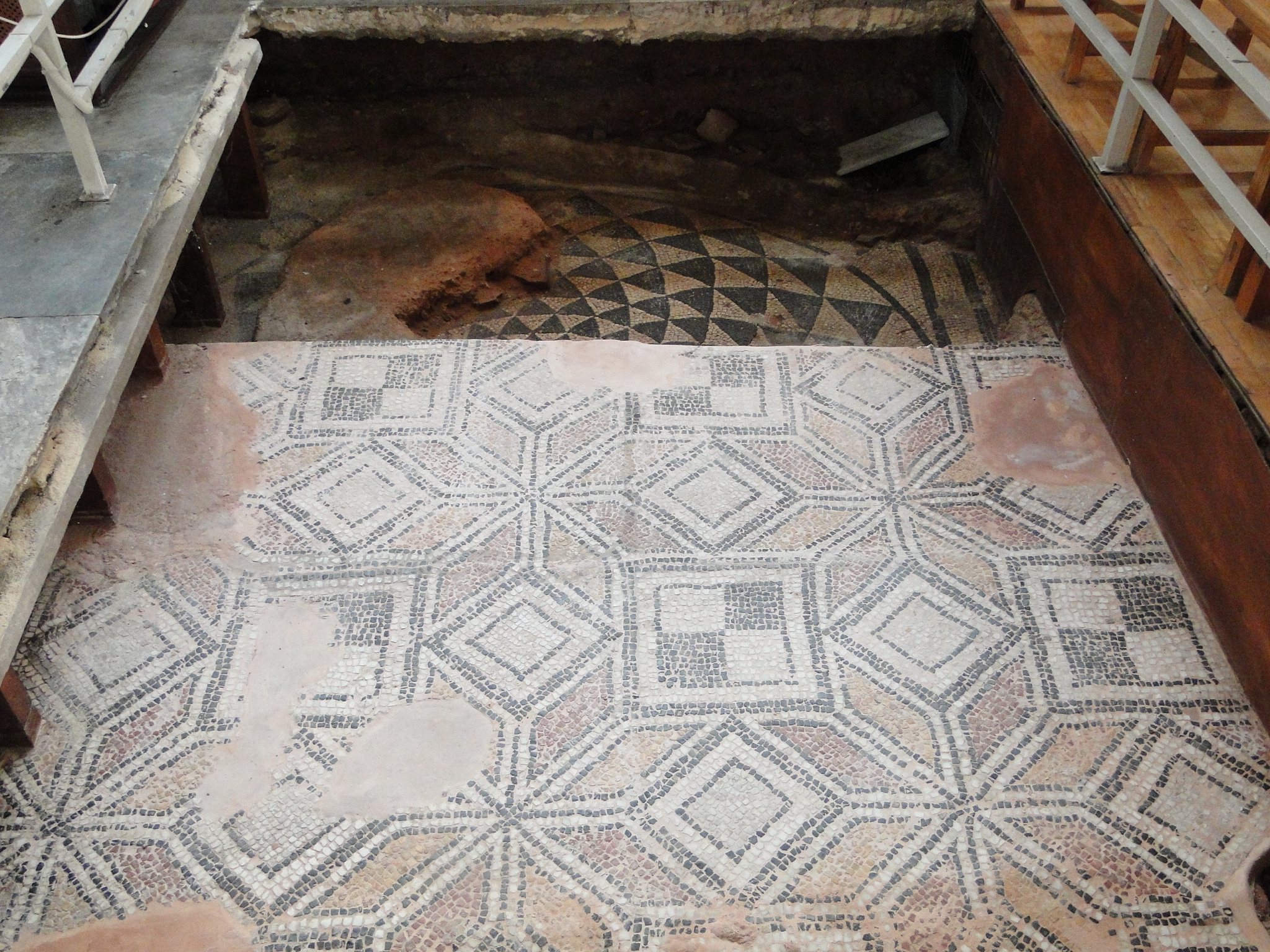
Most of the original interior decoration is gone. What remains is enough to register what was lost. The Ionic capitals on the columns are particularly fine, carved in a Constantinopolitan workshop and shipped here as luxury imports. The pavement of the central nave is still the original Proconnesian marble. Fragments of fifth-century mosaic survive in the soffits of the arches, abstract decorative work in the late-antique style, and beneath the floor of the north aisle archaeologists have uncovered three layers of mosaic flooring from a Roman bath that stood here before the church. On the south wall, damaged but still legible, frescoes from the early thirteenth century depict the Forty Martyrs of Sebaste, Roman soldiers who refused to renounce their Christian faith and were left to freeze to death in a frozen lake in fourth-century Armenia. The fresco is much later than the building, but it speaks to the same long Christian memory the basilica was built to house.
The First Mosque
When Sultan Murad II's army broke into Thessaloniki on March 29, 1430, after a siege that had lasted years, the city's churches were converted to mosques in waves. The Acheiropoietos was the first. Murad himself claimed it, renamed it Eski Camii, the Old Mosque, and made it the principal mosque of the conquered city. He carved an inscription into one of the columns of the northern colonnade, the eighth from the east, which reads in Ottoman Turkish: Fetih Sultan Murad Khan, Sehr-i Selanik, 833, the year of the conquest in the Islamic calendar. The inscription is still there. For nearly five centuries this fifth-century basilica was the heart of Muslim Thessaloniki, where prayers were offered five times a day. After the city returned to Greek control in 1912 the church was reconsecrated, and in 1988 UNESCO added it to the World Heritage list as part of the Paleochristian and Byzantine monuments of Thessaloniki.
Standing Room
The Acheiropoietos sits today at the corner of Agias Sofias street, opposite Makedonomachon Square, in the middle of a busy modern Greek city. Buses stop nearby. People walk past without looking. Inside, the proportions of the original basilica still work the way they were meant to: the long nave drawing the eye toward the apse, the columns marching in pairs, light from the clerestory windows striking the marble floor. Liturgy is celebrated here on the feast days of the Virgin and Saint Demetrius. The tribelon, the triple-arched opening between the narthex and the nave, frames anyone who walks through it the way a doorway in a film frames a character about to make a choice. Sixteen hundred years of Christians have made that choice. The building waits for the next ones.
From the Air
Located at 40.6350 N, 22.9479 E in central Thessaloniki, on Agias Sofias street between the waterfront and the Roman forum. Recommended viewing altitude: 2,000 to 4,000 feet AGL. Visual landmarks include Aristotelous Square and the Thermaic Gulf waterfront a few hundred meters south, the Galerian Rotunda and the triumphal arch a short walk east, and the upper city walls climbing the hill to the north. Nearest airport is Thessaloniki Makedonia International (LGTS), about 15 km southeast.