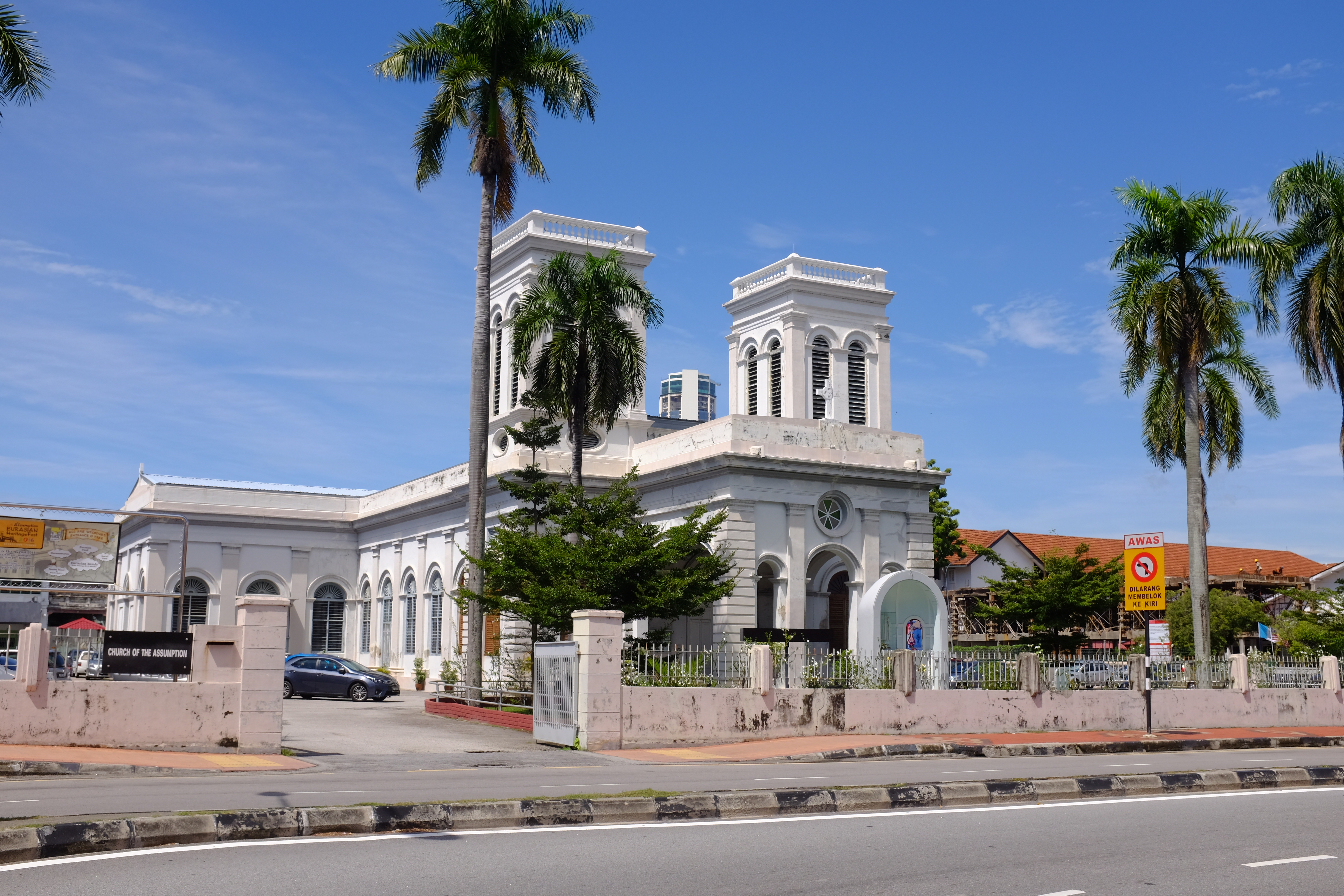
Church of the Assumption (Penang)
The date was no coincidence. When Captain Francis Light landed on Penang Island on 15 August 1786 and claimed it as Prince of Wales Island for the British Crown, the day happened to fall on the Feast of the Assumption of the Blessed Virgin Mary. Light and his companions marked the occasion by building a church and giving it the name the calendar demanded. It was the first Roman Catholic church in northern Malaya, erected alongside Fort Cornwallis at the very moment British colonial rule took root -- faith and empire arriving on the same tide.
A Crucifix in the Cityscape
The original church served for decades, but Penang's population grew rapidly under colonial rule, and by the mid-nineteenth century a larger building was needed. In 1860, construction began on the present structure, a cruciform church completed in 1861 with twin bell towers and a substantial altar. The building's footprint, shaped like a crucifix, gave it a distinctive presence in George Town's streetscape. More than half a century later, in 1916, a pipe organ built by Morton and Moody of Oakham, England, was installed and the choir gallery extended to accommodate it. That instrument -- one of only seven pipe organs still in use in Malaysia today -- continues to fill the nave on Sunday mornings and during Easter and Christmas celebrations.
Silenced Bells
When Japanese forces conquered Penang in December 1941, the church fell quiet. Masses were reduced to a bare minimum, the congregation scattered or living under occupation. One story from those years captures the mood precisely: a Japanese soldier, irritated by the sound of the church bells, walked inside and cut the bell ropes, declaring them too noisy. It was a small act of suppression -- bells silenced, worship curtailed, a community holding its breath. The church endured, and when Japan surrendered in August 1945, its doors opened fully again. The post-war years brought institutional growth. On 25 February 1955, the Penang Diocese was formally established alongside the Archdiocese of Kuala Lumpur, and the Church of the Assumption was elevated to cathedral status -- the seat of Bishop Francis Chan and the principal church of northern Malaysia.
A Cathedral Loses Its Crown
Cathedral status, once granted, proved impermanent. Beginning in the mid-1970s, George Town's Catholic population dwindled as residents migrated to suburbs and newer developments. By the late 1980s, only about 1,500 Catholics remained in the city center. In 1988, Bishop Antony Selvanayagam merged four struggling George Town parishes into a single entity called City Parish. Through the 1990s, diocesan functions migrated to other churches, and discussions began about relocating the cathedral entirely. The decision came in 2001: the Cathedral of the Holy Spirit in Green Lane, Penang, with its larger and more active congregation, would become the new seat of the bishop. On 20 January 2003, the transfer became official, and the Church of the Assumption quietly reverted to parish church status -- a demotion that, paradoxically, may have saved it from irrelevance by forcing a reckoning with what it truly was: not an administrative headquarters, but a historic place of worship.
The Old Lady Sings Again
The church's Morton and Moody pipe organ -- affectionately known as 'The Old Lady' -- became both a symbol and a practical focus for renewal. By 2011, the instrument was deteriorating, and the church launched a fundraising campaign alongside celebrations of its 225th anniversary. Generous donations allowed a full restoration, completed in 2013. A concert in June 2014 brought choirs from across the region to celebrate the organ's revival. The building itself underwent a comprehensive RM 2.5 million restoration beginning in August 2016, closing the church for sixteen months. Workers repainted the exterior, reconstructed the sanctuary, installed air conditioning, and restored the building to what parishioners described as its 1928 glory. When George Town and Malacca were jointly designated UNESCO World Heritage Sites in 2008, the Church of the Assumption was recognized as a heritage landmark -- its 160-year-old walls now formally acknowledged as part of Malaysia's multicultural architectural legacy.
Between Empire and Eternity
In front of the church stands a memorial to the French destroyer Mousquet, sunk in the Battle of Penang in 1914 -- a reminder that this building has witnessed not only spiritual life but the violent intersections of colonial power. Every 15 August, the feast of the Assumption is still celebrated here, connecting the present congregation to Captain Light's landing day in 1786. The organ still plays. The twin bell towers still anchor the George Town skyline. What began as an act of imperial naming -- faith claimed alongside territory -- has outlived the empire that planted it, surviving Japanese occupation, demographic decline, and institutional demotion to remain what it has been for nearly two and a half centuries: a place where people gather, pray, and listen to music that predates the modern nation around it.
From the Air
Located at 5.42N, 100.34E in the heart of George Town, Penang Island. The church's twin bell towers are visible among the dense heritage architecture of the UNESCO zone along the northeast coast of the island. Penang International Airport (WMKP) is approximately 14 km to the south. Fort Cornwallis, built alongside the church at the founding of the colony, is nearby on the waterfront. The Penang Strait separates the island from the mainland, with Butterworth (Sultan Abdul Halim Airport, WMKB) to the east.