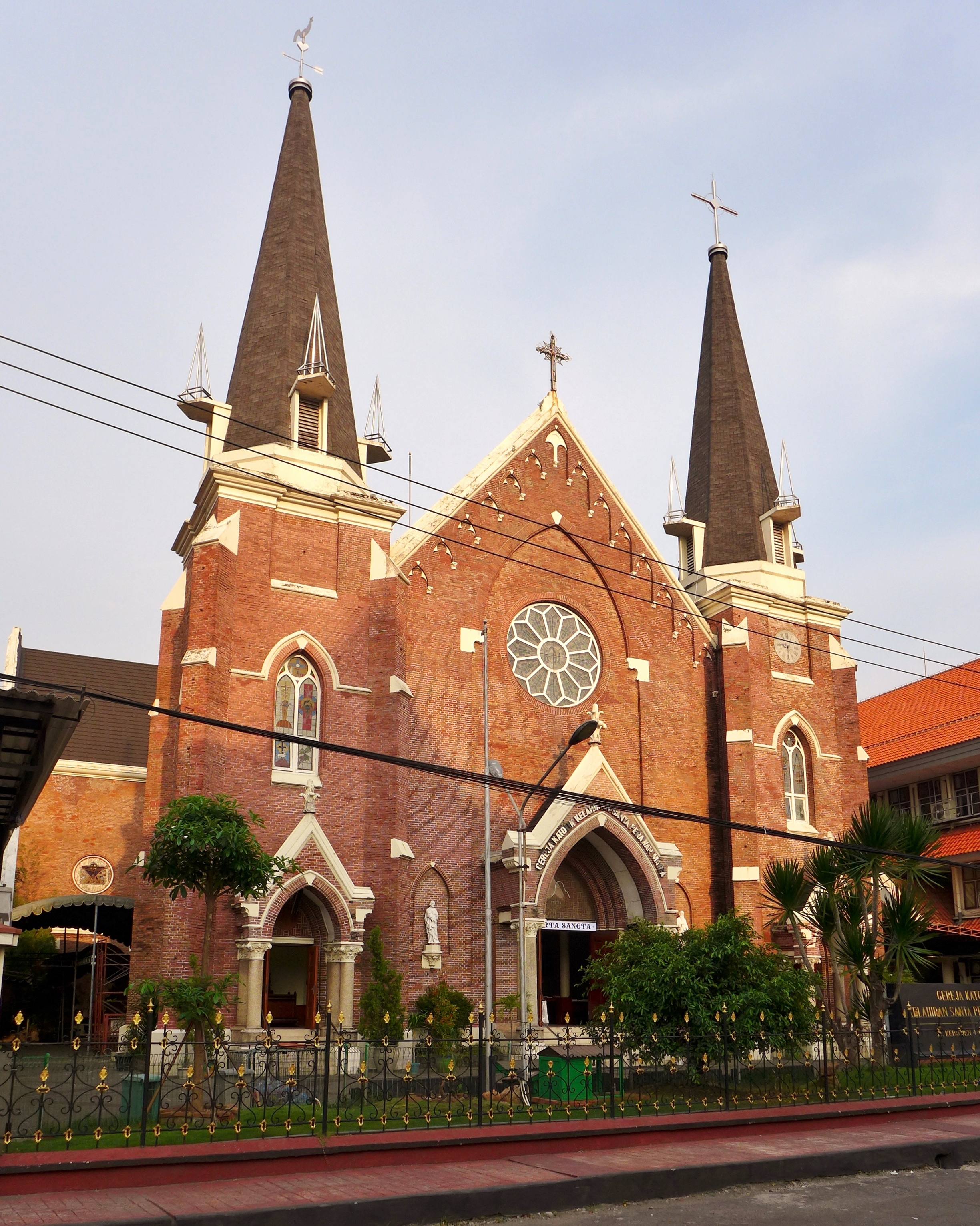
Seven Hundred and Ninety-Nine Pillars
The builders expected to drive their foundation piles four metres into the earth. They ended up going sixteen. Beneath the site where Surabaya's oldest Catholic church would rise, the ground refused to cooperate -- soft, unstable, the kind of soil that swallows ambitions whole. So the construction crew brought in 799 pillars of galam wood from the forests of Kalimantan and hammered them down, four times deeper than planned, until they hit something solid enough to hold a house of worship. The Church of the Birth of Our Lady has stood on that stubborn foundation since 1900, surviving colonial rule, revolution, and fire.
Priests Crossing Paths
Catholicism arrived in Surabaya through the efforts of two Dutch priests who seemed unable to stay put. Father Hendricus Waanders and Father Philippus Wedding were dispatched from the Netherlands to serve the growing number of Catholic faithful in the Dutch East Indies. Initially, Waanders was stationed in Batavia and Wedding in Surabaya. Then they switched. Under Waanders's tenure in Surabaya, the congregation grew large enough to need a proper church, and in 1822 a new building went up at the corner of Roomsche Kerkstraat and Komedie weg -- streets whose Dutch names would eventually give way to the Indonesian Jalan Kepanjen and Jalan Kebonrojo. That 1822 church served for decades, but by the end of the century it was falling apart, and the faithful had multiplied beyond what its walls could hold.
Eight Thousand Guilders for Holy Ground
In 1889, Pastor C.W.J. Wenneker bought a parcel of land from the colonial government for 8,815 guilders, just north of the aging church. The price was steep, but Wenneker had a vision: a church large enough for the swelling congregation, built to last. He commissioned W. Westmaas, an architect who had already proven himself with the reconstruction of the Blenduk Church in Semarang in 1894. Construction began on April 18, 1899, and moved quickly -- the church was completed by August 5, 1900. When Archbishop Edmundus Luypen consecrated it as the Onze Lieve Vrouw Geboorte Kerk, the building stood as the most substantial Catholic structure in Surabaya. Red bricks imported from Europe formed its walls. Teak from Java's forests became its columns and furniture. The mix of materials told the story of its moment: a European faith housed in a building that drew on two continents for its substance.
Baptism by Fire
The Battle of Surabaya in November 1945 was the young Indonesian republic's fiercest early test -- a brutal urban fight between Indonesian independence fighters and British forces that left much of the city scarred. The Kepanjen Church did not escape the violence. Fire tore through parts of the building, damaging walls and destroying interior elements that had survived four decades of tropical heat and monsoon rains. When repairs came, the builders could not perfectly match the original European bricks. New bricks went in alongside the old, and the resulting uneven coloration became a permanent mark on the church's face -- a kind of architectural scar tissue that tells visitors, without any plaque needed, that this building lived through something terrible. The mismatched brickwork remains visible today, a quiet record of the day Surabaya fought for its freedom.
Wood, Brick, and Persistence
What makes the Kepanjen Church remarkable is not its grandeur -- Surabaya has larger and more ornate places of worship -- but its material stubbornness. Those 799 galam wood pillars from Kalimantan have held fast for more than 125 years in soil that engineers considered treacherous. The melaleuca timber, harvested from the swamp forests of Borneo, is naturally resistant to water and rot, which made it ideal for foundations in waterlogged coastal ground. Above those hidden pillars, the European bricks and Javanese teak have weathered earthquakes, humidity, and the corrosive tropical air. The church remains an active parish, its pews filled each Sunday by a congregation that traces its lineage back through those Dutch priests who kept trading assignments between Batavia and Surabaya. The street names changed, the nation changed, the language of the liturgy changed -- but the building persists on its forest of buried wood, still doing exactly what 799 pillars were driven sixteen metres into the earth to make possible.
From the Air
Located at 7.242S, 112.737E in central Surabaya's Kepanjen district, within the old European quarter. The church is situated near the intersection of Jalan Kepanjen and Jalan Kebonrojo, close to other colonial-era landmarks in the Kota Lama area. Nearest major airport is Juanda International (WARR), about 18 km south. Recommended viewing altitude: 2,000-3,000 feet to see the church in context with the surrounding Old City. The Kali Mas river running through central Surabaya provides a useful navigation reference.