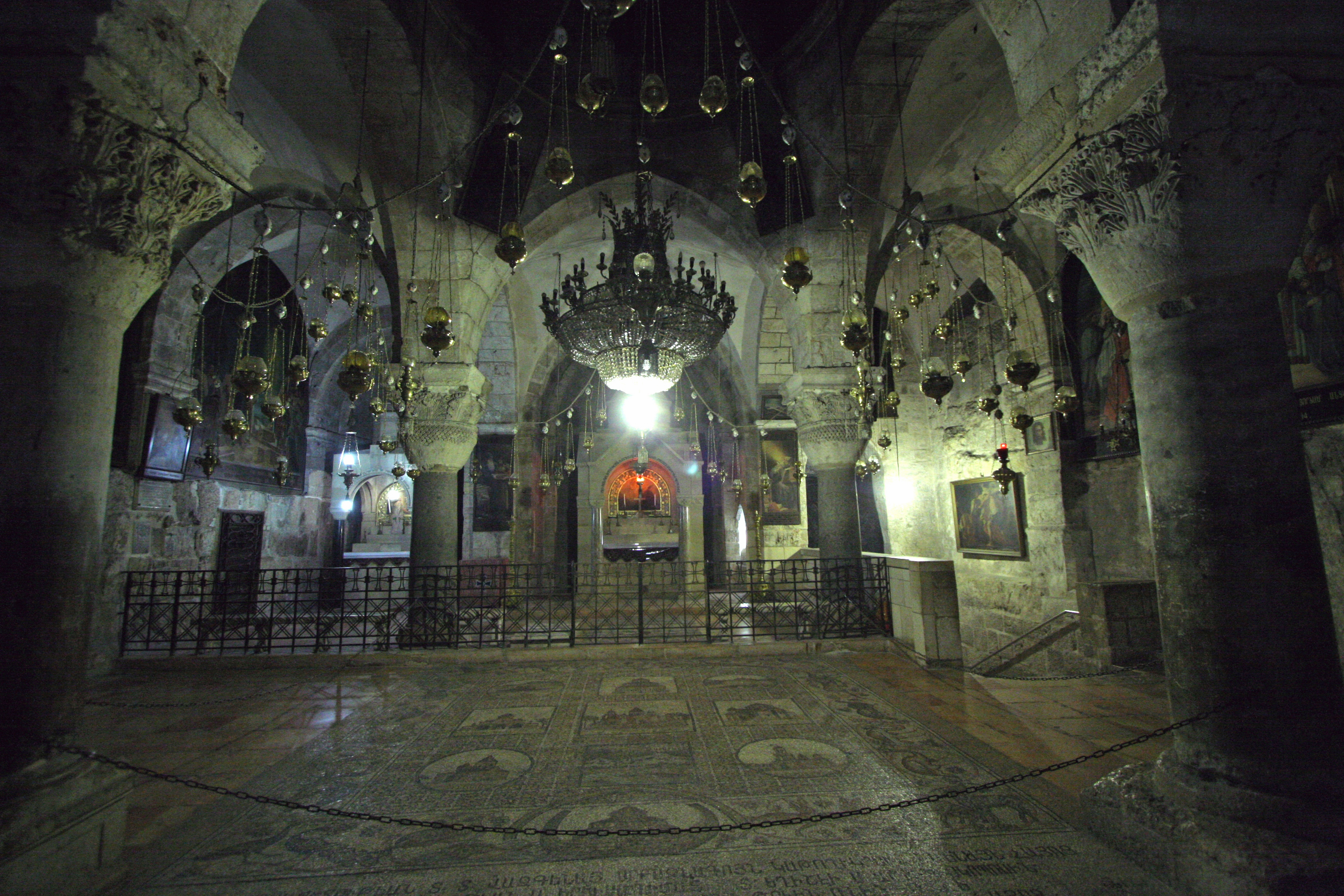
Church of the Holy Sepulchre
A wooden ladder has leaned against a window ledge above the church entrance since at least 1757. No one moves it. No one can -- not without the unanimous consent of six Christian denominations that share custody of the building, and in nearly three centuries, that consensus has never been reached. The ladder, known as the Immovable Ladder, is perhaps the most fitting symbol for the Church of the Holy Sepulchre: a place where the holiest site in Christianity meets the irreducible complexity of human institutions. Beneath the arguments over territory and tradition lies the claim that draws two million pilgrims a year -- that this is the ground where Jesus of Nazareth was crucified, buried, and rose from the dead.
Finding Golgotha Under a Roman Temple
In 70 CE, Roman legions destroyed Jerusalem during the First Jewish-Roman War, reducing the city to rubble. By 130 CE, Emperor Hadrian was building a new Roman colony, Aelia Capitolina, on the ruins. He ordered a pagan temple erected over a cave containing a rock-cut tomb -- the very site that Christians would later identify as the burial place of Jesus. Whether Hadrian intended to suppress the memory of the site or simply chose convenient building ground remains debated. Nearly two centuries later, Emperor Constantine's mother, Helena, traveled to Jerusalem in 327 CE, and the identification was made. The pagan temple was demolished, the cave tomb exposed, and Constantine commissioned a grand church complex: a basilica, an open courtyard, and a rotunda over the tomb itself. Eusebius, the bishop of Caesarea who recorded the construction, described the discovery of the tomb as miraculous. Modern archaeologists have confirmed that the site was indeed outside Jerusalem's walls in the first century -- a necessary condition for a Roman-era execution and burial ground.
Destroyed by Order, Rebuilt by Negotiation
Constantine's church endured for nearly seven centuries before catastrophe struck. In 614, Sassanid Persian forces sacked Jerusalem and set the church ablaze. Repairs followed, and under early Islamic rule the church was protected -- Caliph Umar himself reportedly prayed outside rather than inside, fearing his followers would use his precedent to convert the building into a mosque. Then, on October 18, 1009, Fatimid caliph al-Hakim bi-Amr Allah ordered the church destroyed as part of a broader campaign against Christian sites in Palestine and Egypt. The rock-cut tomb was hacked apart; only portions of the burial bench and southern wall survived. Christian Europe was shocked. The destruction became one of the grievances later cited to justify the Crusades. Reconstruction came through diplomacy: in 1027, al-Hakim's son agreed to allow rebuilding in exchange for the reopening of a mosque in Constantinople. The church was completed in 1048 under Emperor Constantine IX Monomachos, though western pilgrims arriving in the eleventh century found much of the original sacred site still in ruins.
Crusaders, Conquerors, and the Status Quo
The knights of the First Crusade took Jerusalem on July 15, 1099, and immediately set about refurbishing the church in Romanesque style, adding the bell tower that still stands. Crusader kings were buried inside, their tombs looted during the Khwarezmian sack of 1244 and possibly destroyed in an 1808 fire. Saladin captured the city in 1187 but left the church to its Christian communities. Over the following centuries, control shifted among the Greek Orthodox, Roman Catholic, Armenian Apostolic, Coptic, Syriac, and Ethiopian Orthodox churches -- each claiming portions of the building. Disputes grew so bitter that by 1757, the Ottoman sultan imposed what became known as the Status Quo, an arrangement freezing the territorial divisions in place. An 1853 decree solidified it further, requiring unanimous consent for even minor changes. The Immovable Ladder is its most visible consequence, but the principle runs deeper: no stone is moved, no candle relocated, no hour of worship altered without agreement from all parties.
The Tomb Beneath the Marble
At the center of the rotunda stands the Aedicule, a small ornate structure enclosing what tradition identifies as the tomb of Jesus. The current Aedicule dates to 1809-1810, rebuilt in Ottoman Baroque style after a fire collapsed the rotunda dome and destroyed the previous structure's exterior. Inside, pilgrims enter a small anteroom called the Chapel of the Angel before stooping through a low doorway into the burial chamber itself, where a marble slab covers the limestone shelf on which, according to tradition, the body was laid. In 2016, a restoration team from the National Technical University of Athens opened the marble slab for the first time in centuries, revealing the original limestone surface beneath, along with a second slab bearing a carved cross that may date to the Crusader period. The limestone was intact. Whatever one believes happened in this space two thousand years ago, the physical rock that anchored the belief is still there.
Six Denominations, One Roof
The daily life of the Church of the Holy Sepulchre is governed by an intricate schedule that distributes hours and spaces among its six custodial communities. The Roman Catholics, through the Franciscan Custody of the Holy Land, hold services at certain hours; the Greek Orthodox at others; the Armenian Apostolic, Coptic, Syriac, and Ethiopian Orthodox communities each have their designated times and territories. The Ethiopian monks live in a rooftop monastery called Deir al-Sultan, their claim to the space disputed by the Coptic Church. A Muslim family, the Nusseibeh, has held the key to the church's front door since the twelfth century -- a Saladin-era arrangement meant to prevent any single Christian group from locking the others out. Every morning, a Nusseibeh opens the door. Every evening, he closes it. The arrangement works not because the communities trust each other but because no alternative has ever been found. In a city where every stone is contested, this church is a microcosm: a holy place held together by the impossibility of agreement and the necessity of coexistence.
From the Air
Located at 31.778N, 35.230E in the Christian Quarter of Jerusalem's Old City. The church dome and bell tower are visible from the air within the distinctive walled rectangle of the Old City, near the golden Dome of the Rock and Al-Aqsa Mosque. Best viewed from 3,000-5,000 feet AGL. Note: Extremely sensitive airspace over Jerusalem with significant restrictions. Nearest airports: LLJR (Jerusalem/Atarot, currently closed), LLBG (Ben Gurion International) approximately 30 nm west-northwest.