Church of the Jacobins
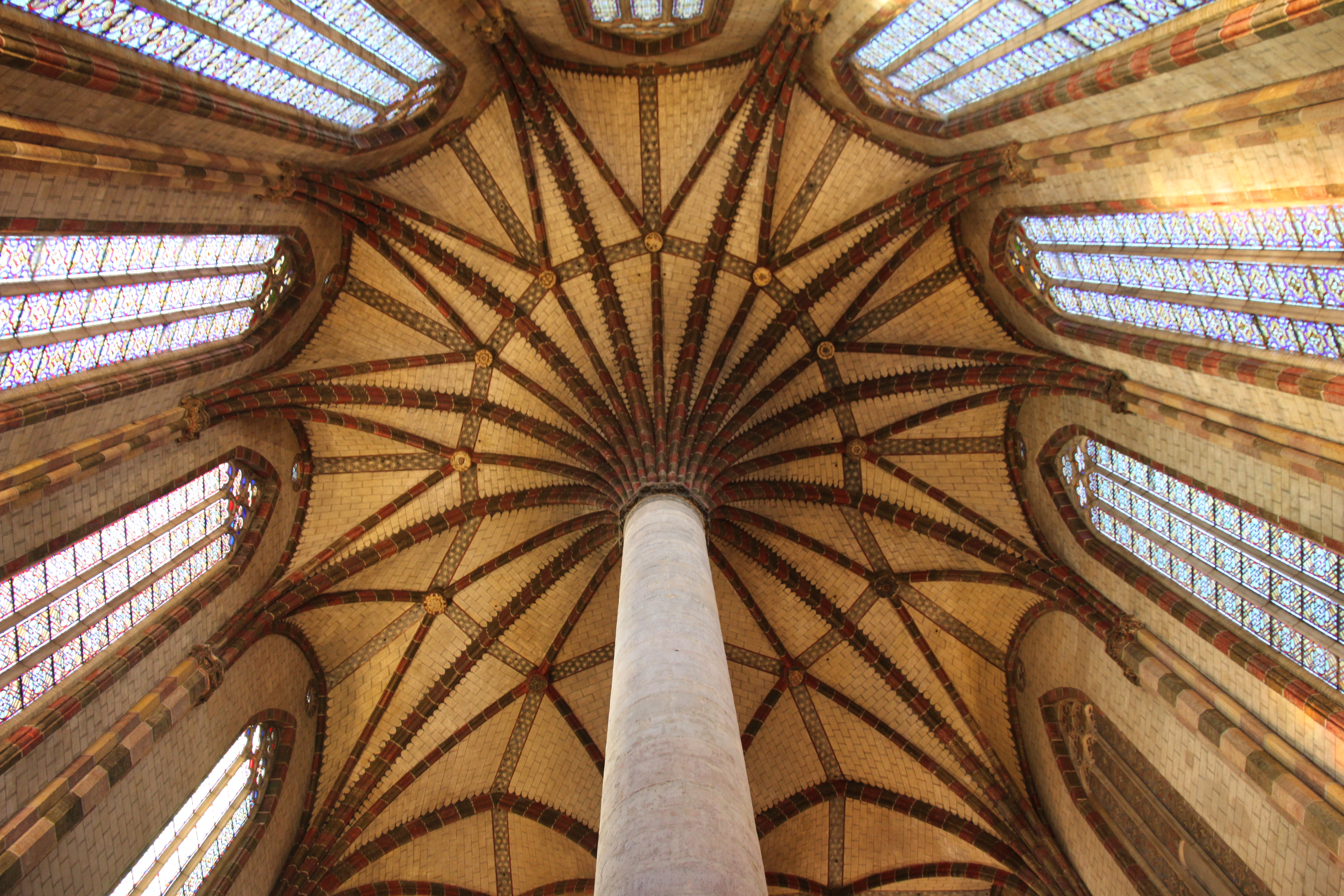
Twenty-two stone ribs radiate from a single column and spread across the ceiling like the fronds of a palm tree. This is Le Palmier des Jacobins, the engineering marvel at the heart of the Church of the Jacobins in Toulouse, and it has been astonishing visitors since the thirteenth century. Built of the city's signature pink brick, the church pioneered the Southern French Gothic style and now houses the relics of one of Christianity's greatest thinkers. That it survives at all is remarkable, given that it spent decades as a military barracks with horses stabled where monks once chanted.
Born of Heresy
In the early thirteenth century, the Cathar heresy was spreading through Languedoc, and the Catholic Church was losing ground. In 1215, the future Saint Dominic founded a small community of monastic preachers in Toulouse to combat the movement through persuasion rather than force. By 1230, his Dominican friars began building a modest church of pink Roman brick, simple and spare in keeping with their vow of poverty. The double-nave design -- one side for the friars, one for the congregation, separated by pillars and screens -- was practical if awkward. The name Jacobins came from their Parisian brethren, whose convent sat on the rue Saint-Jacques, and the nickname stuck to Dominicans across France.
The Palm Tree in Stone
As congregations swelled, the church grew in stages. Between 1245 and 1252, a choir with side chapels was added. Then, between 1275 and 1292, the builders faced their most daunting challenge: raising the choir to 28 meters and capping it with a vaulted roof. The solution was audacious. A single oversized column was planted at the center, and from its capital, 22 ribs fanned outward in every direction, distributing the vault's weight with the elegance of a palm tree opening its crown. Each of the six nave columns, only 1.4 meters in diameter yet rising 28 meters, supports eight ribs of its own. The effect is of a forest of slender stone trunks holding up a canopy of interlocking arches -- a precursor to the complex fan vaults of later Gothic architecture.
Barracks and Whitewash
The French Revolution of 1789 banned the Dominican order and expelled the friars. In 1804 the complex became city property, and in 1810, Napoleon requisitioned it as a barracks. Floors were hammered in to create dormitory stories. Stables and an armory occupied the ground level. The medieval stained glass was destroyed, and the painted choir -- centuries of devotional art -- disappeared under coats of military whitewash. For half a century the church endured this indignity, its soaring vaults hidden behind partitions, its sacred spaces filled with the clatter of boots and the smell of hay.
Rescue and Revival
Appalled citizens finally persuaded the army to vacate in 1861. What followed was a slow resurrection. The building hosted an industrial exhibition in 1865, served as a schoolyard for the nearby Lycee Fermat starting in 1872, and safeguarded Parisian museum treasures during World War I. Restoration gradually revealed what the whitewash and barracks floors had concealed: the Palm Tree intact, the double nave still soaring, the brick glowing its warm pink in the light filtering through new windows. Today the Church of the Jacobins holds the reliquary of Thomas Aquinas, the Dominican theologian whose writings shaped Catholic doctrine for centuries. The fourteenth-century cloister, its galleries framing a quiet garden, and the chapter hall and refectory all survive -- a complete medieval Dominican convent hidden in the heart of a modern city.
From the Air
Located at 43.604N, 1.440E in central Toulouse, roughly 500 m south of the Basilica of Saint-Sernin. The octagonal bell tower is visible among the pink-brick rooftops. Toulouse-Blagnac Airport (LFBO) lies 7 km northwest. Best appreciated from 2,000-3,000 ft AGL.