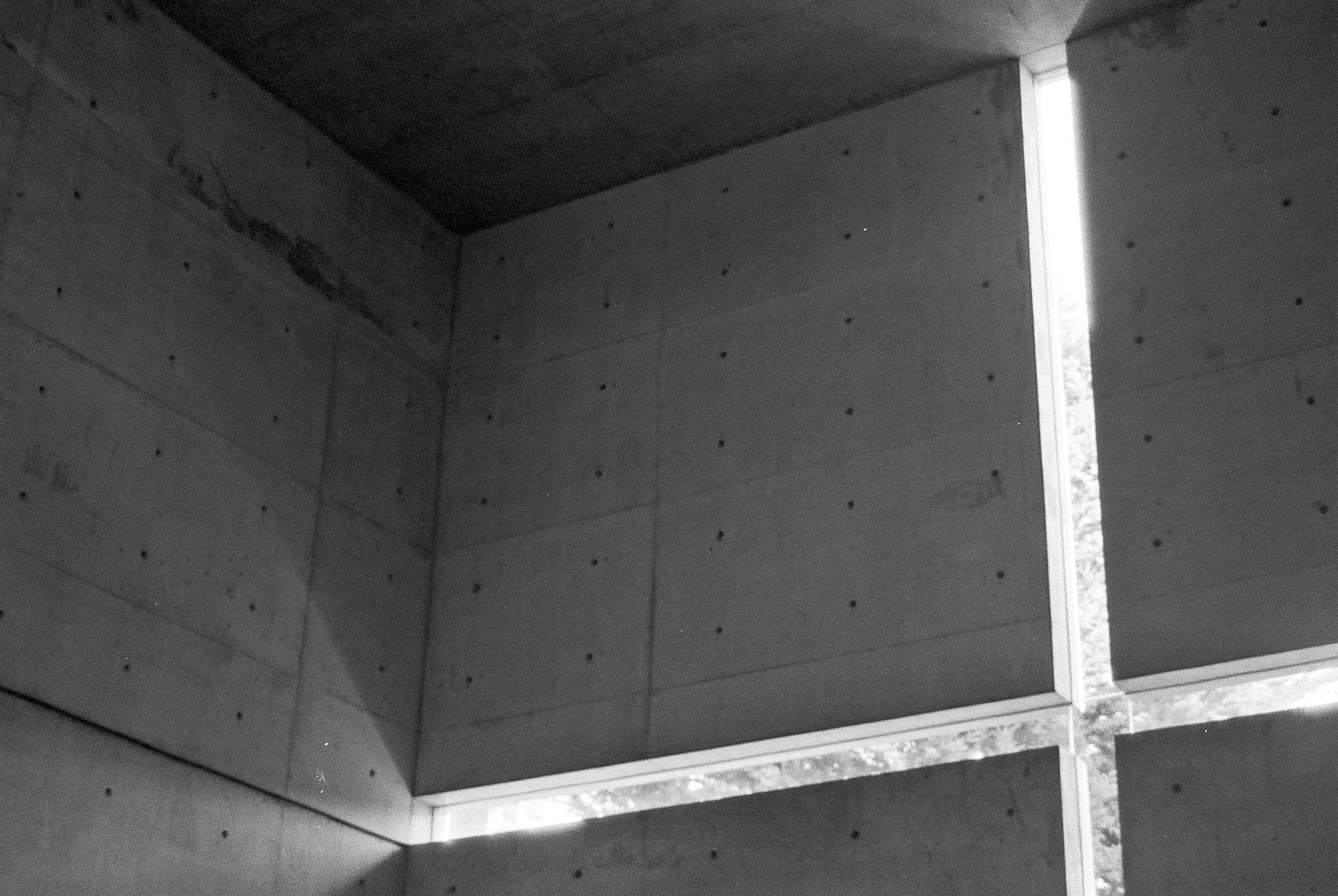
Church of the Light
The architect nearly built it without a roof. Tadao Ando's budget for the Church of the Light was so thin that he seriously considered leaving the concrete box open to the sky -- a chapel where worshippers would sit in the rain. The construction firm donated the roof, and that crisis passed, but the spirit of that radical impulse survives in every other decision Ando made. The benches are repurposed scaffolding planks from the construction itself. The floor is the same rough wood. There are no decorations, no stained glass, no icons. The entire experience of this 113-square-meter chapel in a residential neighborhood of Ibaraki, 25 kilometers north-northeast of Osaka, comes down to a single gesture: a cross-shaped void cut clean through the concrete wall behind the altar, through which daylight pours in the shape of the crucifixion.
Three Concrete Cubes and a Diagonal Wall
From the street corner where it sits, the Church of the Light reads as an exercise in restraint. The building is composed of three 5.9-meter concrete cubes arranged in a row -- 5.9 meters wide, 17.7 meters long, 5.9 meters high -- penetrated by a freestanding wall set at a 15-degree angle. This diagonal wall slices the interior into two volumes: the worship hall on one side, the entrance area on the other. Visitors do not walk straight in. They slip between the two spaces, moving indirectly from the Sunday school volume into the chapel, a passage that forces a moment of transition between the ordinary world outside and the stark interior within. The building was completed in 1989 as an addition to an existing wooden chapel and minister's house, and in 1999 a Sunday school extension was added.
Where Light Becomes the Cross
Behind the altar, the cruciform opening extends vertically from floor to ceiling and horizontally from wall to wall, its edges aligning precisely with the joints in the poured concrete. During the day, sunlight streams through this void and projects a luminous cross onto the dark interior -- a cross made not of wood or metal but of light itself. The effect shifts with the hours and the seasons, the cross growing warm and golden in the afternoon, cool and diffuse under overcast skies. Ando drew on Zen philosophy to frame this interplay of light and solid as a meditation on the dual nature of existence. At the intersection where brightness meets heavy concrete, worshippers are meant to confront the division between the spiritual and the secular within themselves. The cross is not a symbol hung on the wall. It is an absence in the wall through which something larger enters.
The Power of Profound Emptiness
Many visitors describe the interior as disturbing. The chapel is almost entirely void -- bare concrete walls, recycled scaffolding benches, rough floorboards, no ornament of any kind. The quiet is absolute. For Ando, this emptiness is not a failure of decoration but the entire point. He intended the void to invade the occupant, to clear away the noise of daily life so that something spiritual could fill the space left behind. This is a distinctly Japanese architectural sensibility, drawing as much from Buddhist notions of mu -- nothingness, or the fertile void -- as from any Christian tradition. The result is a chapel that works on believers and nonbelievers alike, because the experience is not about religious imagery. It is about being placed inside a carefully calibrated volume of silence and shadow, and then watching light arrive.
Ando's Concrete Obsession
Tadao Ando is self-taught -- he never attended architecture school, training instead as a boxer before turning to design. The signature element across his career is the reinforced concrete wall, poured in place with obsessive care so that every surface is as smooth and precise as technique allows. His walls are thick, massive, and permanent, a deliberate departure from the transparency and lightness prized by Modernist architecture. In the Church of the Light, this obsession achieves its purest expression. The heavy concrete shell does not merely enclose space; it creates the conditions under which a single slit of light can transform an entire room. Ando collaborated with the writer Philip Drew to articulate his thinking, but the building speaks more clearly than any essay. It is a structure that cost almost nothing, measures about the same as a small house, and ranks among the most celebrated works of religious architecture built in the 20th century.
From the Air
Located at 34.82N, 135.54E in the residential neighborhood of Ibaraki, Osaka Prefecture, approximately 25km north-northeast of central Osaka. The church is a tiny structure indistinguishable from the air amid dense suburban development. The Yodo River valley railway corridor runs nearby, providing an east-west visual reference between Osaka and Kyoto. Nearest major airport: Osaka Itami (RJOO) approximately 8nm south. Kansai International (RJBB) lies approximately 42nm to the south-southwest. The area is flat lowland terrain transitioning to the western foothills of the Yodo valley.