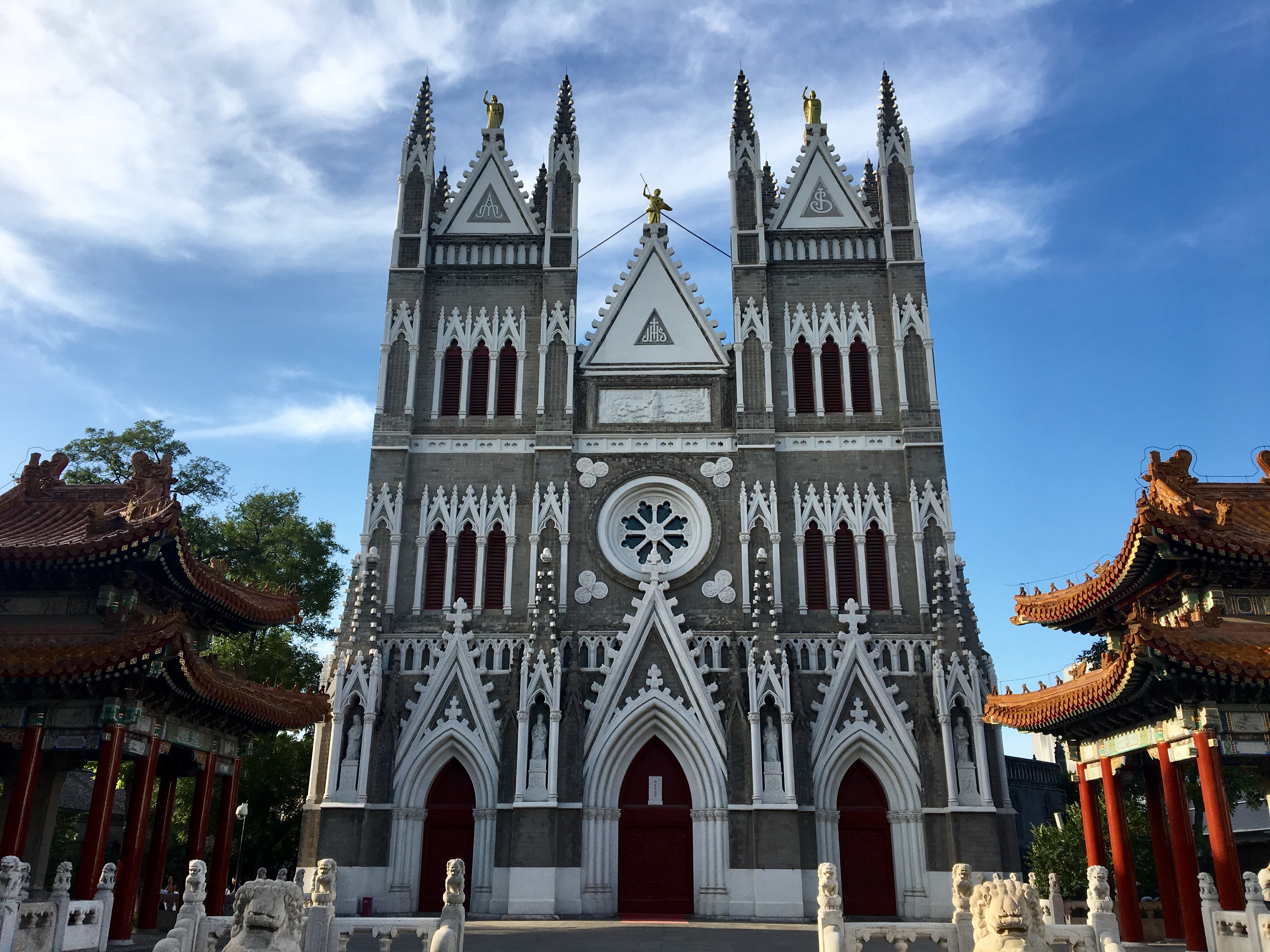
Church of the Saviour, Beijing
Two Jesuit priests cured the Kangxi Emperor of an illness in the 1690s, and the grateful ruler responded with a gift that would shape Beijing's religious landscape for centuries. He bestowed land near Zhongnanhai on the French Jesuits and personally hand-wrote the calligraphy plaque for the church they built there. The Church of the Saviour -- known to Beijingers as the Beitang, or North Church -- opened on February 9, 1703. It would be seized, returned, relocated, besieged, damaged, and rebuilt across the next three hundred years, surviving every upheaval that swept through the capital.
Moved at an Emperor's Whim
The original church stood near Zhongnanhai, opposite the former Beijing Library, on the land the Kangxi Emperor had granted. For over a century and a half it served the Catholic community, though not without conflict. Anti-Catholic sentiment within Chinese society periodically flared, and by 1827 the Qing government had seized the North Church and confiscated all its property. Only after the Second Opium War forced concessions from the weakened Qing court was the land returned to the Catholic Church. Bishop Meng Zhensheng rebuilt the church as a tall Gothic structure at the original site in 1864. But in 1887, the Guangxu Emperor needed the space near the Forbidden City for Zhongnanhai Park. The church was physically moved and rebuilt at its current location on Xishiku Street, where it stands today. The present Gothic structure, with its cast iron framework and elaborate grey marble facade, was completed in 1890 under the direction of Lazarist missionary Bishop Pierre-Marie-Alphonse Favier, who designed the building himself.
Sixty-Three Days Under Siege
In the summer of 1900, the Boxer Uprising engulfed Beijing, and the Beitang became a fortress. An estimated ten thousand Boxers laid siege to the cathedral from June 14 to August 16, joined by Manchu bannermen from Prince Zaiyi's Tiger and Divine Corps. Inside the stone walls, Bishop Favier organized the defense of more than 3,900 people -- roughly one hundred Europeans, mostly women and children, along with 850 orphans and thousands of Chinese converts. For sixty-three days, the defenders were cut off from the outside world as completely, one observer noted, as if they had been at the North Pole. The siege exacted a terrible toll. Of the eighty Europeans and 3,400 Chinese Christians sheltered inside, four hundred died. Forty were killed by bullets, over a hundred by explosions, and the rest succumbed to disease or starvation. Twenty-one children were buried in a single grave. Fifty-one more children were blown to pieces by explosions, leaving nothing to bury. W.A.P. Martin called the defense of the cathedral "the most brilliant page in the history of the siege."
Stone, Glass, and Contradiction
The church that survived the Boxer siege is an unlikely hybrid. Gothic arches and a grey marble facade in the French style rise from spacious grounds surrounded by pine and oak trees and flanked by two Chinese pavilions. In 1909, Belgian missionary architect Alphonse Frederic De Moerloose decorated the interior. The church once housed a large Cavaille-Coll pipe organ, a piece of French craftsmanship that seemed as improbable in this setting as the cathedral itself. The building served as the seat of the Bishop of Beijing until 1958, when it was affiliated with the Patriotic Catholic Church of China. A recent renovation, which many critics regard as a classic example of architectural overhaul that diminishes the original, returned the church to cathedral status for the Beijing diocese.
Faith at the Crossroads
The Beitang's story is ultimately about survival at the intersection of competing powers. An emperor's gratitude created it. Another emperor's landscaping needs relocated it. Political revolution stripped its authority. Renovation altered its character. Yet the church remains, its Gothic spires visible from Xishiku Street, accessible from Exit D of Xisi Station on Line 4 of the Beijing Subway. Worshippers still gather beneath arches designed by a French bishop who once defended these walls with his life. The calligraphy that the Kangxi Emperor wrote for the original building is long gone, but the impulse behind it -- a recognition that healing and faith transcend the boundaries of empire -- persists in the grey marble and cast iron that Favier built to last.
From the Air
Located at 39.92N, 116.37E in Beijing's Xicheng District, near Zhongnanhai. The Gothic spires are a distinctive visual landmark among traditional Chinese architecture. Nearest airport is Beijing Capital International Airport (ZBAA), approximately 30 km northeast. Best viewed at lower altitudes.