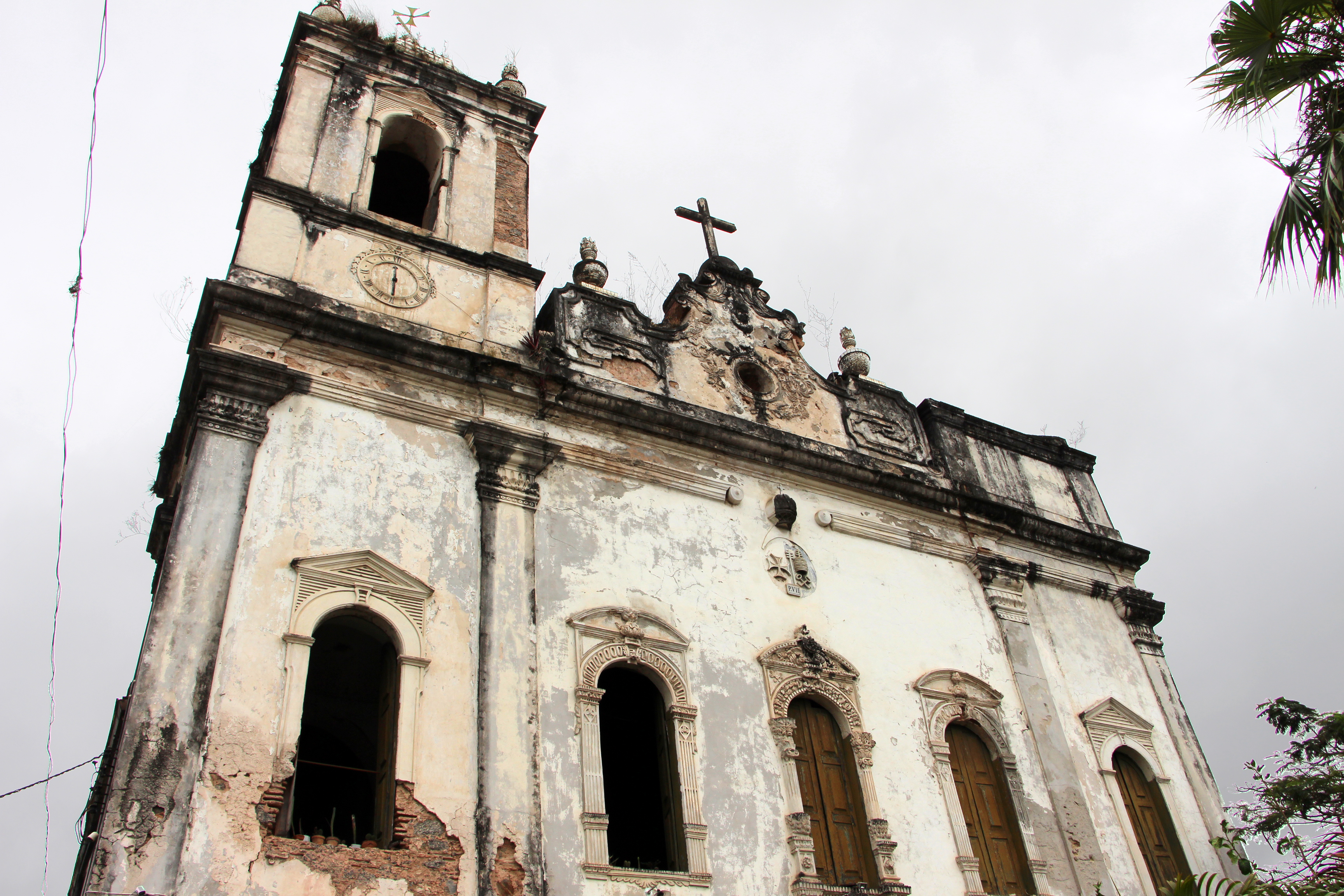
Church of the Third Order of the Holy Trinity
When the Archdiocese of Sao Salvador locked the doors of the Church of the Third Order of the Holy Trinity in 1990, nobody expected them to be opened again by homeless people. For ten years the 1739 church sat empty above the Agua de Meninos fish market in Salvador, its Rococo facade cracked, its right tower already collapsed from a 1968 failure nobody had bothered to fix. Then in 2000 a Catholic monk named Henrique Peregrino came up the old stone stairway with a group of people who had been sleeping rough in the historic center. They opened the building. They cleaned it out. They called themselves the Trinity Community. They still live there.
Three Aisles Above a Fish Market
The chapel began in 1733, when the Brotherhood of the Rosary and the Holy Trinity took a parcel from the parish of Santo Antonio Alem do Carmo and built a small place of worship dedicated to Our Lady of the Rosary and the Holy Trinity. By 1739 it had grown into the three-aisled church that stands - just barely - today. The facade mixes Rococo ornament with later Neoclassical additions, the architectural vocabulary of the late colonial period in Bahia. You reach the church by climbing a stairway off Avenida Jequitaia, the smell of the fish market thick in the air below. Above it the hill rises steeply, and the building appears as a weathered stucco wall against the sky, its surviving tower leaning like a tired shoulder.
A Long Decay
The damage came in slow waves. A fire in 1888 gutted parts of the interior. The restorations that followed were "poorly planned and implemented," according to the Institute of Artistic and Cultural Heritage of Bahia, which has catalogued the non-conforming additions: concrete slabs inserted into the galleries, structural choices that accelerated the slide rather than arresting it. The right tower crumbled in 1968. The windows went next. By the time the Archdiocese walked away in 1990, the images of the Holy Trinity and Our Lady of the Remedy had already been carried off to safer storage by members of the Order, who understood the building would not protect them. For a decade the church stood with empty window openings staring down at the fish boats unloading each dawn, a place officially forgotten.
What the Trinity Community Does
Henrique Peregrino's community rejects the label of non-governmental organization. Its philosophy, the members say, is different. Forty-five people live permanently on the church grounds, in the twenty houses clustered around the main building. Another fifty to sixty homeless residents of Salvador come each Thursday for ecumenical services and shared meals; the food is prepared by the residents themselves, the cleaning done by everyone. Children come separately, for a project staffed by seven educators and two therapists - fifty to sixty a day, totaling around 1,200 visits a month. The community has built its own altar, incorporating images and religious elements from the many faiths practiced in Salvador, a city where Catholicism, Candomble, and Pentecostal traditions overlap in daily life.
Five Steps Out
The community works toward a single end: ending homelessness for its members. The path has five stages. First, food - shared preparation and shared tables, the end of begging. Second, welcome - newcomers accepted without condition, as guests or as future members. Third, care - identity documents recovered, health treated. Fourth, independence - income generated through sacred art, flowers and fruit grown on the grounds, cardboard collected for recycling, and a newspaper, Aurora da Rua, that the residents write and sell themselves. Peregrino has also cultivated arrangements with private companies that hire community members into formal jobs. The fifth step, housing, marks the formal close. The church itself remains closed to visitors; the Archdiocese has not taken it back. What happens here is quiet, unofficial, and twenty-five years old this year.
From the Air
Located at 12.96 degrees south, 38.50 degrees west in Salvador, Bahia, Brazil, on a hillside above the Agua de Meninos fish market near Avenida Jequitaia. Elevation near 30 meters (100 ft MSL) above the bay. Within Salvador's historic harbor district; All Saints Bay (Baia de Todos os Santos) lies immediately west. Nearest airport: Salvador Deputado Luís Eduardo Magalhães International (SBSV/SSA), 25 km north. Coastal weather is generally warm and humid year-round with afternoon showers common; visibility usually excellent except during tropical squalls.