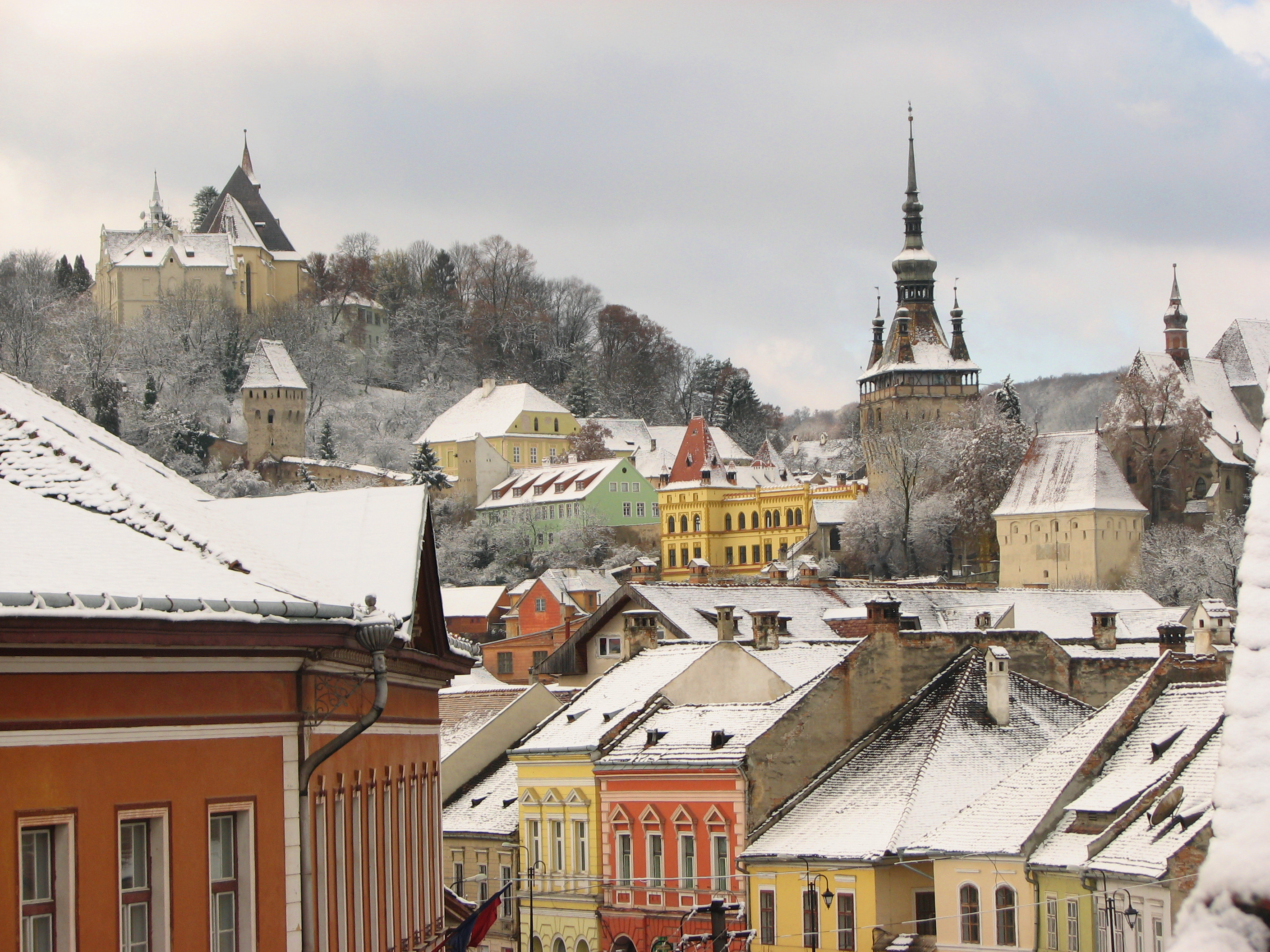
Church on the Hill (Sighișoara)
One hundred and seventy-five wooden steps climb the covered stairway to the Church on the Hill in Sighișoara. The stairway, built in 1642, was designed to protect schoolchildren walking to the Hilltop School from rain and snow -- but it also creates a sense of procession, a gradual ascent from the cobblestoned streets of the medieval citadel to the church that dominates the skyline from every direction. At 429 meters altitude, the Church on the Hill is the third-largest church in Transylvania and the most important religious monument in a town already famous for its medieval architecture. It is also a building that was never finished in one go. Its slightly misaligned bell tower, its choir that sits at an odd angle to the nave -- these asymmetries are not mistakes. They are the signatures of builders working across several centuries, each generation adding to what the last had started.
Stone by Stone, Century by Century
Construction began around 1429, according to a stone inscription that still survives inside the church. The work was carried out under the patronage of St. Nicolae and completed -- at least in its primary phase -- by 1488. But "completed" is a generous word. Development continued for decades afterward, as successive generations of Saxon builders modified and expanded the structure. The architectural style tracks the transition happening across Transylvania during this period: the transformation of older Romanesque churches into Gothic forms, driven by stonemasons and craftsmen of German origin who brought building techniques from central Europe. Unlike the elaborate Gothic cathedrals of western Europe, however, Saxon churches in Transylvania were built for defense as much as worship. Ornamentation was a luxury most communities could not afford when the same walls might need to withstand a siege. The Church on the Hill reflects this tension between aspiration and pragmatism -- Gothic in its bones, austere in its skin.
Fire, Earthquake, and the Cost of Survival
Two disasters left deep marks on the building. In 1704, during a Hungarian siege, the roof and belfry were set ablaze. The great bells collapsed as their supports burned away, crashing through the floors below. The church was repaired, but the scars of that fire shaped the reconstructed roof and tower that visitors see today. Over a century later, in 1838, an earthquake struck with enough force to bring down the choir vaults entirely. Rather than attempt to rebuild the stone vaulting -- an expensive and technically demanding task -- restorers replaced the collapsed vaults with wooden imitations. The substitution is invisible from below unless you know to look for it, a quiet testament to resourcefulness over resources.
Frescoes Hidden Under Lime
In 1776, the church's interior murals were whitewashed with lime, following a common Protestant practice of covering Catholic-era decorations considered distractions from worship. The paintings disappeared for over 150 years. In 1934, a restoration team led by Gustav Binder uncovered what the lime had preserved: frescoes spanning the fourteenth through sixteenth centuries, painted by multiple Gothic and Renaissance masters. The north wall of the choir reveals Christ's Passion instruments guarded by an angel, with St. Ursula and her arrow among the surrounding saints. Elsewhere, St. George fights the dragon across three dramatic scenes. The Archangel Michael weighs a soul while the Evangelist Matthew watches. A Veil of Veronica, bearing the face of Christ, is carried by two angels. These fragments are now considered among the most precious medieval murals in Transylvania -- preserved, ironically, by the very act of concealment that was meant to erase them.
The Only Ancient Crypt in Transylvania
Beneath the church lies a feature found nowhere else in the region: an ancient crypt containing tombs of Sighișoara's former civic leaders. The crypt has been disturbed multiple times over the centuries by thieves who believed the tombs contained valuables buried alongside the dead. Near the church entrance, sixty sarcophagi crowd the space -- a concentration of memorial stonework unusual for a Transylvanian parish church. Inside the nave, monumental wooden pews rise unusually high, each seating fourteen people behind tall gates decorated with carved vegetal stalks and stylized zoomorphic birds. Legend claims the church once held twelve life-sized figures of Christ's disciples, crafted in sheet silver. If they existed, they were stolen in 1601 by Cossack raiders -- adding one more chapter to a building whose history is defined as much by what was taken from it as by what remains.
From the Air
The Church on the Hill sits at 46.218°N, 24.791°E atop the highest point of Sighișoara's medieval citadel in Mureș County, Romania. From 2,000-4,000 feet AGL, the church is the dominant structure on the hilltop, visible from all directions against the surrounding Saxon village roofscape. Sighișoara's compact medieval citadel, a UNESCO World Heritage Site, is identifiable by its clock tower and defensive walls. Târgu Mureș Airport (LRTM) is approximately 50 km to the northwest. The town sits in the Târnava Mare river valley. The covered wooden stairway climbing the hill is visible from low altitude. Expect rolling terrain typical of the Transylvanian plateau, with good visibility in clear conditions.