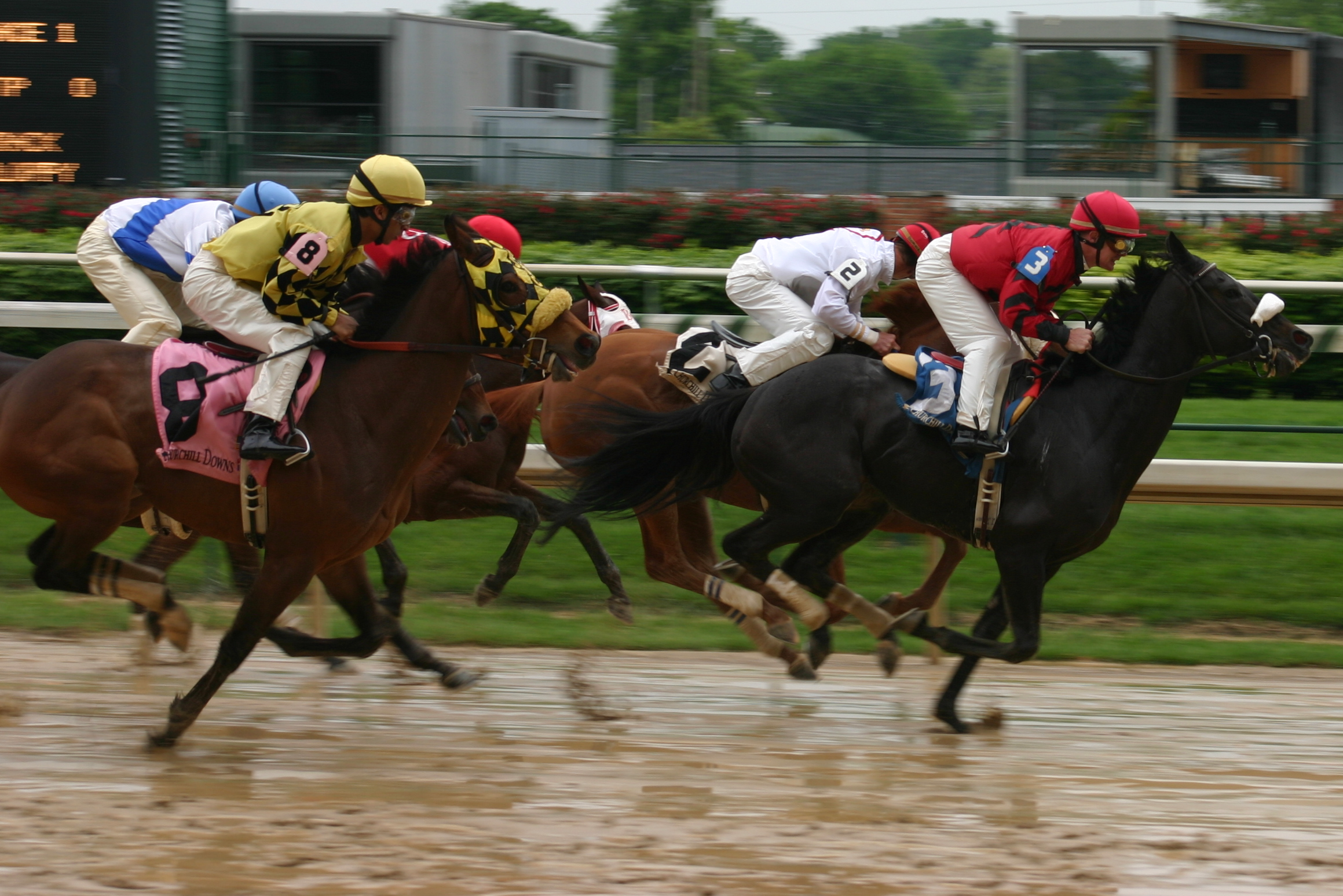
Churchill Downs
Two white spires punch skyward above the Louisville roofline, a pair of exclamation points visible for miles in every direction. They have watched over the first Saturday in May for more than a century, presiding over the precise moment each year when a garland of 554 red roses drapes across a sweating thoroughbred and an entire nation exhales. Churchill Downs did not invent American horse racing, but it perfected the ritual surrounding it. What began in 1875 as Colonel Meriwether Lewis Clark Jr.'s ambitious attempt to transplant the glamour of England's Epsom Downs to a patch of farmland along the Louisville and Nashville Railroad tracks became the single most enduring tradition in American sport.
A Colonel's English Dream
Clark was the grandson of explorer William Clark, but his obsession was speed, not frontier. His father-in-law, the horse breeder Richard Ten Broeck, took him to the English Derby at Epsom Downs outside London, and Clark returned to Louisville with a vision. He persuaded 320 local sportsmen and business leaders to invest $100 each, leased land from his uncles John and Henry Churchill, and built a racetrack. The first Kentucky Derby ran on May 17, 1875, the same year the first Kentucky Oaks was held. Clark preferred long races in an era trending toward shorter ones, and by 1894 he was running short of funds. He sold the track to a syndicate led by bookmaker William E. Applegate, who commissioned the now-iconic twin spires in 1895, shortened the Derby to its modern distance in 1896, and introduced the garland of roses that same year.
Locomotives in the Infield
When Applegate turned daily operations over to Louisville's mayor, Charles F. Grainger, in 1902, the goal was to move Churchill Downs beyond its reputation as a gambling den. The strategy was spectacle. A new clubhouse rose alongside events that had nothing to do with horses: steeplechases, automobile races, band concerts, and the Kentucky State Fair, which featured the bizarre attraction of two locomotives intentionally crashed head-on in the infield. Col. Matt Winn joined the operation and helped transform the Kentucky Derby into the preeminent stakes race for three-year-old thoroughbreds in North America. On June 5, 1907, African-American jockey James Lee set a record that has never been equaled when he won all six races on a single card at Churchill Downs.
Surviving Storms and Scandal
Churchill Downs was designated a National Historic Landmark in 1986, a recognition of both its architecture and its cultural weight. But the track has weathered literal and figurative storms. On June 22, 2011, an EF2 tornado struck the Louisville area, damaging stables and the chapel at Churchill Downs while over 200 horses were evacuated. The twin spires and clubhouse survived untouched. In June 2023, a more sobering crisis forced Churchill Downs to transfer its spring-summer racing meet to Ellis Park in Henderson, Kentucky, after twelve horse fatalities triggered investigations by the Kentucky Horse Racing Commission and the Horseracing Integrity and Safety Authority. The track re-evaluated its safety measures before racing resumed.
The First Saturday in May
With the infield open for the Kentucky Derby, Churchill Downs holds roughly 170,000 people, making it one of the largest-capacity sporting venues in the world. The dirt oval is one mile in circumference, with a turf course nested inside. A $121 million renovation from 2001 to 2005 replaced the clubhouse and added 79 luxury suites, along with a mural by artist Pierre Bellocq depicting every jockey to win the Derby since 1875. In 2014, the track installed a massive ultra-high-definition video board along the backstretch. The Kentucky Derby Museum sits on the grounds, featuring a 360-degree cinema and year-round exhibits on thoroughbred training and racing. Before the 150th Kentucky Derby in 2024, a new $200 million paddock opened, featuring tributes to past winners.
Still Building
Churchill Downs continues to reshape itself. The First Turn Club grandstand opened before the 2023 Derby with capacity for more than 7,000 people. In February 2025, management announced plans for a reconstructed grandstand seating over 13,000 and new permanent infield structures, a project estimated at nearly $1 billion. Two months later, those plans were postponed due to uncertainty over construction costs driven by tariffs and trade disputes. Smaller renovations to the Finish Line suites and Trophy Room, estimated at $25 to $30 million, are expected to be completed before the 2026 Kentucky Derby. Through all the changes, the twin spires remain. Designed by the Louisville firm D.X. Murphy & Bro., they are the one constant, the symbol that says the first Saturday in May is coming.
From the Air
Located at 38.203N, 85.770W in south Louisville, Kentucky. The twin spires and the oval dirt track are clearly identifiable from the air. Best viewed at 2,000-3,000 feet AGL. Louisville Muhammad Ali International Airport (KSDF) is approximately 4 nm south-southwest. Bowman Field (KLOU) is approximately 5 nm east. The Ohio River and downtown Louisville skyline provide strong visual references to the north. Expect busy Class C airspace around KSDF.