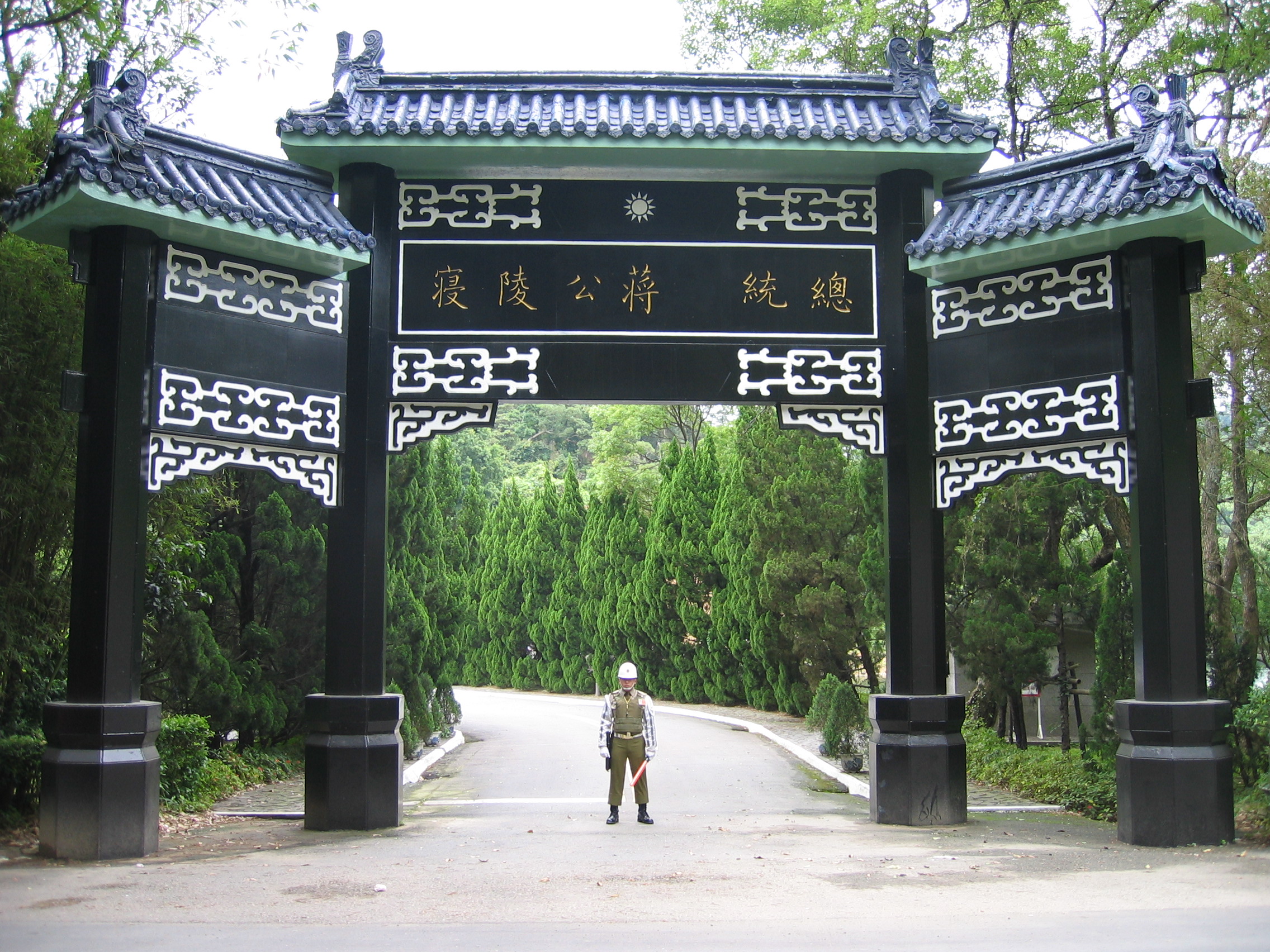
Cihu Mausoleum
Chiang Kai-shek chose the name himself. Cihu -- Benevolence Lake -- because the scenery around this eight-acre lake in northern Taoyuan reminded him of his mother and of Fenghua, the hometown in Zhejiang province he had left behind when the Communists swept the Kuomintang off the mainland. He loved the place so much that he built a residence designed to resemble the houses of Fenghua. When he died in 1975, that residence became his temporary resting place. The word "temporary" has now lasted half a century.
A Lake Named for Longing
The lake was formerly called Green Water Lake. Chiang renamed it in 1962, and the name stuck -- Cihu, written with the character for benevolence and the character for lake. The water body is divided into two smaller lakes connected by a canal, and the residence architect Yang Cho-cheng designed sits on its shore. The Cihu lake is now part of the "Taoyuan Tableland and Ponds" potential heritage site identified by Taiwan's Bureau of Cultural Heritage. It is a beautiful place by any measure, the kind of spot where you can understand why a man in exile would linger. That Chiang saw his mother's kindness in these waters says something about what displacement does to memory -- every landscape becomes a screen for projection.
Neither Buried Nor at Rest
When Chiang Kai-shek died on April 5, 1975, he was not buried in the traditional Chinese fashion. He was entombed in a black marble sarcophagus in the main hall of his Cihu residence, because he had expressed the wish to be eventually interred in his native Fenghua -- once the Kuomintang recovered mainland China from the Communists. That recovery never came. The sarcophagus sits in its hall, guarded by two ceremonial soldiers from the armed forces who stand at attention at the entrance. Visitors are expected to bow respectfully. Photography inside is prohibited.
A Political Battleground
The mausoleum became a flashpoint in Taiwan's struggle over Chiang's legacy. From December 2007 to May 2008, it was closed entirely during the waning months of President Chen Shui-bian's DPP administration, which campaigned to remove public vestiges of a man many Taiwanese view as a brutal dictator. During this period, Chiang Kai-shek statues from around the island were relocated to the hillside park near the mausoleum. In 2004, Chiang Fang-liang, the widow of Chiang's son Chiang Ching-kuo, requested that both father and son be buried at Wuchih Mountain Military Cemetery. A state funeral was planned for late 2006 but repeatedly delayed and never held, as Taiwan independence supporters opposed granting honors to someone they considered a tyrant.
Glass Between the Living and the Dead
On February 28, 2018 -- the 71st anniversary of the 228 Incident, in which thousands of Taiwanese civilians were killed under Kuomintang rule -- pro-independence activists vandalized the tomb. They were later arrested. The consequence was architectural: a glass panel now separates visitors from the sarcophagus, allowing them to view the black marble coffin but no longer enter the room. It is a fitting metaphor for Taiwan's relationship with Chiang Kai-shek -- visible but untouchable, present but sealed off, a figure the nation can neither fully embrace nor entirely let go.
Waiting for a Homeland
Chiang Fang-liang and Chiang's widow Soong Mei-ling had agreed in 1997 that the former leaders should eventually be moved to mainland China in the event of reunification. Soong Mei-ling died in 2003 and was entombed at Ferncliff Cemetery in New York. Chiang Fang-liang died in 2004, her cremated remains placed next to her husband's tomb at the nearby Touliao Mausoleum. The Cihu Mausoleum remains open daily from 8 a.m. to 4 p.m. Visitors still come, especially from mainland China. The black marble sarcophagus still holds a man waiting to go home to a country that no longer exists in the form he knew. The temporary arrangement endures.
From the Air
Coordinates: 24.84N, 121.30E. Cihu Mausoleum is located in Daxi District, Taoyuan City, near a distinctive lake visible from altitude. The complex sits amid hills along the Dahan River valley. Nearby airports: RCTP (Taoyuan International Airport, ~25 km northeast). Best viewed at 2,000-4,000 feet. Look for the lake divided into two sections and the manicured grounds of the memorial park.