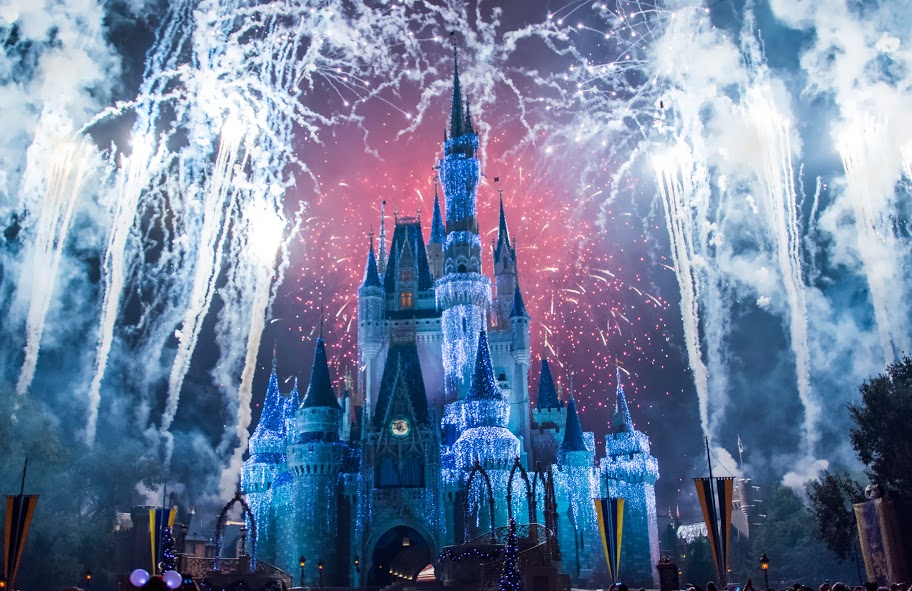
Cinderella Castle
Not a single brick went into building it. The fairy tale spires that anchor the Magic Kingdom's skyline and greet millions of visitors each year are six hundred tons of steel-braced frame construction wrapped in fiber-reinforced gypsum plaster, capped with roofing shingles made from the same plastic used in computer monitor shells. Cinderella Castle stands 189 feet above Walt Disney World, tall enough to be visible from the Seven Seas Lagoon but deliberately kept under 200 feet to avoid Federal Aviation Administration requirements for aircraft warning lights. It is an illusion engineered down to the inch, and that precision is exactly what makes it extraordinary.
A Continent of Castles in One
Chief designer Herbert Ryman drew from an atlas of European architecture to create something that never existed in the real world. The Alcazar of Segovia contributed its profile. Neuschwanstein Castle in Bavaria lent its romantic verticality. Schwerin Castle, Hohenzollern Castle, the Chateau d'Usse, Chambord, Pierrefonds, and Craigievar Castle in Scotland each donated elements. The spire of Notre-Dame de Paris, the Moszna Castle in Poland, and the Tyn Church in Prague added finishing details. Ryman then folded in his own earlier work on Sleeping Beauty Castle at Disneyland and the visual language of Disney's 1950 animated film. The result is a structure that feels instinctively familiar because it borrows from every castle archetype in Western imagination without copying any single one. It belongs to no country and every fairy tale simultaneously.
The Trick of Forced Perspective
Cinderella Castle was completed in July 1971 after roughly 18 months of construction. The design exploits forced perspective: at ground level, the stonework, windows, and doors are built to full scale, but as the eye moves upward, proportions shrink. Upper-story windows are smaller than they should be, making the towers appear taller and farther away than they are. The entire structure sits above a reinforced concrete wall that rises to the full height of the outermost walls, supported by a drilled caisson foundation. No gold is used on the exterior; all gold colors are anodized aluminum. The roofs are plastic over light-gauge steel sheeting. Contrary to persistent legend, the castle cannot be disassembled in the event of a hurricane. It does not need to be. It can withstand winds of 125 miles per hour, more than sufficient for Central Florida's storm season. There are 27 towers, numbered 1 through 29, with towers 13 and 17 cancelled before construction when designers realized they could not be seen from anywhere in the park.
Secrets Inside the Walls
Three elevators serve different functions inside the castle. One carries guests to Cinderella's Royal Table, the second-floor restaurant where children are addressed as princes and princesses and more than forty actual family coat-of-arms seals decorate the walls, representing the people who designed and built Walt Disney World. A second elevator, hidden in tower 2, serves the restaurant kitchen and connects to the underground Utilidors. The third, in tower 20, accesses a secret suite originally planned for the Disney family. Walt Disney died nearly five years before the park opened, and the space sat unfinished for decades, cycling through uses as a telephone call center and dressing room before being decorated as a royal bedchamber in 2005. During the Year of a Million Dreams promotion from 2007 to 2009, overnight stays were randomly awarded to park guests. Inside the castle archway, five mosaic murals tell the Cinderella story in over 300,000 pieces of Italian glass in more than 500 colors, some fused with sterling silver and 14-karat gold, designed by Imagineer Dorothea Redmond and led by mosaicist Hanns-Joachim Scharff.
The Sky Above the Kingdom
Every Disney structure at Walt Disney World stays under 200 feet to dodge FAA obstruction-lighting rules. The Twilight Zone Tower of Terror tops out at 199 feet; Expedition Everest reaches 199.5. Following the September 11, 2001 attacks, the FAA established a permanent Temporary Flight Restriction over the entire resort, and Cinderella Castle serves as the visual reference point for the restricted airspace. The irony is rich: a building designed to make visitors forget the outside world became the geographic center of a post-9/11 security perimeter. In 2026, the castle began yet another transformation as crews started repainting it to restore the classic color scheme of grays, creams, and blues that defined the original 1971 design, replacing the rose pink and gold accents applied during the 50th anniversary celebration.
From the Air
Located at 28.42N, 81.58W within Walt Disney World Resort in Orlando, Florida. A permanent FAA Temporary Flight Restriction (TFR) prohibits general aviation within a 3 nautical mile radius up to 3,000 feet AGL, centered near the Contemporary Resort. The castle at 189 feet is the visual reference for this restricted zone. Nearest airports include Orlando Executive (KORL) approximately 15nm east and Orlando International (KMCO) roughly 20nm southeast. Law enforcement and Walt Disney World Cessna 172 aircraft are exempt from the TFR. The castle is visible from significant distance due to the flat Central Florida terrain.