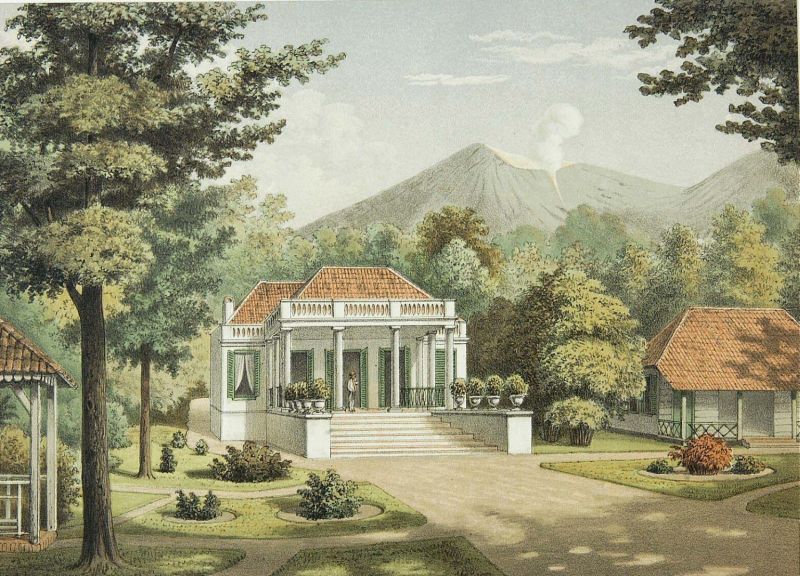
Cipanas Palace
Governor-General Gustaaf Willem van Imhoff came to Cipanas for the mountain air. He died there instead. The villa that a Dutch landlord named Van Heuts had built for him in 1740 sat at 1,100 metres above sea level, nestled against the western slope of Mount Gede in West Java, and the cool climate that made it irresistible also could not save van Imhoff from the illness that took him in 1750. His body was carried down to Jakarta for burial with full military honours, but the palace he left behind outlived the entire Dutch colonial enterprise -- passing through the hands of commissioners, governor-generals, Japanese occupiers, and Indonesian presidents across nearly three centuries.
The Mountain Retreat That Outlasted an Empire
What began as a private villa quickly became the preferred escape for the men who governed the Dutch East Indies. Commissioner General Leonard du Bus de Gisignies visited for the natural sulphur baths. Herman Willem Daendels and Stamford Raffles -- who administered Java during the brief British interregnum from 1811 to 1816 -- kept hundreds of workers tending apple orchards, flower gardens, rice mills, and livestock on the grounds. One governor-general after another made the 103-kilometre journey from Jakarta, drawn by the same combination of cool air and hot springs. Andries Cornelis Dirk de Graeff brought his family to live there from 1926 to 1931. The last Dutch occupant was Alidius Tjarda van Starkenborgh Stachouwer, who was taken prisoner by the Japanese in 1942 and shipped to a camp in Manchuria, ending nearly two centuries of colonial residence in a single wartime seizure.
Sukarno's Writing Desk
After independence, Cipanas Palace became one of seven official presidential residences in Indonesia. Sukarno visited frequently, treating it less as a retreat and more as a workshop. The peaceful atmosphere and cool highland air drew ideas out of him, he said, and he used the palace as a place to draft speeches -- particularly the addresses he gave each August 17 to mark Indonesian independence. The palace was also the site of his 1953 wedding to Hartini, a private ceremony held far from the political heat of Jakarta. The connection between Cipanas and presidential inspiration was not merely sentimental; the distance from the capital, the altitude, the quiet -- these were practical tools for a leader whose public rhetoric shaped a nation. Today the main building, known formally as Gedung Induk Istana Kepresidenan Cipanas, continues to serve as a retreat for the sitting president and vice president.
Teak, Cast Iron, and Hot Springs
The palace complex sprawls across 26 hectares and includes the main building, six pavilions, a mosque called Masjid Baiturrahim, bathhouses fed by natural mineral springs, a fishing pond, and a plant nursery that supplies the surrounding gardens. The original main building was constructed from teak wood reinforced with cast iron -- a blend of materials that reflected both local craftsmanship and colonial engineering. Later renovations replaced some floors and walls with brick and mortar, though the changes eliminated the original raised-house design. Behind the main building sits the Bentol, a smaller structure perched on the mountain slope that stands taller than everything else in the complex thanks to its elevated position. It was designed by two Indonesian architects, R.M. Soedarsono and Friedrich Silaban, and represents one of the few post-independence additions to a site otherwise shaped entirely by Dutch hands. The hot spring bathhouses remain the palace's most distinctive feature -- one reserved for the president, the other for accompanying guests -- fed by the same volcanic geology that drew Van Heuts to build here in the first place.
Power at a Distance
Cipanas Palace occupies a peculiar position in Indonesian political geography. It is not the seat of government -- that role belongs to the Merdeka and Istana Negara palaces in Jakarta -- nor is it a museum or tourist attraction in any conventional sense. It is a working retreat, a place where the machinery of state pauses without quite stopping. From the highway connecting Jakarta and Bandung through the Puncak pass, the palace grounds are largely hidden behind walls and gardens, visible from the air as a green compound against the grey slopes of Mount Gede. The seven presidential palaces scattered across the archipelago each serve a different symbolic function, from Bogor's botanical grandeur to Gedung Agung in Yogyakarta's courtly tradition. Cipanas offers something simpler: altitude, silence, and the mineral-scented steam rising from volcanic springs. For nearly three centuries, the powerful have come here to rest and to think -- a continuity that has survived colonial rule, occupation, revolution, and the ordinary passage of time.
From the Air
Cipanas Palace is located at approximately 6.73S, 107.04E at the foot of Mount Gede in West Java, at an altitude of 1,100 metres. From the air, the palace complex appears as a large green compound against the mountain's western slope, roughly 103 km southeast of Jakarta along the Puncak highway corridor. Mount Gede (2,958m) and Mount Pangrango (3,019m) dominate the landscape to the east. Nearest major airport is Husein Sastranegara International Airport (WICC) in Bandung, approximately 70 km to the southeast. Halim Perdanakusuma (WIHH) in Jakarta is approximately 100 km to the northwest.