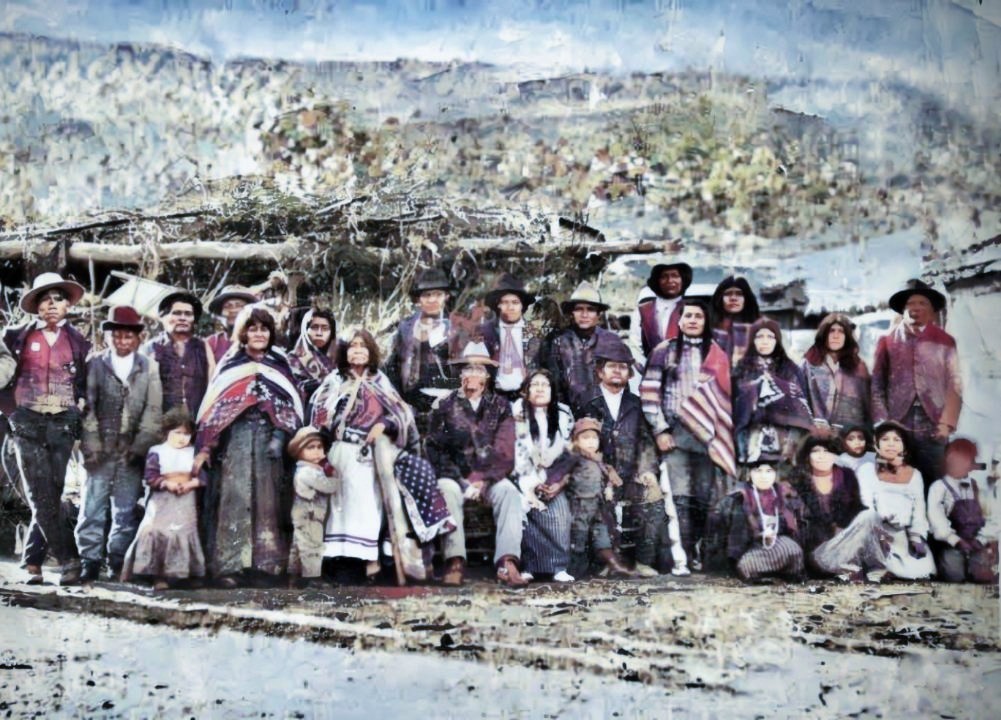
Circleville Massacre
They came because of a letter. The Koosharem Southern Paiute band living in Circle Valley - the place settlers called Box Creek, soon to be renamed Circleville - had been trying to live peacefully alongside the Mormon colonists who kept pushing into their homeland. In the spring of 1866, the settlers told the Koosharem people that a letter had arrived and they wanted it read to them. It was a trap. What happened next in this small Utah valley, tucked between the Tushar Mountains and the Sevier Plateau at 6,000 feet elevation, would be deliberately buried for over a century. The Circleville Massacre stands as one of the most harrowing episodes of the Black Hawk War, a conflict that convulsed Utah Territory from 1865 to 1872 as Native peoples fought to hold onto land that was being taken from them at an accelerating pace.
A Valley on Edge
By 1866, the broader conflict between Mormon settlers and Native American groups in Utah had reached a boiling point. The Ute leader known as Antonga Black Hawk had been leading raids against settlements, and church officials ordered that Paiute groups be disarmed throughout the territory. The Koosharem band in Circle Valley had not joined Black Hawk's resistance. They remained in the valley, trying to coexist. But the settlers, aware that other Native groups were fighting back, viewed even peaceful neighbors with suspicion and fear. When the ruse about the letter brought the Koosharem people into Circleville, one young man refused to go. He began firing at the posse that had come for his band. The settlers returned fire and killed him. The rest - men, women, and children - were taken at gunpoint into town, where the letter was read to them. Then they were told they were prisoners.
The Cellar
The captives were moved to an underground cellar for more secure confinement. What followed was not an act of panic or battlefield chaos. The settlers held a town meeting. They discussed what to do with their prisoners. They voted. The decision was to kill them. Twenty-four Paiute men, women, and children were led out of the cellar. Each was struck on the back of the head to stun them, then had their throat slit. They were left to bleed to death. Three children somehow survived the executions - two boys and a girl - and escaped into the surrounding landscape. This was not war. It was a deliberate, collective act of murder, decided by community vote and carried out methodically against people who had come willingly, trusting the pretense of a letter.
The Children Who Escaped
The following day, the three children were found hiding in a nearby cave. A man named James Allred took them to Marysvale, a settlement roughly twenty miles to the northeast. His intention was to sell or trade them. The girl was killed by a violent bludgeoning. One of the boys disappeared from the historical record entirely - his fate unknown. The other boy was taken by Allred to Spring City, over a hundred miles to the north, and sold to a man named Peter Monson. The price was a horse and a bushel of wheat. Monson kept the boy in a tool shed. But the child found an unlikely companion: Monson's own daughter, who had been disfigured by burns on her face. The two became friends. Eventually, Peter and Bertha Monson adopted the boy and gave him a new name - David Monson. The sole known survivor of the Circleville Massacre grew up in the household of the man who had purchased him.
Silence and Memory
For generations, the massacre was simply not discussed. Circleville remained a small ranching community in Piute County, population a few hundred, the kind of place where silence about an ugly past was easy to maintain. The event received scattered attention from historians - Albert Winkler wrote about it in 1987, and W. Paul Reeve published a detailed account in 2016 - but it remained largely unknown to the broader public. In April 2016, a memorial was dedicated at the site, the first formal acknowledgment by the community. The Paiute Indian Tribe of Utah has worked to ensure the story is told. The landscape itself has not changed much. Circle Valley is still a high-altitude basin rimmed by mountains, a place where the Sevier River bends through sagebrush flats. From the air, Circleville reads as a handful of buildings along Highway 89, population around 500. Nothing in the topography suggests what happened here. That is precisely why the memorial matters - because the land does not remember on its own.
From the Air
Located at 38.17N, 112.27W in Piute County, south-central Utah. Circleville sits in Circle Valley along the Sevier River at approximately 6,000 feet elevation, flanked by the Tushar Mountains to the west and the Sevier Plateau to the east. The town is visible along US Highway 89. The nearest airport is Richfield Municipal Airport (KRIF), approximately 30nm to the north. From the air, Circle Valley appears as a broad, sagebrush-covered basin surrounded by mountains. The terrain rises steeply on both sides. Weather is continental high desert with cold winters and summer thunderstorms. Density altitude can be significant due to the base elevation.