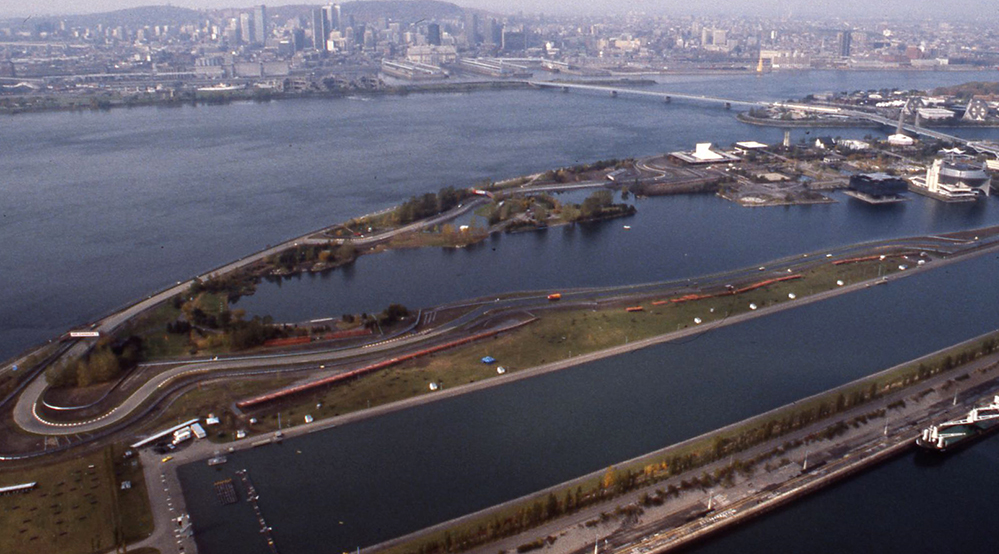
Circuit Gilles Villeneuve: The Island Where Champions Hit the Wall
In 1999, three Formula One World Champions - Damon Hill, Michael Schumacher, and Jacques Villeneuve - all crashed into the same concrete barrier during the Canadian Grand Prix. The wall sits at the exit of the final chicane, marked with a sign reading "Bienvenue au Quebec" - Welcome to Quebec. The irony was too perfect to ignore. Since that day, the barrier has been known as the Wall of Champions, and it has continued to claim victims: Jenson Button in 2005, Sebastian Vettel in 2011. The wall is just one feature of the Circuit Gilles Villeneuve, a track built on a man-made island in the St. Lawrence River that has hosted Formula One since 1978 and has earned a reputation as one of the most unpredictable venues on the calendar.
An Island Born from a World's Fair
Notre Dame Island did not exist in its current form until Montreal needed it. The island was built up for Expo 67, the world's fair that transformed Montreal's international profile. When the fair ended, the city was left with an artificial island in the middle of the St. Lawrence, complete with the geodesic dome that became the Montreal Biosphere. Adjacent Saint Helen's Island had been artificially enlarged for the same fairgrounds. A decade later, with the Formula One Canadian Grand Prix in need of a new home after safety concerns plagued Mosport Park near Toronto, the island found its second life. The circuit was designed by Roger Peart, built in 1978, and originally named the Ile Notre-Dame Circuit. It sits within Parc Jean-Drapeau, named after the mayor who organized Expo 67. Almost half the track runs alongside the Olympic Basin, the rectangular waterway created for rowing and canoeing events at the 1976 Summer Olympics. The circuit is built from the infrastructure of two of Montreal's greatest spectacles.
A Hometown Hero's Legacy
The first Canadian Grand Prix held at the circuit, in 1978, was won by Gilles Villeneuve driving for Scuderia Ferrari. Villeneuve was a hometown hero - a Quebec native whose fearless, aggressive driving style made him one of the most beloved figures in Formula One history. He died in a qualifying crash at the 1982 Belgian Grand Prix at the age of 32. The circuit was renamed in his honor that same year, and it has carried his name ever since. His son, Jacques Villeneuve, would go on to win the Formula One World Championship in 1997 - and, in a twist befitting this track's theatrical nature, became one of the three champions to hit the wall that bears their collective nickname in 1999. The Grand Prix was moved from its original September date to mid-June in 1982, providing warmer weather for what quickly became a fixture on the F1 calendar.
A Track That Punishes Mistakes
The circuit's defining characteristic is how close the concrete barriers run to the racing surface. There is almost no margin for error. The track layout has evolved over decades: originally a sequence of technical, medium-speed chicanes, it transformed into a power circuit where straight-line speed is critical. The Senna S curves at turns one and two open the lap. The Pont de la Concorde corner, a fast kink after the bridge underpass, leads into one of Formula One's most dramatic hairpins - Turn 10, a full 180-degree reversal where heavy braking creates passing opportunities in front of packed grandstands. After the hairpin, the track unfolds into a long straight before the final chicane and the Wall of Champions. Safety modifications have been continuous: a chicane added in 1994 after the deaths of Ayrton Senna and Roland Ratzenberger at Imola, pit lane changes in 2002, modified curbs in 2005, and additional Tecpro barriers in 2017 to accommodate the faster cornering speeds of modern F1 cars.
Four Hours in the Rain
The 2011 Canadian Grand Prix became the longest Formula One World Championship race in history. Torrential rain halted the race for over two hours, stretching the total event past four hours. Jenson Button, running last at one point, charged through the field in changing conditions to take one of the most dramatic victories in the sport's history. The race captured what makes Montreal's circuit special: its weather is unpredictable, its barriers are unforgiving, and its results regularly defy expectation. The circuit was briefly dropped from the F1 calendar in 2009, replaced by the inaugural Abu Dhabi Grand Prix, but Quebec officials and race organizers negotiated a return, signing a new five-year contract that brought Formula One back to Notre Dame Island in 2010. The track has also hosted the Champ Car World Series, the NASCAR Nationwide Series, the World Sportscar Championship, and the Ferrari Challenge, among other series.
The Quietest Island in Montreal
For most of the year, the Circuit Gilles Villeneuve belongs not to race cars but to joggers, cyclists, and inline skaters. Parc Jean-Drapeau is open to the public between race events, and the circuit itself becomes a recreational loop on a green island in the middle of the St. Lawrence. The contrast with Grand Prix weekend is total: during the few days of the race, Notre Dame Island is one of the noisiest places in Montreal. The rest of the year, it is one of the quietest - a park filled with greenery and wildlife, with the Biosphere dome from Expo 67 visible just beyond the circuit's edge. The fastest qualifying lap ever recorded here, Sebastian Vettel's 1:10.240 in 2019, covered the circuit in slightly over a minute. On a quiet Tuesday afternoon, a cyclist might take fifteen minutes to complete the same loop, passing the Wall of Champions without incident.
From the Air
Located at 45.50N, 73.52W on Notre Dame Island in the St. Lawrence River, east of downtown Montreal. From the air, the circuit is clearly visible as a ribbon of asphalt on the narrow island, with the Olympic Basin running parallel along its southern edge. The Montreal Biosphere - Buckminster Fuller's geodesic dome from Expo 67 - sits adjacent to the circuit on Saint Helen's Island to the northwest. The Jacques Cartier Bridge passes to the west, connecting the islands to downtown Montreal. The nearest major airport is Montreal-Trudeau International (CYUL), approximately 25 km west. Montreal-Saint-Hubert (CYHU) is closer, about 10 km to the southeast across the river. The island circuit, the Biosphere, and the Olympic Basin create a distinctive complex visible from moderate altitude.