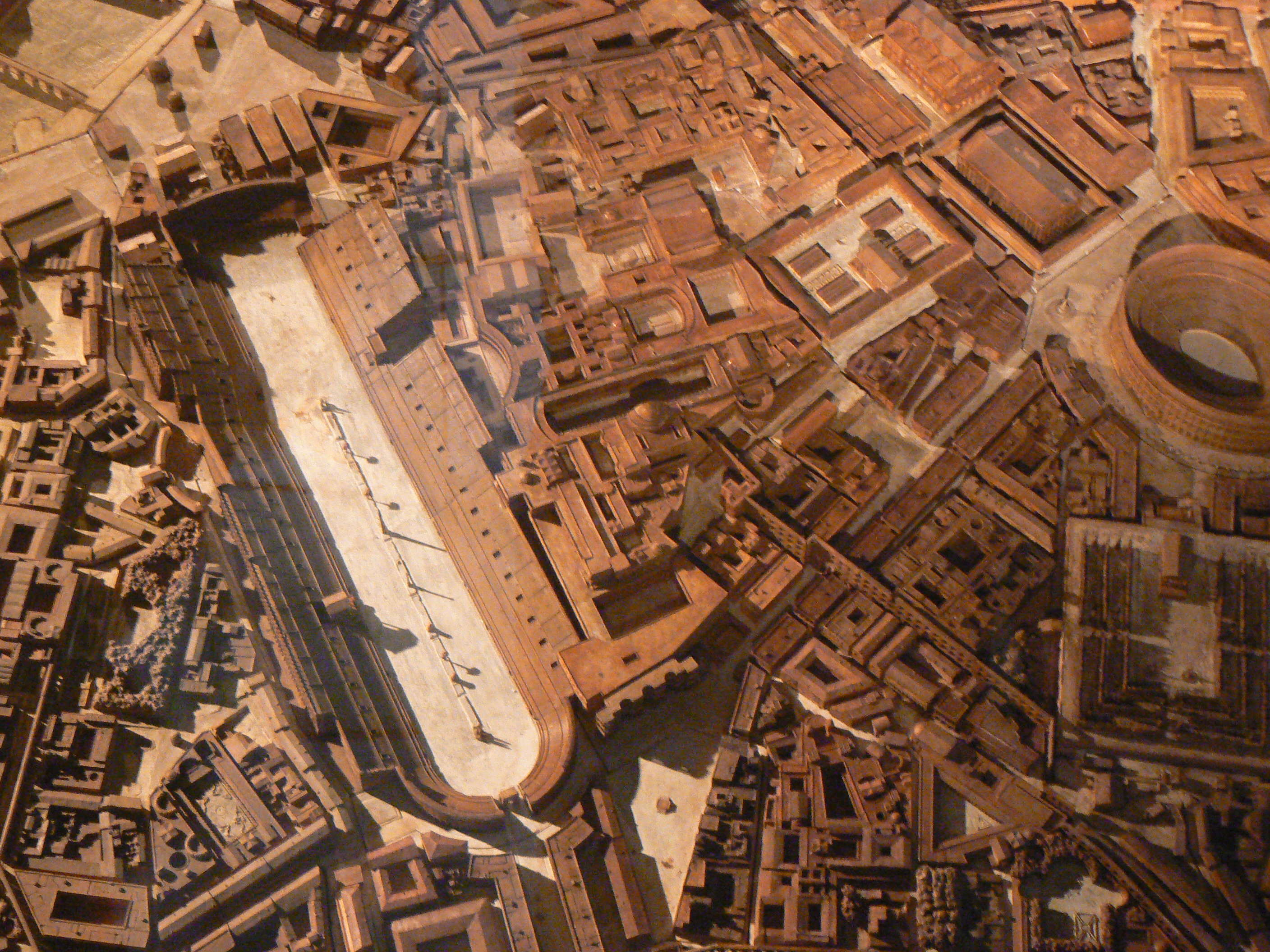
Circus Maximus: 150,000 Voices in a Valley
Imagine 150,000 people packed into a single venue, screaming for their chariot team. Not the Colosseum - that held a mere 50,000. The Circus Maximus was Rome's true mass entertainment venue, a stadium 621 meters long and 118 meters wide, nestled in the natural valley between the Aventine and Palatine Hills. For more than a thousand years, this was where Rome came to watch, bet, worship, and riot. Chariot races thundered around the central barrier while spectators in the upper tiers could see the emperors watching from the Palatine above. The arena that made the Colosseum look intimate is now a public park, its original track buried six meters beneath the grass where Romans jog and dogs chase frisbees.
Sacred Speed
The Circus was never merely a racetrack. Its events - the ludi - were sacred games tied to Roman religious festivals, sponsored by the state or by ambitious politicians courting public favor. In Roman tradition, the very first games at the Circus were vowed by Tarquin the Proud to Jupiter after his victory over Pometia, linking chariot racing to divine gratitude from the kingdom's earliest days. Each race day began with a pompa circensis, a flamboyant procession modeled on the triumphal parade, introducing the gods being honored and the competitors who would perform. The southeastern curve of the track ran between two ancient shrines that may have predated the Circus itself: one dedicated to the obscure goddess Murcia, associated with Venus and the myrtle shrub, and another to Consus, the god of grain storage, whose underground altar was uncovered only during his festivals. Racing and religion were inseparable here.
Augustus and the Egyptian Obelisk
Augustus transformed the Circus from a grand venue into a statement of empire. After conquering Egypt, he shipped an obelisk from Heliopolis at enormous expense - an object sacred to Egyptian sun gods long before Rome existed - and erected it on the central barrier, the spina, around which chariots turned. It was Rome's first obelisk, a trophy and a reminder that Augustus had defeated his Roman rivals and their Egyptian allies, securing both peace and a new province. He also built the pulvinar, a monumental shrine raised high above the trackside seats, from which he could watch the races alongside statues of the gods. Occasionally his family joined him there, blurring the line between mortal ruler and divine patron. Dionysius of Halicarnassus described the resulting Circus as "one of the most beautiful and admirable structures in Rome," praising its entrances designed so that "countless thousands may enter and depart without inconvenience."
Fire, Flood, and Spectacle
The Circus was perpetually at war with the elements. Its valley location made it prone to flooding through the starting gates until Emperor Claudius built an anti-flooding embankment. Fires were an even greater menace: the crowded wooden perimeter workshops and bleacher seats ignited repeatedly. A devastating fire in AD 36 killed thousands, and the Great Fire of Rome in AD 64 reportedly started in the shops around the Circus before consuming much of the city. Yet Romans rebuilt every time, eventually replacing wood with stone and raising the seating tiers higher. At its peak under Trajan and his successors, the Circus could accommodate over 150,000 spectators - some ancient sources claim 250,000 - making it the largest purpose-built entertainment venue the ancient world ever produced. Beyond chariot racing, the Circus hosted beast hunts, athletic competitions, and public executions, including the grim spectacle of damnatio ad bestias, in which condemned prisoners faced wild animals.
The Longest Silence
After the 6th century, the roar of 150,000 voices faded. The Circus fell into disuse as Rome's population collapsed. Flooding resumed, and centuries of waterlogged alluvial soil buried the track six meters deep. By the 11th century, dwellings occupied the site; by the 16th, it was a market garden. Renaissance builders quarried its standing structures for stone. In 1587, Pope Sixtus V removed two obelisks from the central barrier - Augustus's Egyptian prize now stands in the Piazza del Popolo. A gas works occupied the site from 1852 to 1910. Mid-19th-century excavations uncovered fragments of the seating tiers and outer portico, but the scale, depth, and persistent waterlogging of the site have limited further digging. Today the Circus Maximus is a grassy public park where the elongated oval of the ancient track remains clearly visible from the air - a ghostly outline of the place where Rome cheered loudest.
From the Air
Located at 41.886N, 12.486E in central Rome. From the air, the Circus Maximus appears as a long, narrow, oval-shaped green park - its ancient track outline clearly visible in the grass. The elongated shape stretches roughly 600 meters northwest-southeast in the valley between the Aventine Hill (southwest) and the Palatine Hill (northeast), with the ruins of the imperial palaces visible on the Palatine above. The Colosseum is approximately 500 meters to the east. Best viewed at 1,500-3,000 feet to appreciate the stadium's enormous footprint relative to the Colosseum. Nearest major airport: Leonardo da Vinci-Fiumicino Airport (LIRF), approximately 30 km southwest.