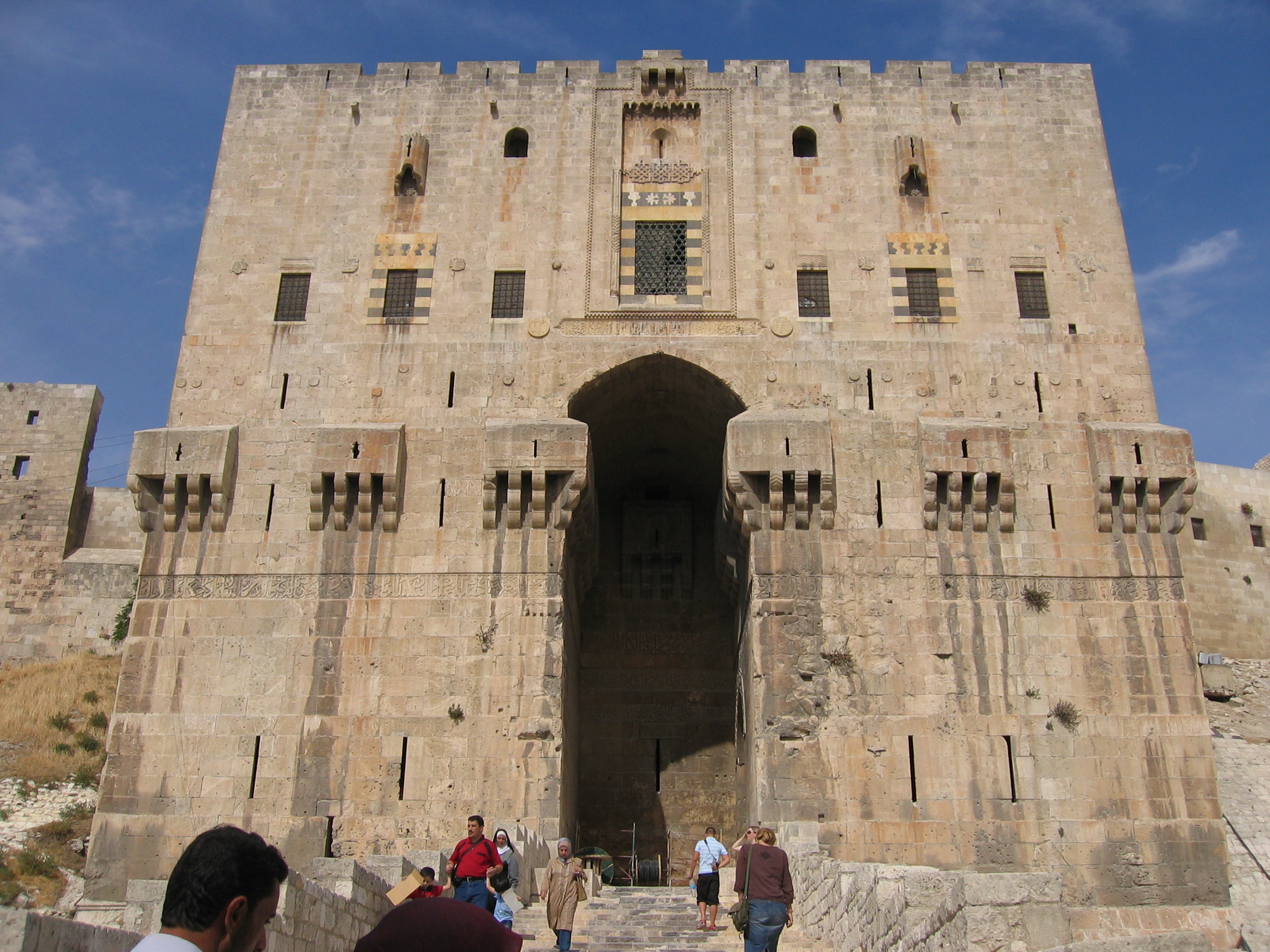
Citadel of Aleppo
Five thousand years of occupation are stacked inside a single hill. The Citadel of Aleppo rises fifty meters above the old city on an elliptical mound -- 450 meters long, 325 meters wide -- that was once sheathed in gleaming limestone blocks visible for miles across the northern Syrian plain. A temple to the storm god Hadad stood here in the 3rd millennium BC, referenced in cuneiform tablets from Ebla and Mari. Arameans, Assyrians, Greeks, Romans, Byzantines, Ayyubids, Mamluks, Ottomans, and the modern Syrian army have all held this ground. Each left something behind. Each took something away.
City of the Storm God
When Aleppo was the capital of the kingdom of Yamhad, it was known as the "City of Hadad." The recently excavated temple of the ancient storm god, uncovered by German archaeologist Kay Kohlmeyer, dates use of the citadel hill to at least the 24th century BC. Reliefs found during the dig show the temple remained in continuous use for more than 1,500 years, into the 9th century BC. After the decline of the Neo-Hittite Empire, the Assyrians took control, followed by the Neo-Babylonians and the Achaemenid Persians. Hellenistic settlers left up to two meters of archaeological remains in some areas, and a colonnaded street once led up to the hill from the west. Emperor Julian visited in 363 CE and noted that he "offered a white bull to Zeus according to imperial customs" -- a casual mention of a ritual atop a mound already ancient beyond his imagining.
The Sultan's Fortress
The citadel as visitors recognize it today was largely shaped by one man: al-Zahir al-Ghazi, son of Saladin, who ruled Aleppo from 1193 to 1215. He strengthened the walls, smoothed the rock outcrop, deepened the moat, and connected it to water canals spanned by a soaring bridge-and-viaduct that still serves as the entrance. During his reign, the citadel evolved into a self-contained palatial city: residential palaces and baths, a mosque and shrines, an arsenal and training grounds, defense towers, water cisterns, and granaries. The entrance block, rebuilt in 1213, is a masterpiece of medieval military architecture -- would-be attackers faced six turns up a vaulted ramp, with machicolations above for pouring hot liquids on anyone who made it that far. Secret passageways wind through the stone. Ghazi's "palace of glory" burned down on his wedding night, though he escaped with his queen and later rebuilt it.
Janissaries and Earthquakes
Under Ottoman rule, the citadel's military significance slowly faded as Aleppo grew beyond its walls into a commercial metropolis. An anonymous Venetian traveler recorded some 2,000 people living within the citadel in 1556. By 1679, the French consul d'Arvieux counted 1,400 residents, 350 of them Janissaries. Sultan Suleyman ordered a restoration in 1521. Then came the devastating earthquake of 1822, which heavily damaged both the citadel and the city below. After the quake, only soldiers lived on the hilltop. The earthquake marked a turning point: the citadel ceased to be a living community and began its long transformation into a monument.
Scars of the 21st Century
The Battle of Aleppo, which raged from 2012 to 2016, returned the citadel to its original purpose as a military fortification -- with catastrophic results. The Syrian Army used the hilltop as a base, firing from behind medieval walls and repurposing ancient arrow slits as sniper positions. In July 2015, rebels detonated a bomb in a tunnel under the outer wall. The magnitude 7.8 earthquake of February 2023 inflicted further damage, cracking the southern forward tower and shaking the already weakened structure. Restoration began in phases; by February 2024, the entrance had been reopened. In November 2024, Hay'at Tahrir al-Sham and allied rebel forces captured the citadel during the Second Battle of Aleppo. The hill that has endured five millennia of conflict absorbed yet another chapter.
What Survives Underground
Not everything in the citadel is visible from the surface. Wells penetrate 125 meters below the hilltop, and underground passageways connect to the advance towers and possibly beneath the moat to the city itself. The Ayyubid palace retains its muqarnas entrance portal -- honeycomb vaulting carved from stone -- and a courtyard designed in the four-iwan layout. The traditional hammam follows medieval Islamic bathing conventions: a dressing room, a warm room, a hot room, and a steam room with alcoves, all supplied by earthenware pipes. These details survive because they were built into bedrock and buried under rubble. The citadel is part of the Ancient City of Aleppo, a UNESCO World Heritage Site since 1986, and some of the war damage will be deliberately preserved -- the newest layer in a stratigraphy that began when someone first built a temple to a storm god on a hill in northern Syria.
From the Air
Located at 36.20N, 37.16E in the heart of Aleppo, northern Syria. The citadel is unmistakable from the air -- an enormous elliptical mound rising sharply above the flat rooftops of the old city. Aleppo International Airport (OSAP) is approximately 10 km to the east. The citadel is best viewed from 2,000-4,000 feet, where its relationship to the surrounding old city souks and mosques becomes clear. The Ancient City of Aleppo extends in all directions below the hill.