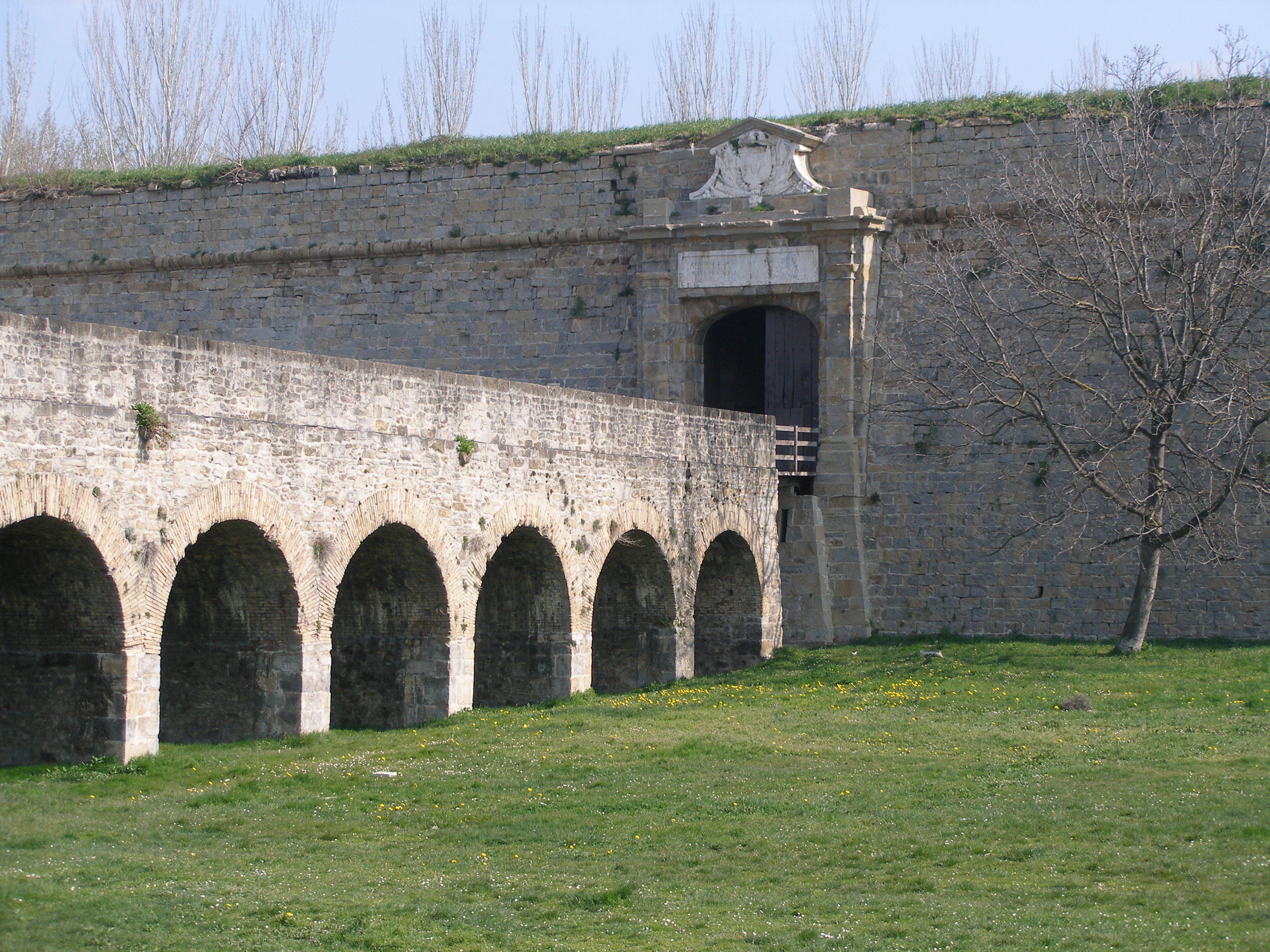
Citadel of Pamplona
On February 16, 1808, during a snowstorm in Pamplona, French soldiers began throwing snowballs near the gates of the Citadel. The Spanish defenders watched, amused or annoyed, as the snow games crept closer to the walls. When the soldiers were close enough, they dropped the snowballs, drew concealed weapons, and stormed the fortress. The Citadel of Pamplona, one of the best-preserved Renaissance star forts in Europe, had been taken by a ruse that was equal parts audacious and absurd.
A Fortress Against Its Own People
Philip II of Spain ordered construction of the citadel in 1571, six decades after Castile had conquered the Kingdom of Navarre. The project was designed by military engineer Giacomo Palearo, known as "el Fratin," with the involvement of the Viceroy of Navarre, Vespasiano Gonzaga y Colonna. The design followed Italian Renaissance military theory: a five-pointed star with bastions named San Anton, El Real, Santa Maria, Santiago, and Victoria. Two of the points faced inward, toward the city itself. This was deliberate. As the scholar Alicia Camara wrote, the citadel "should be understood as a means of dominating a city from which rebellion could be expected." The Venetian ambassador Contarini confirmed as much, reporting widespread hostility toward Spanish rule and popular support for the exiled Navarrese king Juan de Albret.
Stars and Half-Moons
Construction took seventy-four years, finishing in 1645. But fortification design kept evolving, and the citadel evolved with it. In 1685 and again in the first half of the eighteenth century, external ravelins -- defensive outworks known as "half-moons" -- were added between the bastions. These reinforcements followed the principles associated with Vauban, the French engineer who revolutionized fortress design during the reign of Louis XIV. The additions created layered fields of fire that made the citadel extraordinarily difficult to assault directly. The irony is that the fortress was rarely tested in pitched battle. When it fell, it fell to cleverness, not force.
Snowball Stratagems and Liberal Sieges
The snowball ruse of 1808 was not the citadel's only dramatic chapter. French troops had entered Pamplona on February 9 under the terms of the Treaty of Fontainebleau, ostensibly to cross Spain en route to Portugal. Up to 4,000 soldiers were quartered in the city, and tensions escalated until a French soldier was killed in a street altercation. Napoleon ordered General D'Armagnac to seize the city, and the snowstorm provided the opportunity. Fifteen years later, in 1823, liberal forces held the citadel for five months against the army of the Hundred Thousand Sons of St. Louis, who were restoring absolute monarchy across Spain. The attackers besieged rather than stormed the fortress, and after sustained bombardment beginning September 3, the garrison surrendered.
The Socorro Gate
The citadel's darkest chapter came during the Spanish Civil War, when Nationalist forces executed 298 residents of Pamplona at the Socorro Gate. The victims were members and supporters of the Republican side, killed as part of the broader repression in Navarre. A commemorative plaque was installed in 2007, replaced in 2012 by a monolith bearing inscriptions in Spanish and Basque: "The City Council and the city of Pamplona, in tribute to the 298 residents shot in 1936 for defending freedom and social justice." The memorial stands in the moat near the gate where the executions took place.
From Garrison to Garden
In 1964, the citadel ceased military operations and was transferred to the city. The fort and its surrounding open space, called Vuelta del Castillo, together form 275,840 square meters of parkland in the center of Pamplona -- the city's largest continuous green zone. A 1971 citywide consultation confirmed that residents wanted the space preserved rather than developed. Historic military buildings inside the walls were adapted for cultural use: the 1694 ammunition depot by Torelli, the warehouse renovated by Ignacio Sala in 1720, and the artillery hall designed in 1725 by Jorge Prospero Verboom, who also designed the Citadel of Barcelona. The citadel was declared a Natural Historic-Artistic Monument in 1973. The fortress that was built to control Pamplona's citizens now belongs to them.
From the Air
Located at 42.81N, 1.65W in Pamplona, the star-shaped fort is clearly visible from the air as a large pentagonal green space in the city center, surrounded by the Vuelta del Castillo park. Nearest airport is Pamplona (LEPP), approximately 6km south. Best viewed at 2,000-4,000 feet AGL. The Citadel is a component of the Camino de Santiago UNESCO route.