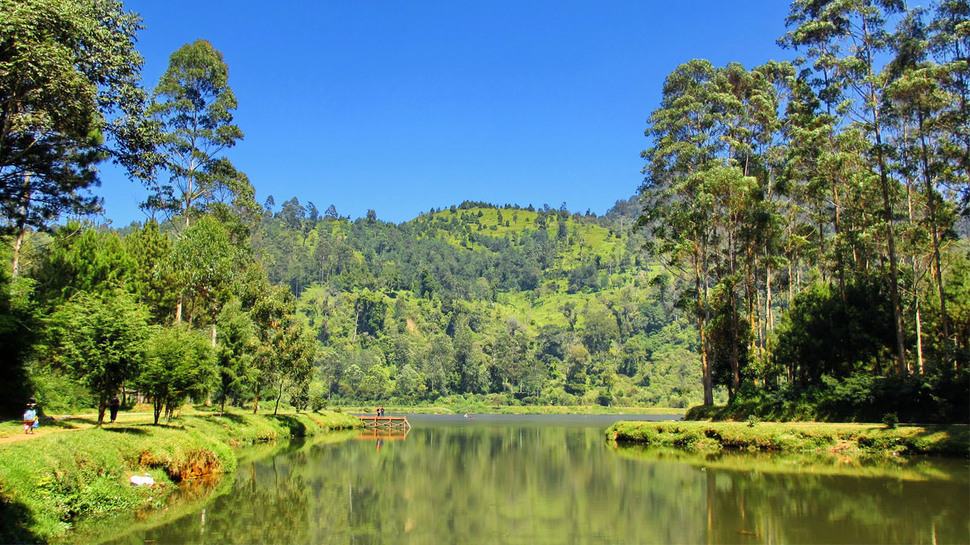
Citarum River
The prefix "Ci" in Sundanese simply means water, which makes the Citarum's full name redundant -- the Water Tarum River. But redundancy is the least of this waterway's problems. Flowing 297 kilometres from the volcanic highlands south of Bandung to the Java Sea, the Citarum is the longest river in West Java, the lifeblood of roughly 25 million people, and the source of 80 percent of their surface water. It also carries more than 20,000 tons of solid waste and 340,000 tons of industrial wastewater into its current every single day. In 2008, the Asian Development Bank approved a $500 million loan to clean it up and, in doing so, attached a label that has followed the river ever since: the world's dirtiest.
Kingdom of Indigo
Long before the pollution, the Citarum nurtured one of Southeast Asia's earliest Hindu kingdoms. The word "tarum" is Sundanese for the indigo plant, and the 4th-century Tarumanagara kingdom took its name directly from the river that sustained it. Stone inscriptions, Chinese trade records, and archaeological sites like Batujaya and Cibuaya confirm that human civilization flourished in and around the Citarum's estuaries and valleys for centuries before European contact. Even earlier, around the 4th century BCE, the Buni culture -- known for its distinctive clay pottery -- thrived near the river's mouth. The Citarum was not just a geographic feature; it was the economic and spiritual backbone of western Java's ancient world. That a river this historically significant could become synonymous with environmental catastrophe is itself a kind of parable about what happens when a resource is taken for granted.
Three Dams, One Lifeline
Modern Java depends on the Citarum in ways its ancient inhabitants could never have imagined. Three massive hydroelectric dams -- Saguling, Cirata, and the Jatiluhur -- straddle the river, generating electricity for both Bandung and the greater Jakarta metropolitan area. The Jatiluhur Dam alone holds 3 billion cubic metres of water in Indonesia's largest reservoir, a freshwater lake spanning 83 square kilometres. Below the dams, the Citarum's water irrigates vast rice paddies across the Karawang and Bekasi lowlands, making northern West Java one of the country's most productive agricultural regions. Yet pollution has degraded the water so severely that farmers downstream have sold their paddies for half their normal price. The river that once made the region's agriculture possible is now undermining it -- a slow-motion crisis playing out across thousands of hectares of contaminated farmland.
A River Buried Alive
About five million people live in the Citarum's drainage basin, which covers nearly 7,000 square kilometres. More than 2,000 industrial operations -- textile factories in Bandung and Cimahi chief among them -- pour lead, mercury, arsenic, and a cocktail of chemical compounds into the water. Documentarian Martin Boudot's investigation identified sulphites, nonylphenol, phthalates, and PCBs among the toxins, many of which are not even tested for under Indonesia's textile industry guidelines. On top of the industrial discharge, household garbage has accumulated so densely in stretches of the river that the water itself disappears beneath a floating carpet of plastic and refuse. Since 2008, an estimated 60 percent of the river's fish population has vanished. The Citarum has become a place where the consequences of rapid industrialization and weak environmental enforcement are visible not in statistics but in the landscape itself -- a river you can sometimes walk across without getting your feet wet, because the trash is that thick.
Soldiers in the Current
Revitalization efforts began in November 2011 with an estimated price tag of 35 trillion rupiah -- roughly $4 billion -- spread over 15 years and 180 kilometres of river from Mount Wayang through eight regencies and three cities. Progress was slow until February 2018, when President Joko Widodo personally launched a seven-year cleanup plan and ordered 7,000 soldiers to work the river in shifts, clearing garbage, blocking illegal discharge pipes, and installing water treatment facilities. The military approach reflected the scale of the problem: decades of factory bribes, local government inaction, and upstream deforestation had made the Citarum's degradation self-reinforcing. Soil erosion from stripped hillsides silted the lower river, and factories paid off inspectors rather than build treatment plants. The soldiers brought enforcement power that civilian agencies had lacked, but the underlying challenges -- coordination between jurisdictions, chronic underfunding, and the economic incentives that reward pollution -- remain formidable. Anti-plastics campaigns and international consulting partnerships have begun to shift public awareness, though the Citarum's recovery, if it comes, will be measured in decades rather than years.
From the Air
The Citarum River flows northwest through West Java from the volcanic highlands south of Bandung (approximately 7.2S, 107.65E) to the Java Sea. From altitude, the river corridor is visible threading through dense urban and agricultural landscapes. The three major dams -- Saguling, Cirata, and Jatiluhur -- create large reservoirs clearly visible from cruising altitude. Nearest major airport is Husein Sastranegara International Airport (WICC) in Bandung. Halim Perdanakusuma (WIHH) and Soekarno-Hatta (WIII) serve the Greater Jakarta area downstream.