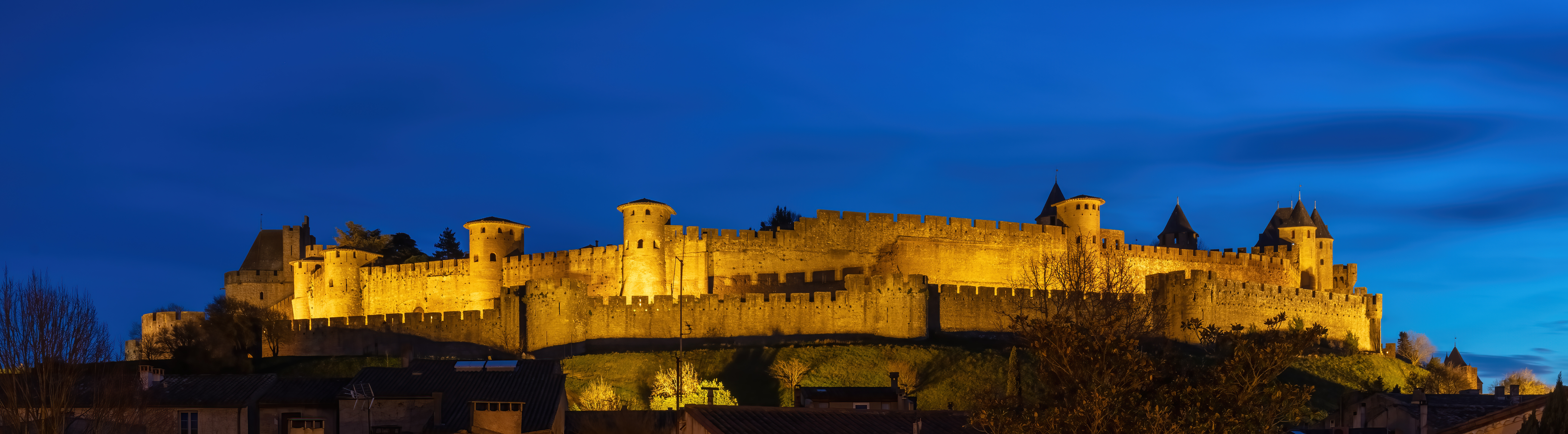
Cité de Carcassonne
According to legend, the city got its name from a bluff. When Charlemagne's army besieged the fortress, a woman named Lady Carcas kept it from falling by manufacturing fake soldiers for every tower and, when food ran desperately low, feeding the last sack of wheat to a pig and hurling it from the walls. Charlemagne's men, convinced the city still overflowed with provisions, lifted the siege. Lady Carcas rang the bells in triumph, and a soldier cried "Carcas sonne!" — Carcas is ringing. The etymology is almost certainly wrong, but the story captures something true about the Cité de Carcassonne: this is a place that has survived everything thrown at it, often through sheer improbability.
Twenty-Five Centuries on a Hill
The citadel sits on a hill above the right bank of the river Aude in the Occitania region of southern France. Its 3 kilometers of double walls, punctuated by 52 towers, encompass a settlement that has been continuously occupied for roughly 2,500 years. It began as a Gaulish village. By the third century CE, the Romans had transformed it into a fortified town described in records as a castellum, surrounded by walls with 34 to 40 semicircular towers, each about 14 meters tall, spaced 18 to 30 meters apart along the curtain wall. The Visigoths occupied and rebuilt parts of the Roman defenses in the 5th and 6th centuries, but the original structure persisted beneath the modifications. Layer upon layer, century after century, conquerors arrived and left their stonework behind. Romans, Visigoths, Crusaders, and the French crown all shaped these walls, and all are visible in them if you know where to look.
The Crusade at the Gates
In 1096, the Viscount of Trencavel authorized construction of the Basilica of Saint-Nazaire with the blessing of Pope Urban II. Carcassonne prospered under the Trencavel dynasty, but the rise of Catharism in the Languedoc drew the attention of Rome. In 1208, Pope Innocent III called on the northern barons to mount a crusade against the Cathars, and the Albigensian Crusade descended on the south. On August 1, 1209, the Cité was besieged. The young Viscount Raimond-Roger Trencavel surrendered two weeks later, on August 15, exchanging himself for safe passage for his people. The citizens were driven from their homes. Trencavel died of dysentery in his own dungeon on November 10. His lands were awarded to the crusade's military leader, Simon de Montfort. By 1226, after further crusading campaigns, the Cité had become a royal domain of France. A second ring of fortifications was added outside the Roman walls, and the fortress became a critical border defense between France and the Crown of Aragon.
Decline and Near Destruction
The Treaty of the Pyrenees in 1659 made Roussillon part of France and stripped Carcassonne of its military significance overnight. The fortifications were abandoned, and the city reinvented itself around the woolen textile industry. In 1793, the Revolutionary town council burned the Cité's historical archives. Napoleon officially demilitarized the fortress in 1804, transferring most of the walls to civil authorities. By the mid-19th century, the government decided the fortifications should simply be torn down. The walls that had repelled Charlemagne's army (at least in legend), survived the Albigensian Crusade, and anchored a border between kingdoms were scheduled for demolition like an inconvenient old building.
The Architect's Controversy
The campaign to save Carcassonne was led in part by the writer and archaeological advocate Prosper Mérimée, and the government reversed course. In 1853, the architect Eugène Viollet-le-Duc was commissioned to restore the fortress. His work was ambitious, meticulous, and immediately controversial. Critics argued that his additions — particularly the slate roofs he placed on the towers, appropriate to northern France rather than the terracotta tiles of the Mediterranean south — reflected his own architectural theories more than the building's history. Viollet-le-Duc died in 1879, and the restoration continued under his pupil Paul Boeswillwald and later the architect Nodet. The debate over whether the restored Cité is an authentic medieval fortress or a 19th-century fantasy has never been fully settled. But without Viollet-le-Duc, there would be nothing left to argue about.
A Living Fortress
In 1997, the Cité was added to the UNESCO World Heritage list for its exceptional testimony to the architecture and planning of a medieval fortress town. Within the walls, the Chateau Comtal — the fortress-within-a-fortress that housed the Viscounts of Carcassonne — still stands, its 12th-century core visible beneath later modifications including round towers, a barbican, and a moat added between 1240 and 1250. Walking the lices, the grassy corridor between the inner and outer walls, you can trace the entire military history of southern France in stone: Roman foundations, Visigothic repairs, Crusader-era reinforcements, and the royal French towers that sealed the city's absorption into the kingdom. Carcassonne endures not as a relic but as a palimpsest, each layer of construction a chapter in a story that began before France itself existed and shows no sign of ending.
From the Air
Located at 43.21°N, 2.36°E on a hill above the Aude River. The double-walled citadel with its 52 towers is one of the most recognizable medieval structures from the air in all of France. Best viewed at 2,000-4,000 ft AGL. Nearest airport: LFMK (Carcassonne-Salvaza), just 3 km west of the city. The contrast between the medieval Cité and the modern lower town (Bastide Saint-Louis) is striking from altitude.